
From April 26-28, many of the best players in the world will be battling for pride, glory, and money at Pro Tour Outlaws of Thunder Junction. Despite the new set having just recently released officially in paper, the Pro Tour is just around the corner. While many Pro Tours over the last few years have been held a few weeks after a set’s release, this time the Pro Tour is happening only one week after the release of Thunder Junction.
Many players were hopeful that this change would bring about some cool innovation. After all, holding the Pro Tour so close to a set’s release means that there’s less of a chance for the format to be “solved” and become stale. In theory, this makes a lot of sense. Unfortunately, in practice, things didn’t quite turn out the way some players wanted.
The Pro Tour metagame breakdown is now available, and there’s a noticeable lack of exciting breakout archetypes. The bulk of the metagame is made up of tier one strategies that were well-established prior to the release of Outlaws of Thunder Junction. This isn’t to say that there aren’t some important metagame shifts and unique brews to make note of. However, if you were looking forward to a potential breakout strategy similar to Pioneer Rakdos Vampires at Pro Tour Murders at Karlov Manor, you may be disappointed.
Esper Midrange Domination
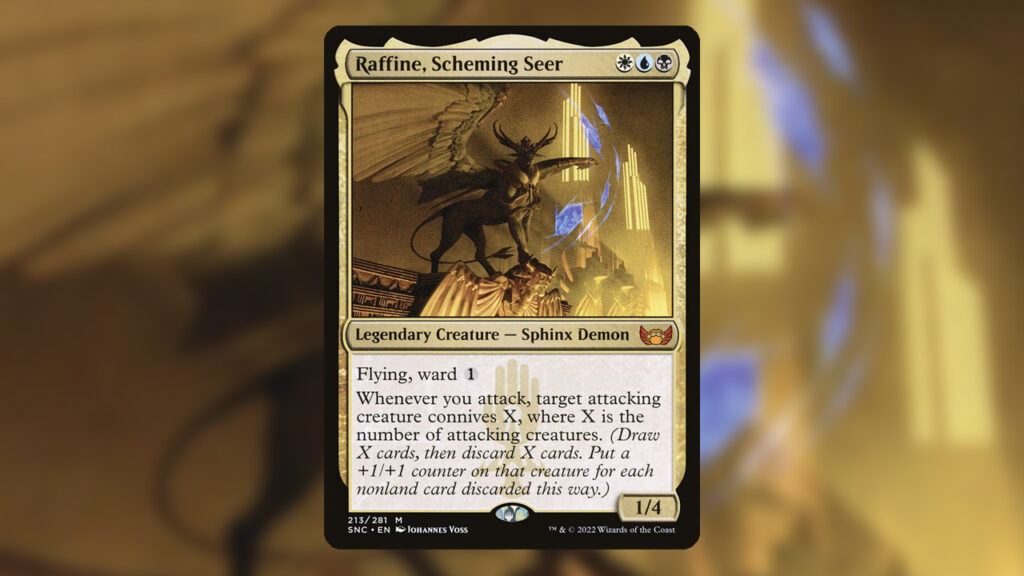
Perhaps the most jarring aspect of the Pro Tour metagame data is the fact that over 31% of the field is playing Esper midrange. It wasn’t entirely clear prior to Pro Tour decklist registration that Esper midrange was going to make up this much of the room. After all, other strategies such as Domain ramp and Temur Lands were immensely popular prior to Thunder Junction’s release and were still putting up great results afterwards.
As we will see later, these strategies are certainly still present, just in lower numbers. As it turns out, there’s nearly a 21% gap between Esper midrange and Boros Convoke, the second most played deck. Esper midrange may not be nearly as dominant as Simic Food or Temur Reclamation decks of Standard’s past, but 31% is still far from ideal. If you’re not a fan of Esper, the one saving grace is that Raffine, Scheming Seer will be rotating out of Standard in August. Notably, the different builds between this Esper Midrange representation are significant. More aggressive, midrange, and combo oriented builds are included in the larger percentage.
Interestingly, though, other
Deep-Cavern Bat
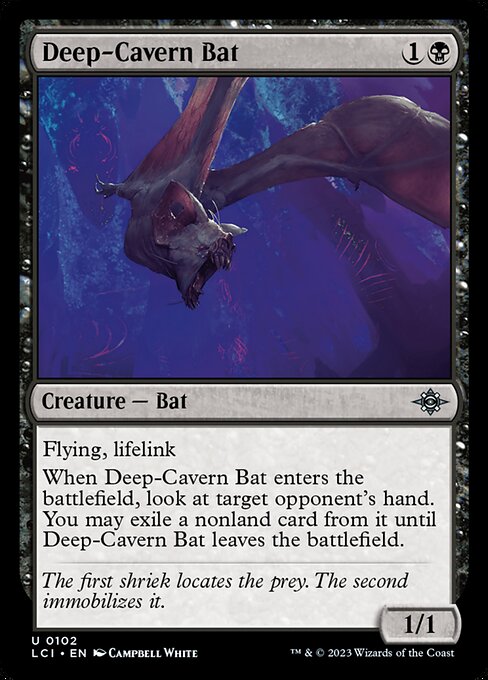 Deep-Cavern Bat
Flying, lifelink
Deep-Cavern Bat
Flying, lifelink
When this creature enters, look at target opponent's hand. You may exile a nonland card from it until this creature leaves the battlefield.
shells like Dimir midrange won’t lose much of anything. Before Thunder Junction cards were printed, there used to be more of an even split between Esper and Dimir midrange, with Golgari close behind. At the Pro Tour, though, other black-based midrange decks paled in comparison to Esper. Dimir and Golgari midrange made up under 7% of the field combined. So, what contributed to Esper’s surge?
Read More: Incredible Big Score MTG Card Leads to Turn Three Kills Out of Nowhere!
The Importance of White as a Support Color
The answer largely lies with how essential white has become as a support color. Even before Thunder Junction cards were made available, no one doubted the power of Raffine, Scheming Seer. However, outside of Raffine, white didn’t provide many potent upgrades.
Sure,
Wedding Announcement
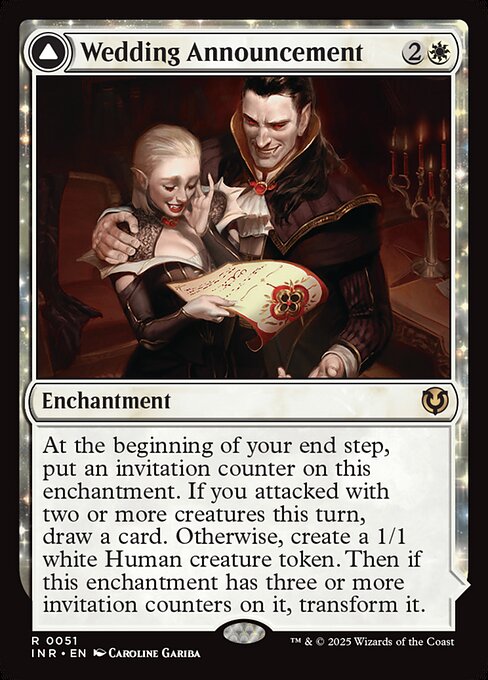 Wedding Announcement
At the beginning of your end step, put an invitation counter on this enchantment. If you attacked with two or more creatures this turn, draw a card. Otherwise, create a 1/1 white Human creature token. Then if this enchantment has three or more invitation counters on it, transform it.
and
Dennick, Pious Apprentice
Wedding Announcement
At the beginning of your end step, put an invitation counter on this enchantment. If you attacked with two or more creatures this turn, draw a card. Otherwise, create a 1/1 white Human creature token. Then if this enchantment has three or more invitation counters on it, transform it.
and
Dennick, Pious Apprentice
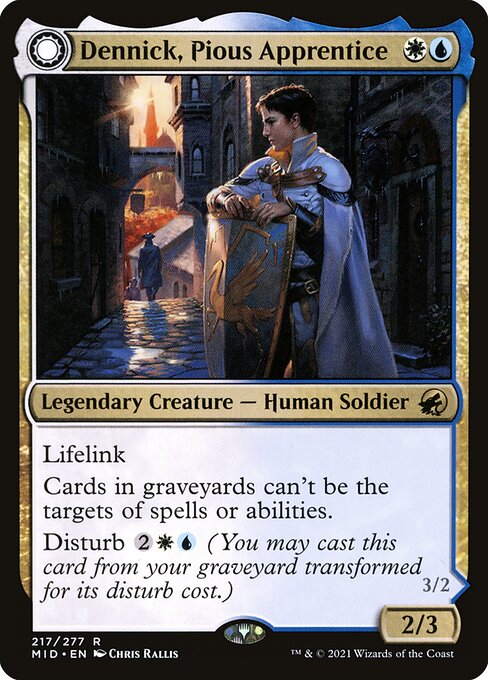 Dennick, Pious Apprentice
Lifelink
Dennick, Pious Apprentice
Lifelink
Cards in graveyards can't be the targets of spells or abilities.
Disturb {2}{W}{U} (You may cast this card from your graveyard transformed for its disturb cost.)
are nice tools to have. But,
Faerie Mastermind
 Faerie Mastermind
Flash
Faerie Mastermind
Flash
Flying
Whenever an opponent draws their second card each turn, you draw a card.
{3}{U}: Each player draws a card.
and Gix, Yawgmoth Praetor are more than serviceable in those slots. Some players deemed it better to give up Raffine and other white card to gain access to more consistent mana and strong utility Lands like Mirrex.
When looking at the most played Thunder Junction cards at the Pro Tour, it’s clear this thought process has changed for many players. The top three most played Thunder Junction cards are all Esper midrange staples. First, Concealed Courtyard provides the deck with cleaner mana. Next,
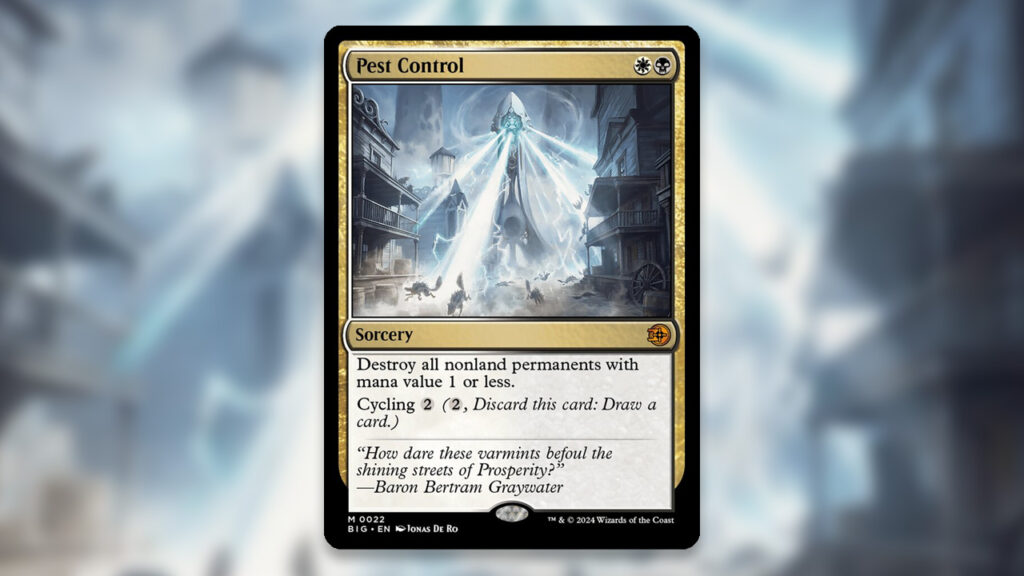
Pest Control
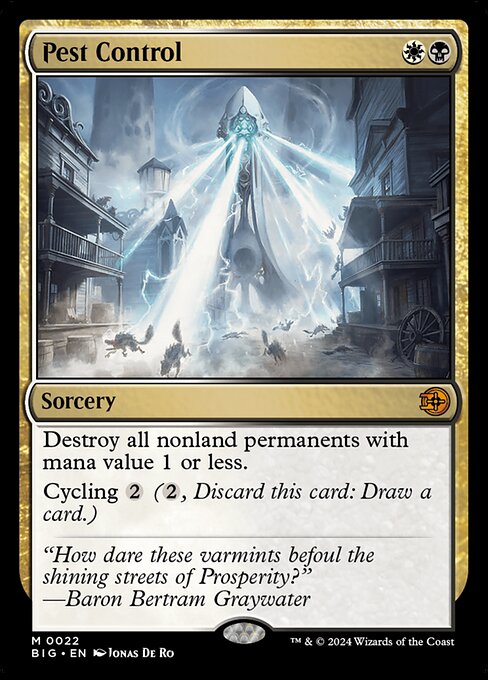 Pest Control
Destroy all nonland permanents with mana value 1 or less.
Pest Control
Destroy all nonland permanents with mana value 1 or less.
Cycling {2} ({2}, Discard this card: Draw a card.)
out of the sideboard improves the Boros Convoke matchup considerably. Lastly,
Rest in Peace
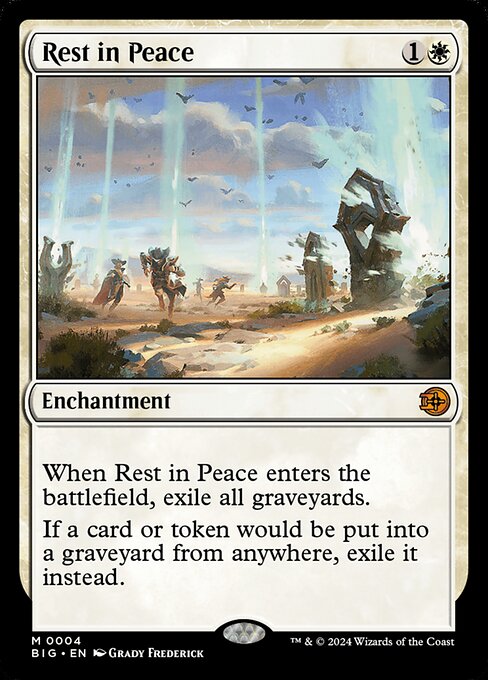 Rest in Peace
When this enchantment enters, exile all graveyards.
Rest in Peace
When this enchantment enters, exile all graveyards.
If a card or token would be put into a graveyard from anywhere, exile it instead.
gives the deck a fighting chance against Temur Lands, which is another weak matchup.
Read More: Controversial MTG Mechanic Could See Big Changes in the Future!
Other Strong Choices
Speaking of Boros Convoke and Temur Lands, these decks also have respectable representation at the Pro Tour. Boros Convoke was popular before Thunder Junction but has risen up the food chain over the last week. While it may seem like just a minor upgrade, the addition of
Inspiring Vantage
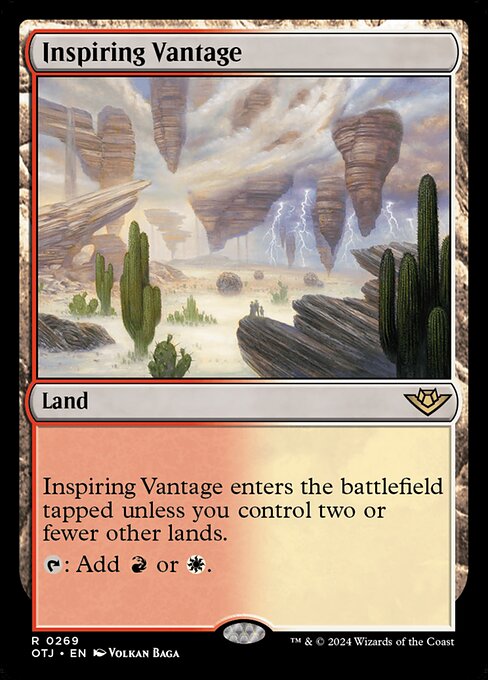 Inspiring Vantage
This land enters tapped unless you control two or fewer other lands.
Inspiring Vantage
This land enters tapped unless you control two or fewer other lands.
{T}: Add {R} or {W}.
was a huge deal for this archetype. Sundown Pass simply doesn’t cut it for a deck that needs to curve out early. This deck also has tough color requirements given the mix of red and white one-drops, making Vantage’s role more crucial.
Temur Lands falls shortly behind Boros Convoke, with 19 of the 207 players registering this archetype. This deck is absurdly powerful but has fallen out of favor a bit with Thunder Junction cards in the mix. This deck received very little in the way of help, but now has to contend with hosers like Rest in Peace. Without graveyard synergies, Aftermath Analyst and
Worldsoul’s Rage
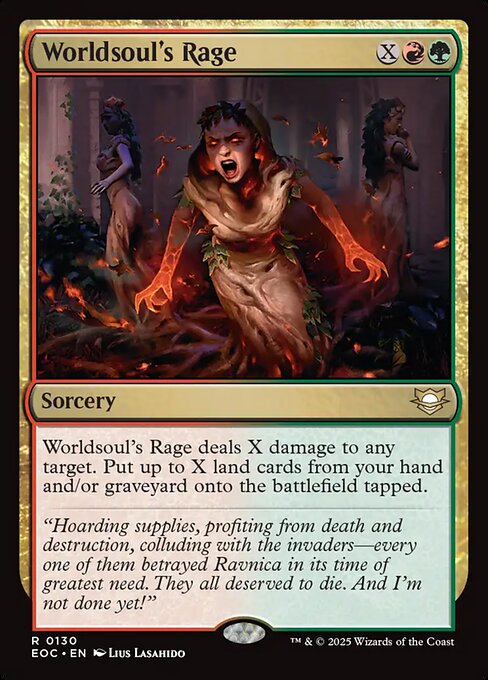 Worldsoul’s Rage
Worldsoul's Rage deals X damage to any target. Put up to X land cards from your hand and/or graveyard onto the battlefield tapped.
become rather mediocre. Still, some players feel graveyard strategies like this weren’t given proper respect and could flourish as a result.
Worldsoul’s Rage
Worldsoul's Rage deals X damage to any target. Put up to X land cards from your hand and/or graveyard onto the battlefield tapped.
become rather mediocre. Still, some players feel graveyard strategies like this weren’t given proper respect and could flourish as a result.
The other two strategies to each represent at least 5% of the field are four-color legends and Domain ramp. The printing of
Honest Rutstein
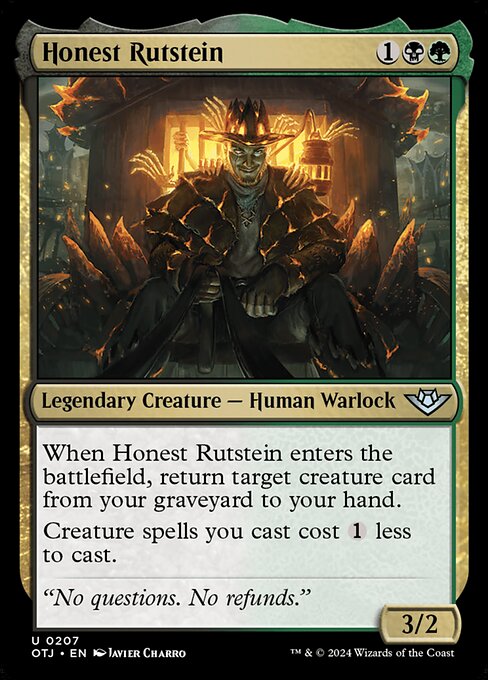 Honest Rutstein
When Honest Rutstein enters, return target creature card from your graveyard to your hand.
Honest Rutstein
When Honest Rutstein enters, return target creature card from your graveyard to your hand.
Creature spells you cast cost {1} less to cast.
has given four-color legends a neat combo kill thanks to the power of
Relic of Legends
 Relic of Legends
{T}: Add one mana of any color.
Relic of Legends
{T}: Add one mana of any color.
Tap an untapped legendary creature you control: Add one mana of any color.
and
Rona, Herald of Invasion
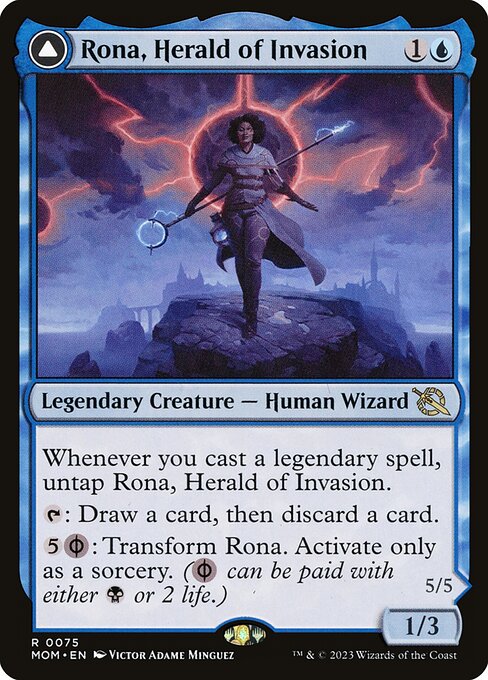 Rona, Herald of Invasion
Whenever you cast a legendary spell, untap Rona.
Rona, Herald of Invasion
Whenever you cast a legendary spell, untap Rona.
{T}: Draw a card, then discard a card.
{5}{B/P}: Transform Rona. Activate only as a sorcery. ({B/P} can be paid with either {B} or 2 life.)
. We discussed this combo in more detail here, though it’s worth noting that Vial Smasher, Gleeful Grenadier and other cards can serve as kill conditions, not just
Tinybones Joins Up
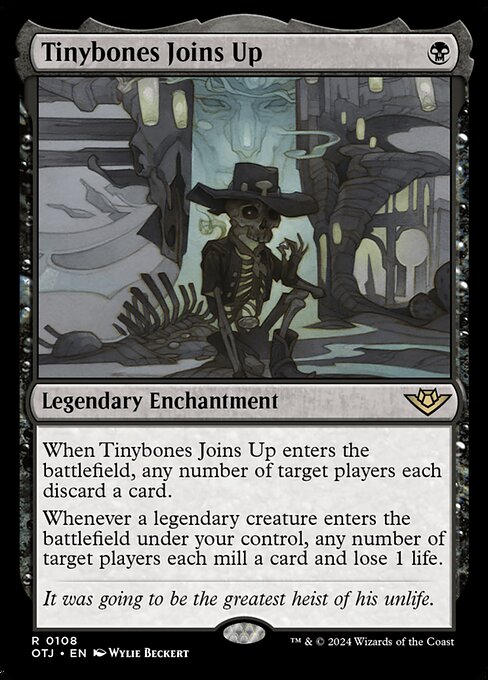 Tinybones Joins Up
When Tinybones Joins Up enters, any number of target players each discard a card.
Tinybones Joins Up
When Tinybones Joins Up enters, any number of target players each discard a card.
Whenever a legendary creature you control enters, any number of target players each mill a card and lose 1 life.
.
Read More: Three-Year MTG Mega Announcement Is Surprisingly Controversial
General Lack of Innovation
Overall, it’s a bit disappointing to see a minimal amount of exploration so soon after Thunder Junction’s release. The set clearly impacted the Standard metagame, as made indicative by Esper’s immense showing. Still, there aren’t many players that registered intriguing new ideas entirely.
For the few players that did choose an off-the-wall strategy, we salute you.
Caustic Bronco
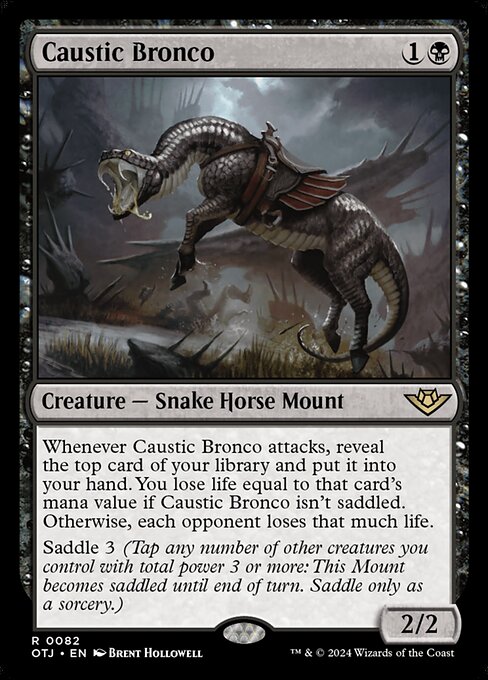 Caustic Bronco
Whenever this creature attacks, reveal the top card of your library and put it into your hand. You lose life equal to that card's mana value if this creature isn't saddled. Otherwise, each opponent loses that much life.
Caustic Bronco
Whenever this creature attacks, reveal the top card of your library and put it into your hand. You lose life equal to that card's mana value if this creature isn't saddled. Otherwise, each opponent loses that much life.
Saddle 3 (Tap any number of other creatures you control with total power 3 or more: This Mount becomes saddled until end of turn. Saddle only as a sorcery.)
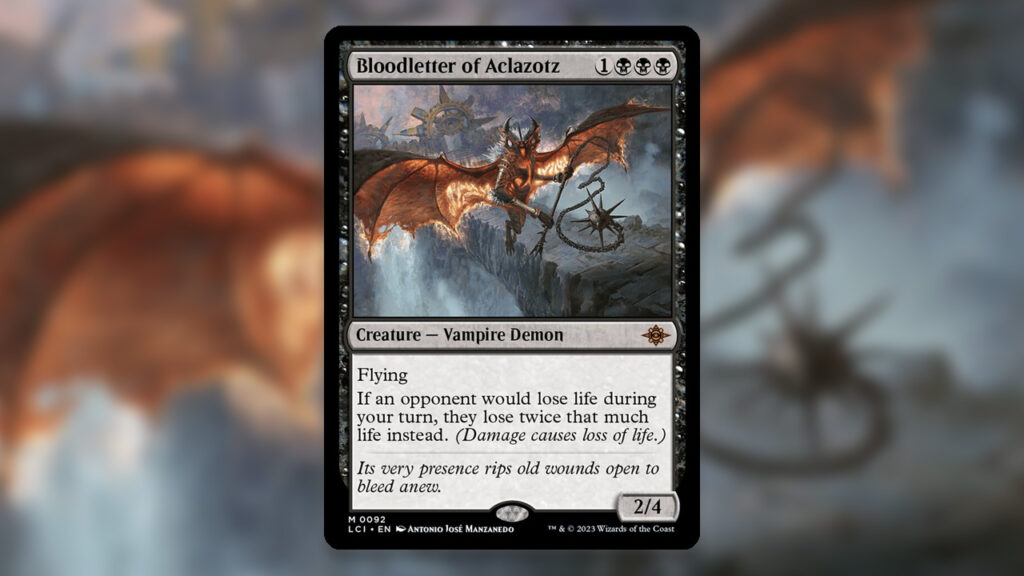
and Bloodletter of Aclazotz drew a bit of attention, for instance. Using
Insatiable Avarice
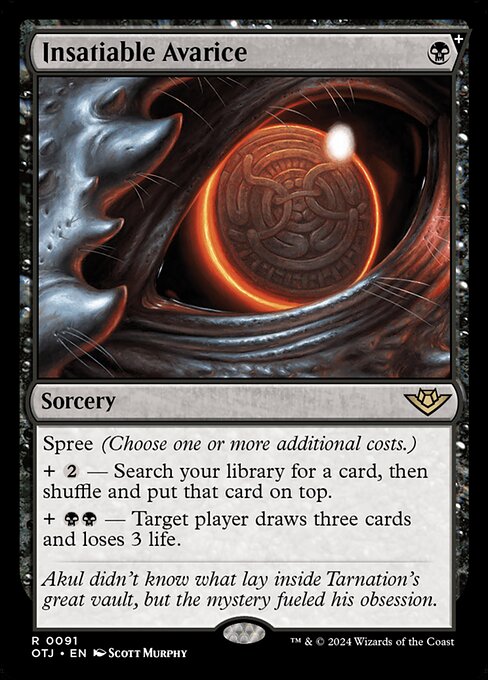 Insatiable Avarice
Spree (Choose one or more additional costs.)
Insatiable Avarice
Spree (Choose one or more additional costs.)
+ {2} — Search your library for a card, then shuffle and put that card on top.
+ {B}{B} — Target player draws three cards and loses 3 life.
to put
Shadow of Mortality
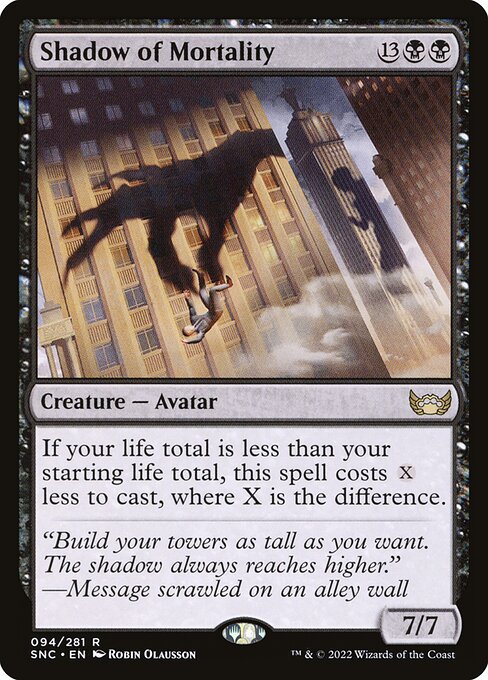 Shadow of Mortality
If your life total is less than your starting life total, this spell costs {X} less to cast, where X is the difference.
on top and doming the opponent for 15 damage is certainly an exciting kill condition, as is combining Bloodletter of Aclazotz with Rush of Dread to make the opponent lose all their life! One thing’s for sure: I’ll be rooting for these decks this weekend!
Shadow of Mortality
If your life total is less than your starting life total, this spell costs {X} less to cast, where X is the difference.
on top and doming the opponent for 15 damage is certainly an exciting kill condition, as is combining Bloodletter of Aclazotz with Rush of Dread to make the opponent lose all their life! One thing’s for sure: I’ll be rooting for these decks this weekend!
Still, these brews are few and far between. Even though the format is far from solved, some players had pointed out in advance that moving the Pro Tour so close to a set’s release could have negative consequences, not positive. Some argued that Pro Tour players now have less time to test new ideas, as well as less time to find and purchase the cards they would need. With this in mind, seeing more players take decks that have already proven their worth and just adding some upgrades does make sense.
Regardless, I’m still excited to see how things play out at Pro Tour Outlaws of Thunder Junction. Will some of these intriguing brews end up at the top tables, or will basic Esper emerge victorious? Only time will tell.
Read More: New Fallout-Themed Bonus Card Selling For Over $800!