
In the world of Magic: The Gathering, there are some cards players talk of in reverent tones. Some cards are so central to the mythos of the game that their names become part of the vernacular.
Storm Crow
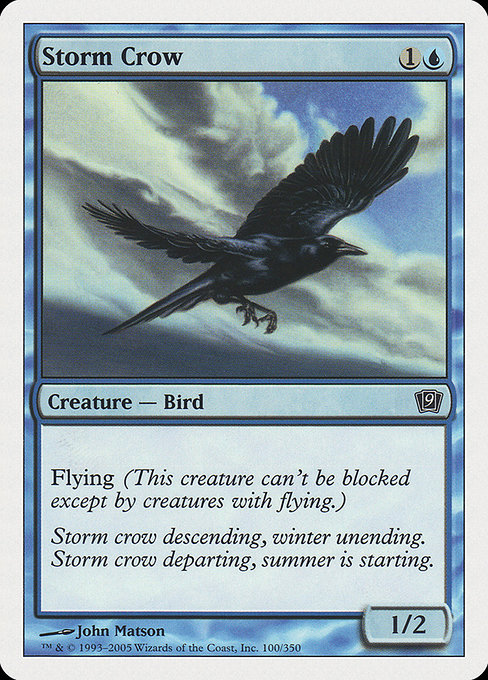 Storm Crow
Flying (This creature can't be blocked except by creatures with flying or reach.)
, a terrifying 1/2 flier for two mana, is one such card. Today the floodgates of MTG power creep have been well and truly thrown open as Hookblade Veteran, a one mana card that bears a striking resemblance to Storm Crow, has been revealed. Batten down the hatches, folks: no port is safe from this fresh horror.
Storm Crow
Flying (This creature can't be blocked except by creatures with flying or reach.)
, a terrifying 1/2 flier for two mana, is one such card. Today the floodgates of MTG power creep have been well and truly thrown open as Hookblade Veteran, a one mana card that bears a striking resemblance to Storm Crow, has been revealed. Batten down the hatches, folks: no port is safe from this fresh horror.
Hookblade Veteran: The Savior Of MTG Assassin Decks?
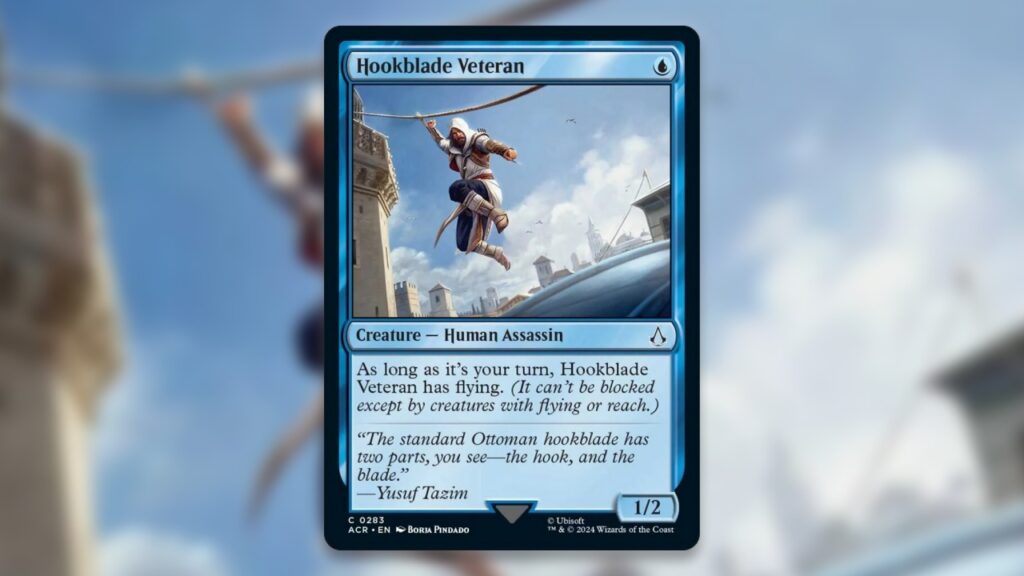
Hyperbole aside, Hookblade Veteran is actually a very exciting card. However, this isn’t because of its resemblance to the iconic MTG meme of Storm Crow. For one blue mana, Hookblade Veteran is a 1/2 Human Assassin that has Flying during your turn. This means it can’t block like a Storm Crow can, but it can attack like one. For our purposes, that’s all that really matters.
The reason this card is relevant at all, and not just some mildly memey draft chaff, is the Freerunning mechanic. This is a new addition in Assassin’s Creed, which lets you play a card at a discounted cost if you’ve dealt combat damage with an Assassin or Commander. Given the lack of playable Assassins in Magic, most have already written this off as a Commander-only mechanic. Hookblade Veteran changes that, however.
As we’ll get to later, two mana is a key breakpoint for Freerunning costs. This means that, if you want to cast them as early as possible, you’ll need a one mana Assassin that can get in on turn two. Hookblade Veteran provides exactly that. Even in Modern, it’s very unlikely that your opponent will be able to block a 1/2 flier that early in the game. With this card in the mix, we can start looking at a Dimir Assassins deck as a serious Modern proposition.
A Critical Mass
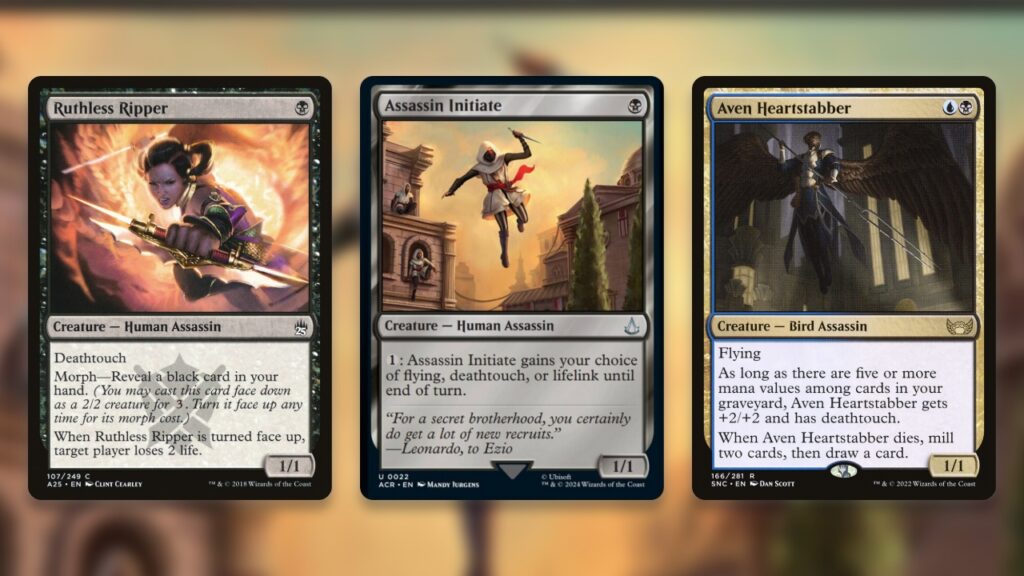
Of course, one evasive Assassin does not an archetype make. We’ll need a few others if we’re going to lean hard into a Freerunning Tempo plan. Thankfully, there are a few good options.
Assassin Initiate
 Assassin Initiate
{1}: This creature gains your choice of flying, deathtouch, or lifelink until end of turn.
is a fellow newcomer from Assassin’s Creed and is similarly capable of swinging in with Flying on turn two. Since you need to pay one mana for said Flying, it’s not as good an enabler as Hookblade, but it can still get your Freerunning cards going on turn three in a pinch.
Assassin Initiate
{1}: This creature gains your choice of flying, deathtouch, or lifelink until end of turn.
is a fellow newcomer from Assassin’s Creed and is similarly capable of swinging in with Flying on turn two. Since you need to pay one mana for said Flying, it’s not as good an enabler as Hookblade, but it can still get your Freerunning cards going on turn three in a pinch.
There are also some Assassins from the past we can turn to for support.
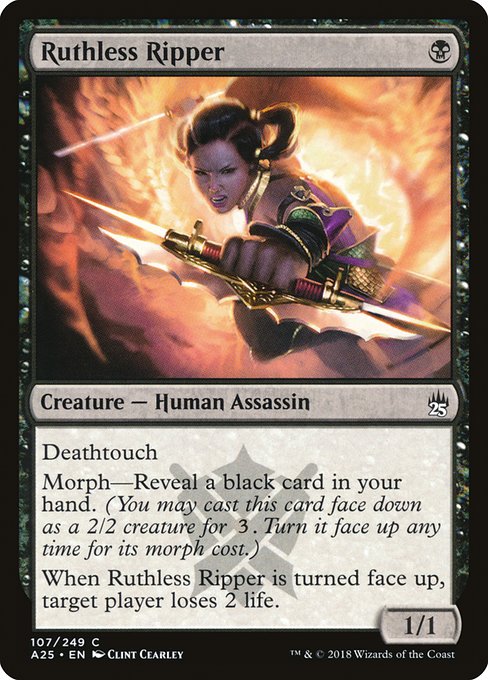
Ruthless Ripper
 Ruthless Ripper
Deathtouch
Ruthless Ripper
Deathtouch
Morph—Reveal a black card in your hand. (You may cast this card face down as a 2/2 creature for {3}. Turn it face up any time for its morph cost.)
When this creature is turned face up, target player loses 2 life.
doesn’t have a traditional evasive keyword, but it does have Deathtouch, which acts similarly in many situations.
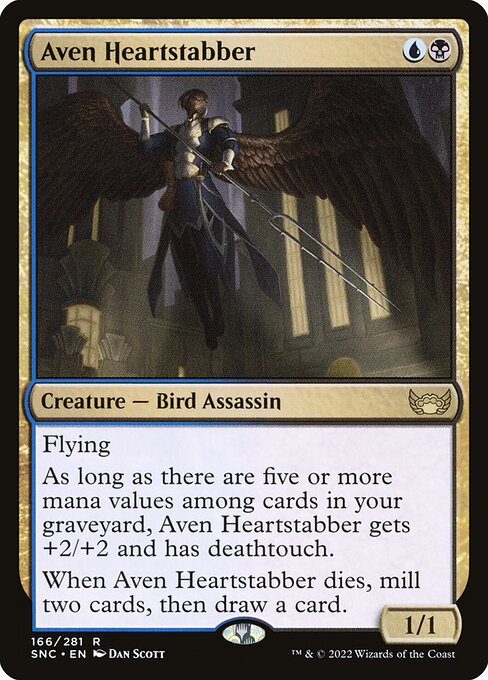
Aven Heartstabber
 Aven Heartstabber
Flying
Aven Heartstabber
Flying
As long as there are five or more mana values among cards in your graveyard, this creature gets +2/+2 and has deathtouch.
When this creature dies, mill two cards, then draw a card.
is a pricier option at two mana, but it has Flying by default, can scale up later, and provides card advantage on death. Given the cost variance on Freerunning cards, all of which you can easily subvert in a deck like this, it’s easy to get Heartstabber swinging for three in the early game.
So those are the cheap Assassins that can form the bedrock of our deck. None are particularly remarkable on their own, but all are great at getting in for damage and enabling Freerunning early on in the game. But what exactly makes Freerunning so good? And is it worth playing a bunch of mediocre creatures to facilitate? I’m glad you asked.
Hardcore Parkour
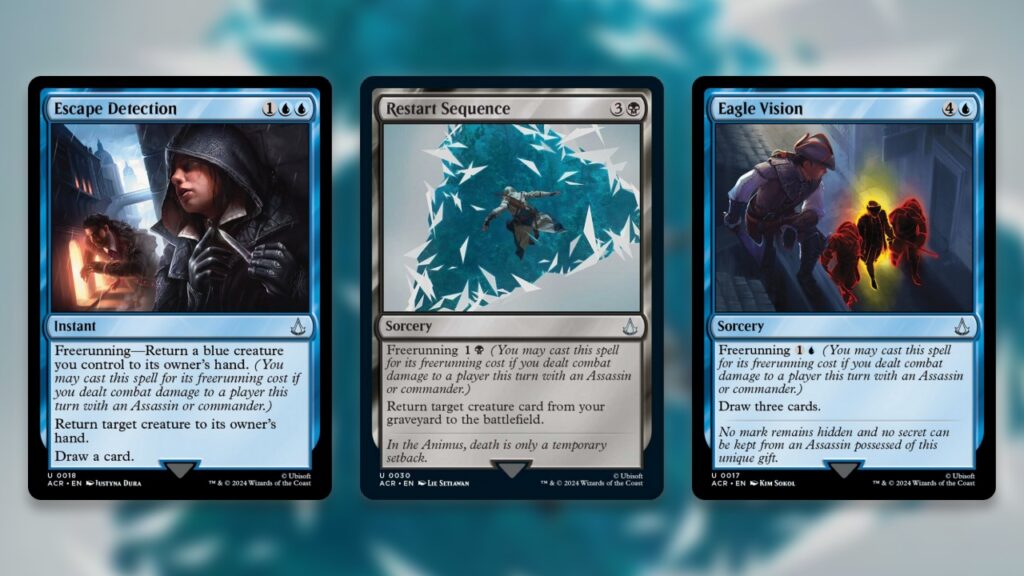
There are a number of spicy Freerunning cards in Assassin’s Creed. Most of which, appropriately enough, can be found in blue/black. This means the Assassin package we discussed above works perfectly with them. One of the most intriguing among these, to me at least, is
Escape Detection
 Escape Detection
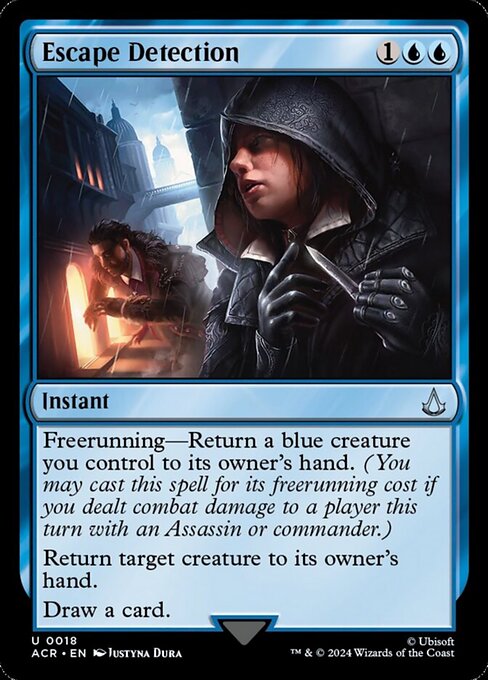
Freerunning—Return a blue creature you control to its owner's hand. (You may cast this spell for its freerunning cost if you dealt combat damage to a player this turn with an Assassin or commander.)
Escape Detection
Freerunning—Return a blue creature you control to its owner's hand. (You may cast this spell for its freerunning cost if you dealt combat damage to a player this turn with an Assassin or commander.)
Return target creature to its owner's hand.
Draw a card.
. For three mana, this bounces a creature and draws a card. Not a bad deal honestly, but a bit slow for Modern. If you have Freerunning active, however, you can pay for it by bouncing a blue creature you control instead.
This pairs perfectly with Hookblade Veteran, and can create some classic MTG tempo turns wherein you bounce your opponent’s turn one play and develop a board of your own. Alternatively, you could follow this up with another Freerunning card like
Eagle Vision
 Eagle Vision
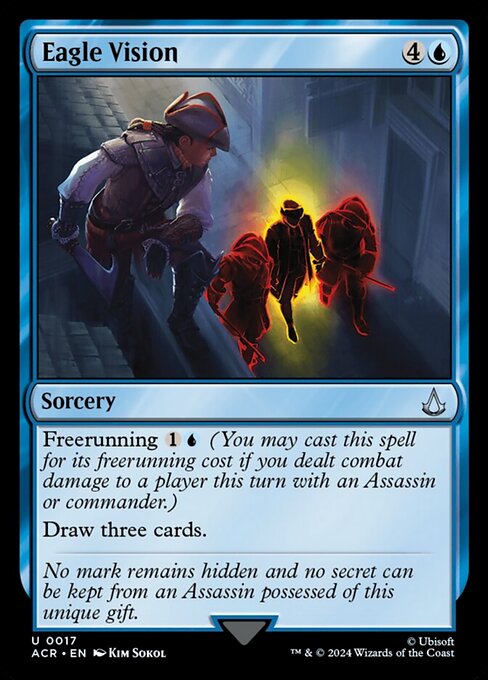
Freerunning {1}{U} (You may cast this spell for its freerunning cost if you dealt combat damage to a player this turn with an Assassin or commander.)
Eagle Vision
Freerunning {1}{U} (You may cast this spell for its freerunning cost if you dealt combat damage to a player this turn with an Assassin or commander.)
Draw three cards.
. This sets you up with a full hand, potentially including Flares and Evoke Elementals with which you can interact with your opponent. Given the cheap nature of Assassins, free spells like these are a no-brainer inclusion.
Speaking of the Evoke Elementals, they also play very nicely with another Freerunning card.
Restart Sequence
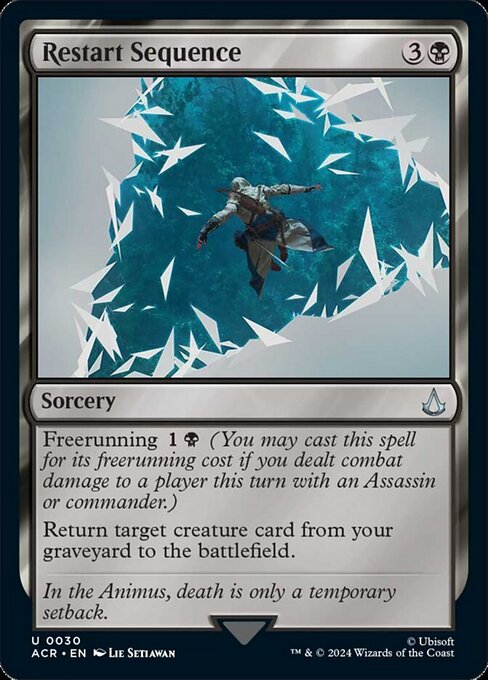 Restart Sequence
Freerunning {1}{B} (You may cast this spell for its freerunning cost if you dealt combat damage to a player this turn with an Assassin or commander.)
Restart Sequence
Freerunning {1}{B} (You may cast this spell for its freerunning cost if you dealt combat damage to a player this turn with an Assassin or commander.)
Return target creature card from your graveyard to the battlefield.
is a straight-up reanimation spell for two mana, provided you have Freerunning active. A turn two where you Evoke
Grief
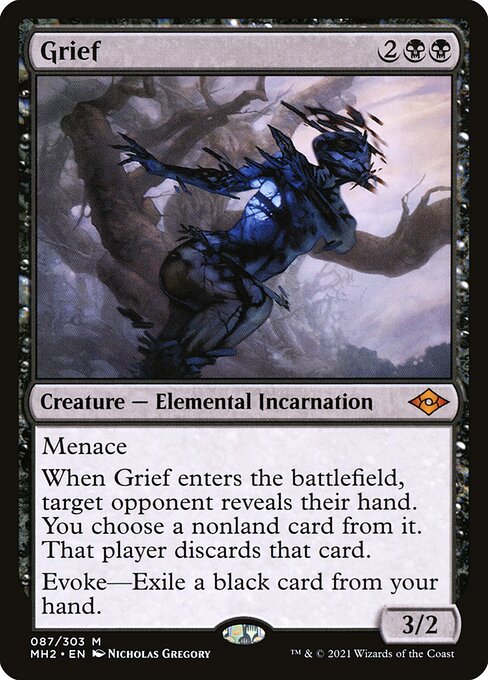 Grief
Menace
Grief
Menace
When this creature enters, target opponent reveals their hand. You choose a nonland card from it. That player discards that card.
Evoke—Exile a black card from your hand.
, swing in with Hookblade Veteran, then use Restart Sequence to bring Grief back sounds pretty great to me. Alternatively, you can try a more traditional reanimator plan. Cycle a
Troll of Khazad-dûm
 Troll of Khazad-dûm
This creature can't be blocked except by three or more creatures.
Troll of Khazad-dûm
This creature can't be blocked except by three or more creatures.
Swampcycling {1} ({1}, Discard this card: Search your library for a Swamp card, reveal it, put it into your hand, then shuffle.)
early, bring it back next turn, profit.
Clearly, there’s a lot of potential in Freerunning, and now that it has the enablers, it could make a real impact in Modern. You may be hearing that ‘One mana Storm Crow’ joke an awful lot if this deck works out, so brace yourself for that.
Read More: New Assassin’s Creed Uncommon Breaks Magic’s Deckbuilding Rules!