
For the past few weeks, Standard has felt like a relatively stable format overall. It seemed like the metagame had mostly settled, while decks like Dimir midrange, four-color ramp, and Esper control continued to dominate. Diversity wasn’t a big issue, as Selesnya Enchantments, mono-red aggro, Azorius Soldiers and more were all reasonable choices as well. In this sense, there were plenty of decks to choose from, but not a lot of room for innovation beyond these well-established archetypes. After all, with Wilds of Eldraine on the horizon, it seemed like the introduction of a new set to Standard was needed for a shakeup.
As it turns out, this uniquely diverse Standard metagame is not as well-solved as I thought. One player in the Magic Online Standard Challenge on Saturday piloted a strange Izzet control deck with a very interesting gameplan. Not only did the deck perform well, but he won the whole event. A day later, the top 32 of Sunday’s Magic Online Standard Challenge featured five players on the same archetype, showcasing its potential even further. What makes this Izzet Control deck so different from other archetypes, and why did it have such a good showing this weekend? To answer these questions, it’s worth looking at the deck’s main strategy.
Building to the Late Game
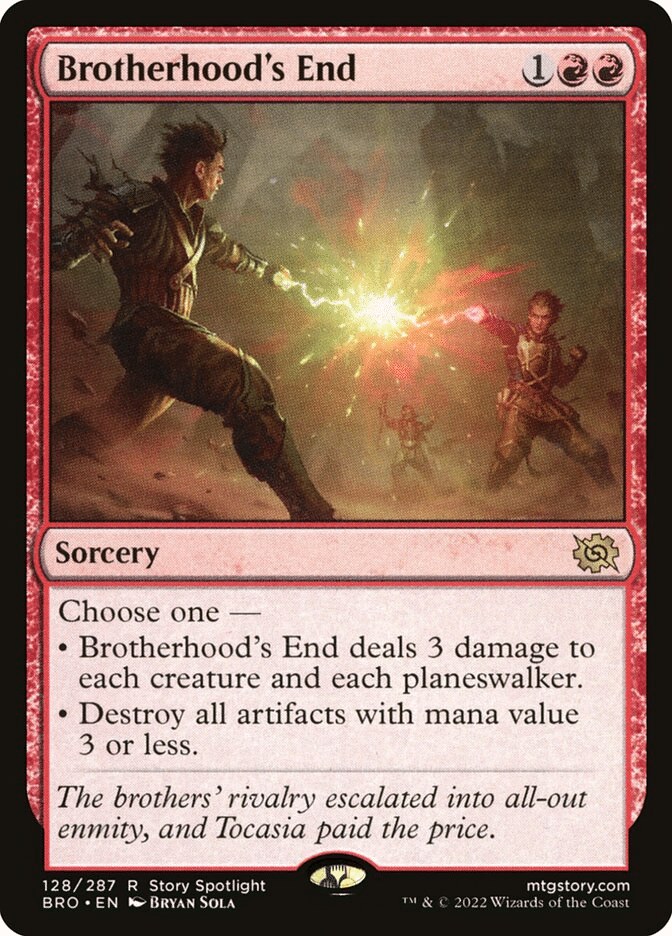
The goal of this deck is to continuously interact with the opponent to keep them off balance while developing enough mana to take over the game with late game bombs. The most important piece of interaction this deck has access to is Brotherhood’s End. At three mana, Brotherhood’s End can answer almost any Creature with toughness three or less. This helps you make sure you don’t get run over by fast starts from mono-red aggro, mono-white aggro, Azorius Soldiers, or Selesnya Enchantments. This deck also makes use of
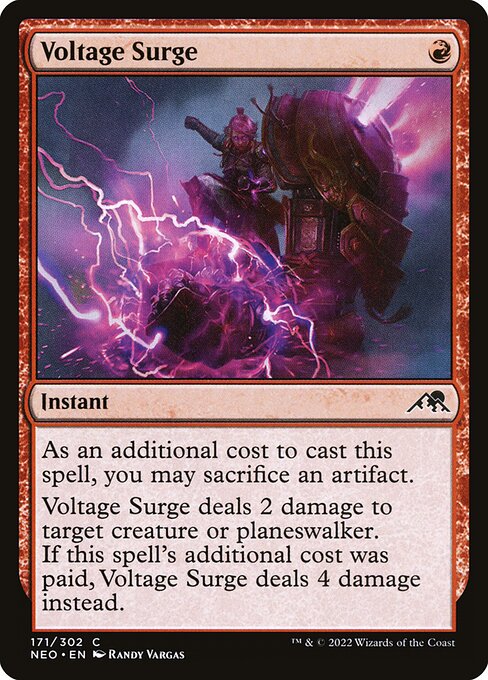
Voltage Surge
 Voltage Surge
As an additional cost to cast this spell, you may sacrifice an artifact.
Voltage Surge
As an additional cost to cast this spell, you may sacrifice an artifact.
Voltage Surge deals 2 damage to target creature or planeswalker. If this spell's additional cost was paid, Voltage Surge deals 4 damage instead.
, which is a strong removal spell in a deck with enough expendable Artifacts.
That leads us to the mana development portion of the deck, which is perhaps what sets the deck apart the most from others. In a typical blue control deck, you’d expect to find lots of Counterspells to supplement removal, keeping the opponent from developing their board in a meaningful way. From there, you can play card advantage to pull ahead in the mid to late game and win with top-end threats that are hard to remove. This deck definitely deviates from the norm, running very few Counterspells at all.
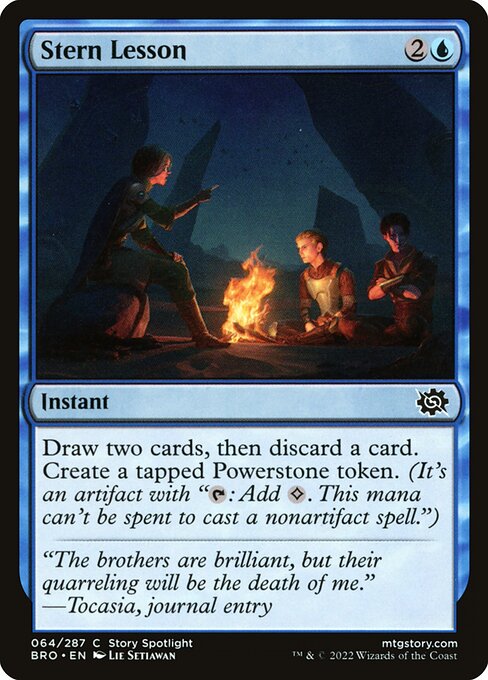
Instead, this deck plays an abundance of Lands and cards that make mana to bridge the gap from the early turns to the late game. Cards like
Stern Lesson
 Stern Lesson
Draw two cards, then discard a card. Create a tapped Powerstone token. (It's an artifact with "{T}: Add {C}. This mana can't be spent to cast a nonartifact spell.")
provide decent card selection while also making a Powerstone token.
Thran Spider
Stern Lesson
Draw two cards, then discard a card. Create a tapped Powerstone token. (It's an artifact with "{T}: Add {C}. This mana can't be spent to cast a nonartifact spell.")
provide decent card selection while also making a Powerstone token.
Thran Spider
 Thran Spider
Reach
Thran Spider
Reach
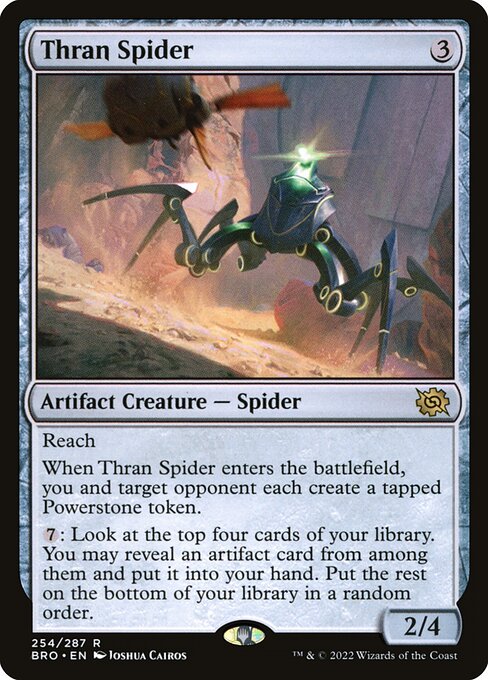
When this creature enters, you and target opponent each create a tapped Powerstone token.
{7}: Look at the top four cards of your library. You may reveal an artifact card from among them and put it into your hand. Put the rest on the bottom of your library in a random order.
is a brick wall that makes you and your opponent Powerstone tokens. It’s more difficult to kill than you might expect and, despite being inexpensive and underrepresented, does a lot of heavy lifting for this deck. The thing is, Powerstone tokens are typically difficult to utilize, since they can’t be used to cast non-Artifact spells. Luckily, this deck abuses them quite nicely.
Read More: MTG Format Staples Hit Record High $40+ Values After Spikes!
Maximizing Powerstones
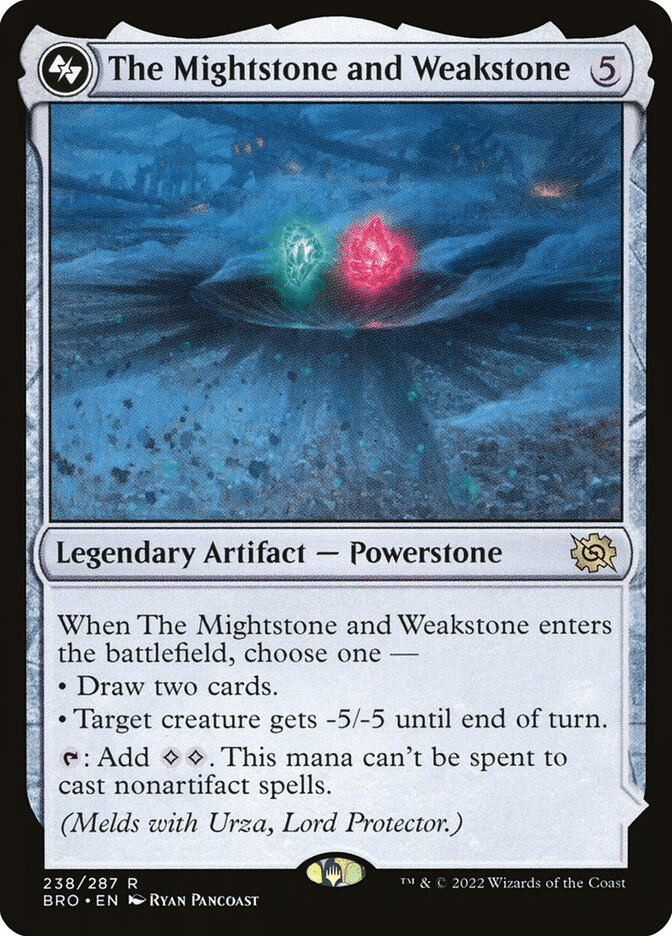
The reason Thran Spider is such a strong card for this deck is that it both blocks well and helps you ramp. The idea is that, unless the opponent is playing lots of Artifacts, their Powerstone token is worth a lot less than yours. This is because this deck has lots of Artifacts to cast with them. Both Stern Lesson and Thran Spider can let you cast five-drops ahead of schedule, which works extremely well with
The Mightstone and Weakstone
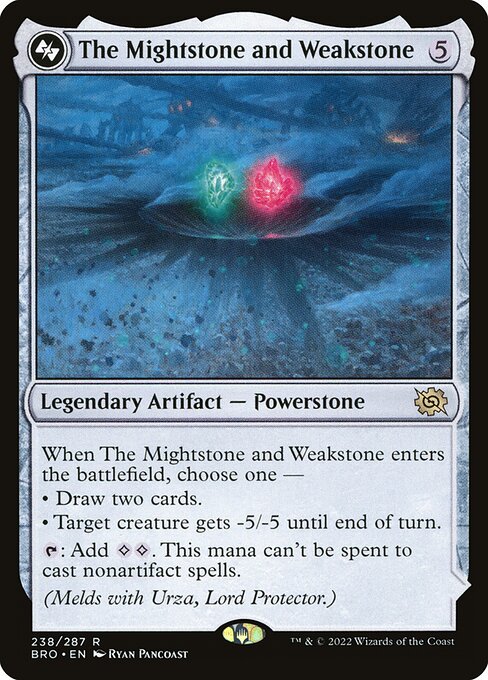 The Mightstone and Weakstone
When The Mightstone and Weakstone enters, choose one —
The Mightstone and Weakstone
When The Mightstone and Weakstone enters, choose one —
• Draw two cards.
• Target creature gets -5/-5 until end of turn.
{T}: Add {C}{C}. This mana can't be spent to cast nonartifact spells.
(Melds with Urza, Lord Protector.)
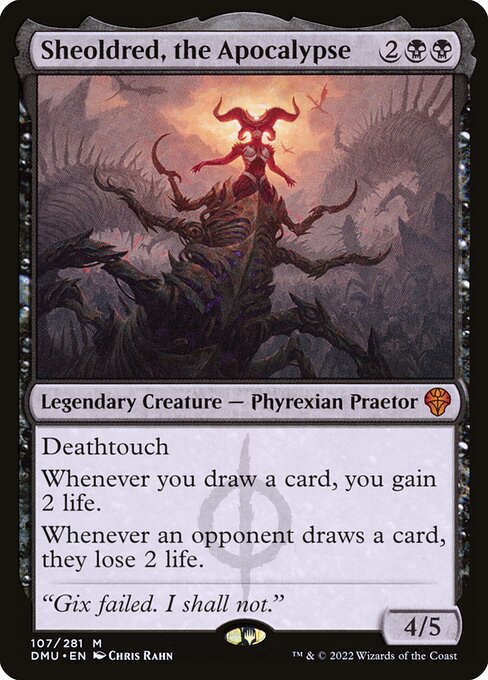
. The Mightstone and Weakstone plays a few roles here. When it enters the battlefield, you either get to draw two cards or give a Creature -5/-5 until end of turn. Notably, this deals with
Sheoldred, the Apocalypse
 Sheoldred, the Apocalypse
Deathtouch
Sheoldred, the Apocalypse
Deathtouch
Whenever you draw a card, you gain 2 life.
Whenever an opponent draws a card, they lose 2 life.
in an effective manner, which is essential in this format.
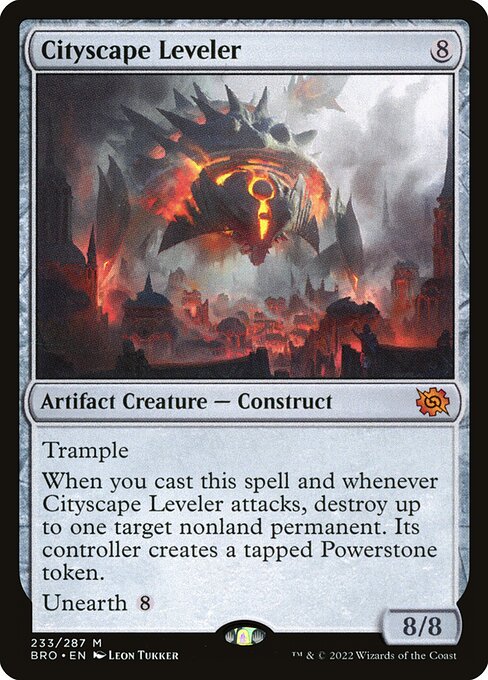
From there, you are left with another card that taps for mana to help cast Artifacts. Between this card and various Powerstones, you can cast your Artifact-based top-end to try to close the game in short order. For eight mana, this deck plays
Cityscape Leveler
 Cityscape Leveler
Trample
Cityscape Leveler
Trample
When you cast this spell and whenever this creature attacks, destroy up to one target nonland permanent. Its controller creates a tapped Powerstone token.
Unearth {8}
, which answers any problematic non-Land permanent, leaving behind an eight-power Trampler. You can even Unearth Cityscape Leveler should it die and answer another non-Land permanent when it attacks!
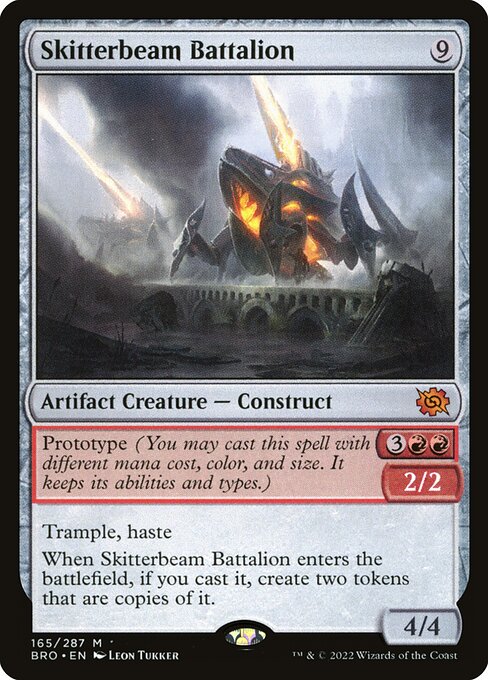
Beyond Cityscape Leveler, this deck also plays
Skitterbeam Battalion
 Skitterbeam Battalion
Prototype {3}{R}{R} — 2/2 (You may cast this spell with different mana cost, color, and size. It keeps its abilities and types.)
Skitterbeam Battalion
Prototype {3}{R}{R} — 2/2 (You may cast this spell with different mana cost, color, and size. It keeps its abilities and types.)
Trample, haste
When this creature enters, if you cast it, create two tokens that are copies of it.
, which is surprisingly amazing. If you can get to nine mana, which is very doable with The Mightstone and Weakstone in the mix, you end up with three 4/4 Hasty Trampling threats. If you kept the board relatively stable, this closes the game extremely fast. Nine mana may be a bit tough, though, but luckily Skitterbeam Battalion has you covered. You can pay five mana instead to get three 2/2 Hasty Tramplers instead. This can still be a strong mid game play and helps add much-needed pressure against ramp and control decks. This deck is as much a ramp deck as it is a control deck, and it meshes both styles together quite nicely.
Read More: Unique Synergy Helps Make LOTR Staple Even Better!
Strengths and Weaknesses
This archetype has a lot going for it. By pairing removal with ramp and elite top-end, this deck has a strong gameplan against opposing midrange decks. One of the most premium removal spells that many midrange and control decks have access to is
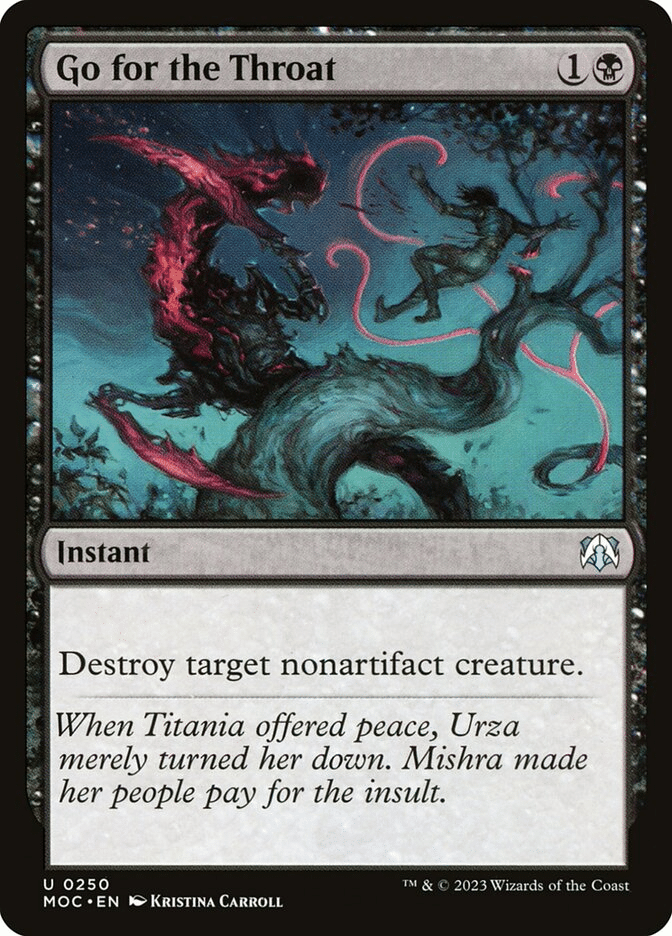
Go for the Throat
 Go for the Throat
Destroy target nonartifact creature.
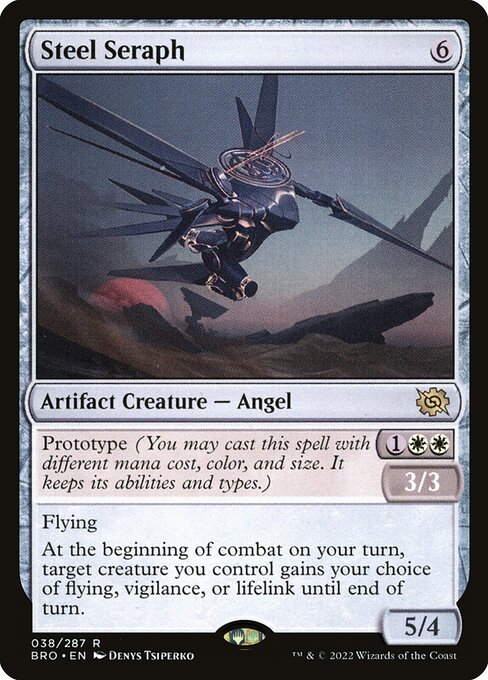
, which is rendered useless against a deck with all Artifact threats. Some archetypes already began playing cards like
Steel Seraph
Go for the Throat
Destroy target nonartifact creature.
, which is rendered useless against a deck with all Artifact threats. Some archetypes already began playing cards like
Steel Seraph
 Steel Seraph
Prototype {1}{W}{W} — 3/3 (You may cast this spell with different mana cost, color, and size. It keeps its abilities and types.)
Steel Seraph
Prototype {1}{W}{W} — 3/3 (You may cast this spell with different mana cost, color, and size. It keeps its abilities and types.)
Flying
At the beginning of combat on your turn, target creature you control gains your choice of flying, vigilance, or lifelink until end of turn.
and
Phyrexian Fleshgorger
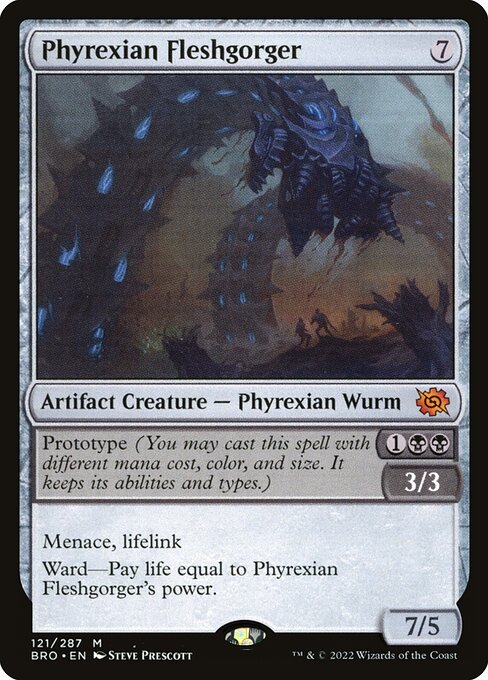 Phyrexian Fleshgorger
Prototype {1}{B}{B} — 3/3 (You may cast this spell with different mana cost, color, and size. It keeps its abilities and types.)
Phyrexian Fleshgorger
Prototype {1}{B}{B} — 3/3 (You may cast this spell with different mana cost, color, and size. It keeps its abilities and types.)
Menace, lifelink
Ward—Pay life equal to this creature's power.
to effectively dodge
Cut Down
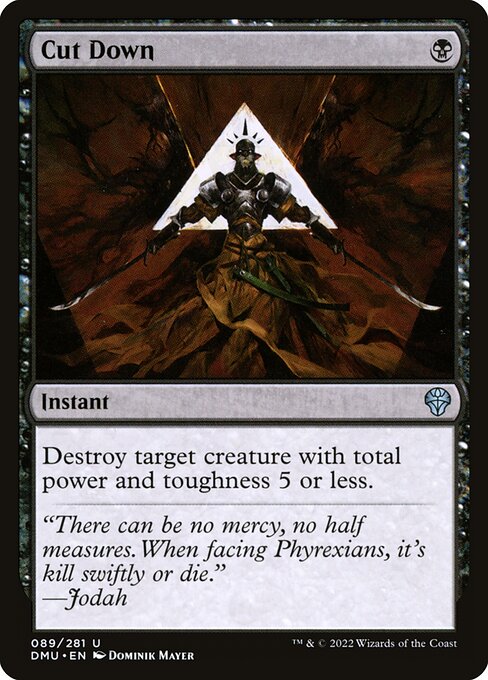 Cut Down
Destroy target creature with total power and toughness 5 or less.
and Go for the Throat simultaneously. This deck takes this same strategy to the extreme.
Cut Down
Destroy target creature with total power and toughness 5 or less.
and Go for the Throat simultaneously. This deck takes this same strategy to the extreme.
Skitterbeam Battalion helps this deck shore up its control and ramp matchups, providing lots of power spread across multiple bodies. The tricky part is simply resolving the cards that matter. This deck is reliant on using cards like the Mightstone and Weakstone to build to the late game. By simply countering the cards in this deck that help ramp, it’s possible to slow this deck down immensely. The curve of casting turn three Thran Spider, turn four Mightstone, turn five Leveler is obviously extremely strong, but if you can cast
Make Disappear
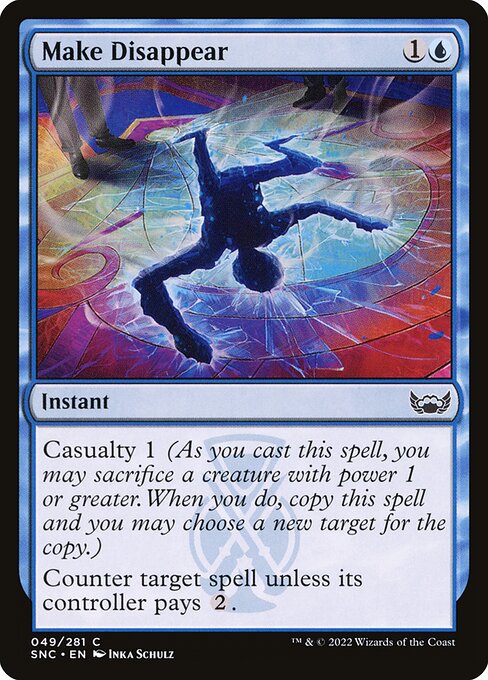 Make Disappear
Casualty 1 (As you cast this spell, you may sacrifice a creature with power 1 or greater. When you do, copy this spell and you may choose a new target for the copy.)
Make Disappear
Casualty 1 (As you cast this spell, you may sacrifice a creature with power 1 or greater. When you do, copy this spell and you may choose a new target for the copy.)
Counter target spell unless its controller pays {2}.
on the Spider or Mightstone, getting to Leveler gets a lot harder.
That being said, actually dealing with this deck’s threats in an effective way once they resolve is a bit tough. Even killing a Thran Spider can be surprisingly difficult, and the card effectively staves off any aggressive attackers. The Mightstone and Weakstone generates value and mana when it hits the board, and Skitterbeam Battalion spreads its power across three bodies. Once this deck gets rolling, it can be hard to stop it. This deck is the real deal, but it will be interesting to see how Wilds of Eldraine impacts the metagame moving forward.
Read More: New LOTR Leaks May Feature Best Protection Spell Ever Printed!