
Just a couple weeks ago, arguably the most prestigious MTG event of the year, the Magic World Championship, played out in Las Vegas. This tournament showcased the Standard format and was largely dominated by various Esper strategies. This weekend, another major tournament featuring an Arena format is still going on, but this time, the format is Historic. 32 players are competing for cash and glory at Arena Championship 4, which features gameplay specifically on Arena.
It’s interesting to see the Historic format getting the spotlight, especially given how much of a shakeup recent sets have caused within the format. It’s no surprise at this point that the Lord of the Rings set was extremely powerful, but the fact that the cards were added to Arena made for some extreme changes in the Historic metagame. The metagame is extremely combo-heavy, for better or for worse. Let’s start by taking a look at the most played decks at the Arena Championship.
Top Decks
Two decks tied for the most played deck at the Arena Championship. The first of these strategies is mono-green Devotion. For those that closely follow the Pioneer metagame, it’s likely not a big surprise to see mono-green Devotion performing so well. However, there are some key differences between the Pioneer and Historic versions.
Both decks make use of similar win conditions in the form of
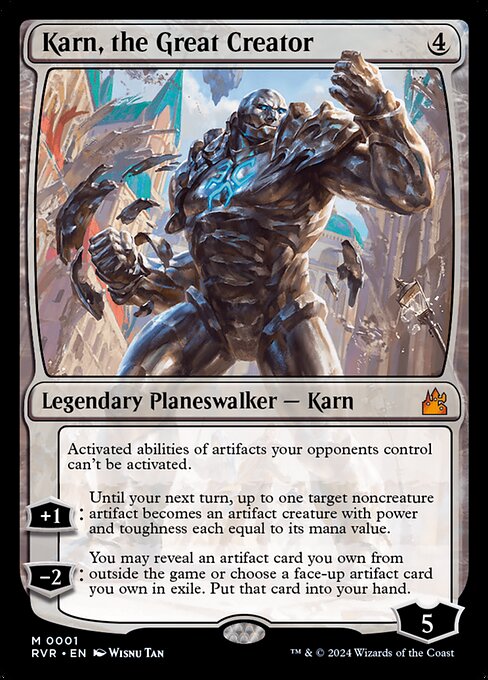
Karn, the Great Creator
 Karn, the Great Creator
Activated abilities of artifacts your opponents control can't be activated.
Karn, the Great Creator
Activated abilities of artifacts your opponents control can't be activated.
+1: Until your next turn, up to one target noncreature artifact becomes an artifact creature with power and toughness each equal to its mana value.
−2: You may reveal an artifact card you own from outside the game or choose a face-up artifact card you own in exile. Put that card into your hand.
,
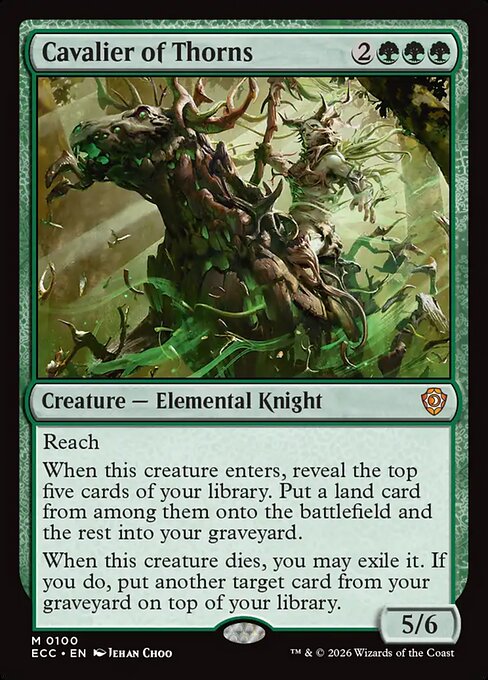
Cavalier of Thorns
 Cavalier of Thorns
Reach
Cavalier of Thorns
Reach
When this creature enters, reveal the top five cards of your library. Put a land card from among them onto the battlefield and the rest into your graveyard.
When this creature dies, you may exile it. If you do, put another target card from your graveyard on top of your library.
, and
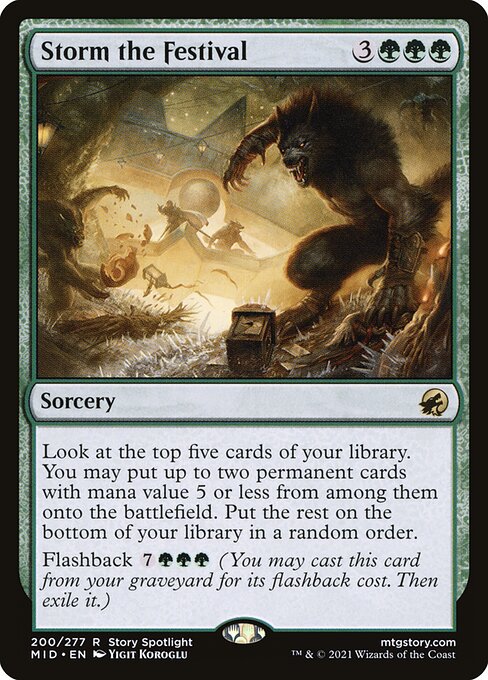
Storm the Festival
 Storm the Festival
Look at the top five cards of your library. You may put up to two permanent cards with mana value 5 or less from among them onto the battlefield. Put the rest on the bottom of your library in a random order.
Storm the Festival
Look at the top five cards of your library. You may put up to two permanent cards with mana value 5 or less from among them onto the battlefield. Put the rest on the bottom of your library in a random order.
Flashback {7}{G}{G}{G} (You may cast this card from your graveyard for its flashback cost. Then exile it.)
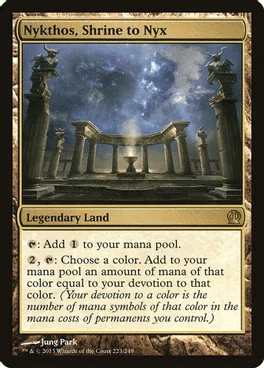
. Both decks also utilize
Nykthos, Shrine to Nyx
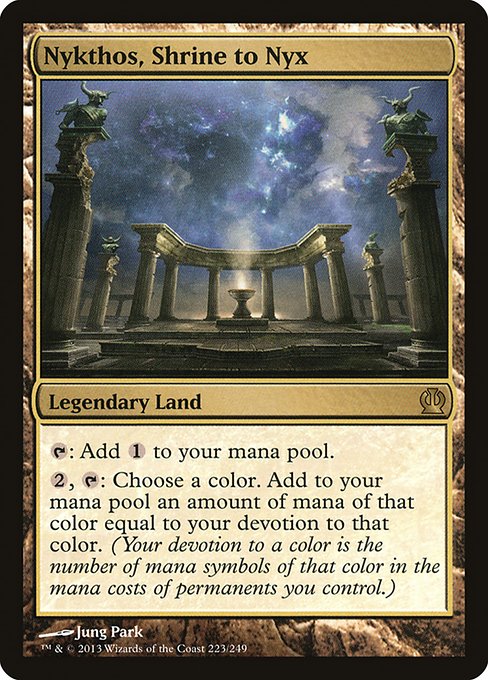 Nykthos, Shrine to Nyx
{T}: Add {C}.
Nykthos, Shrine to Nyx
{T}: Add {C}.
{2}, {T}: Choose a color. Add an amount of mana of that color equal to your devotion to that color. (Your devotion to a color is the number of mana symbols of that color in the mana costs of permanents you control.)
to pull far ahead on mana.
Perhaps the biggest difference between the two strategies is that the Historic version has access to
Utopia Sprawl
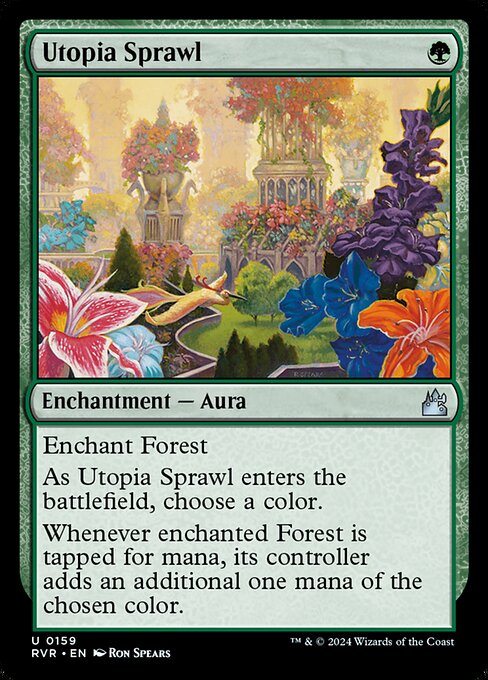 Utopia Sprawl
Enchant Forest
Utopia Sprawl
Enchant Forest
As this Aura enters, choose a color.
Whenever enchanted Forest is tapped for mana, its controller adds an additional one mana of the chosen color.
and
Delighted Halfling
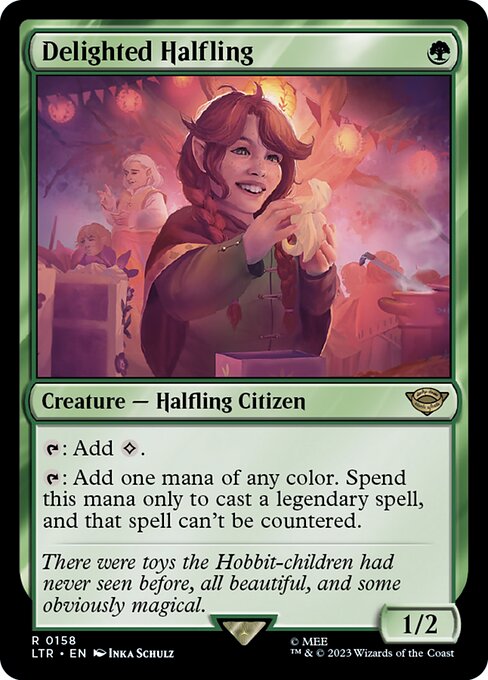 Delighted Halfling
{T}: Add {C}.
Delighted Halfling
{T}: Add {C}.
{T}: Add one mana of any color. Spend this mana only to cast a legendary spell, and that spell can't be countered.
as upgrades in the one-mana slot. You can also use Karn to tutor for
The One Ring
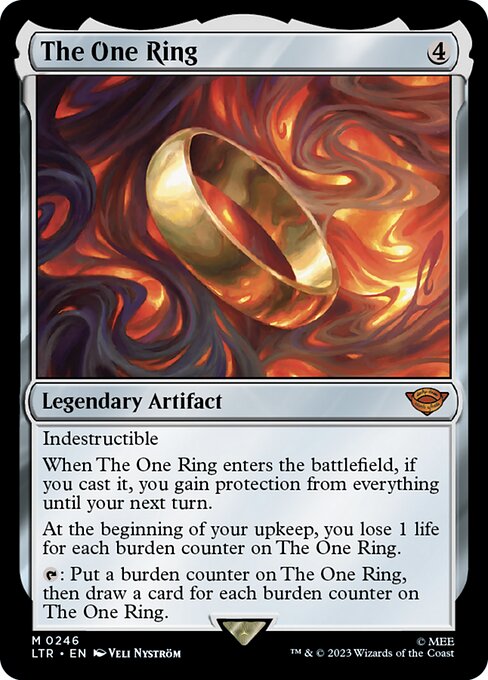 The One Ring
Indestructible
The One Ring
Indestructible
When The One Ring enters, if you cast it, you gain protection from everything until your next turn.
At the beginning of your upkeep, you lose 1 life for each burden counter on The One Ring.
{T}: Put a burden counter on The One Ring, then draw a card for each burden counter on The One Ring.
in Historic.
In Pioneer, you have access to
Oath of Nissa
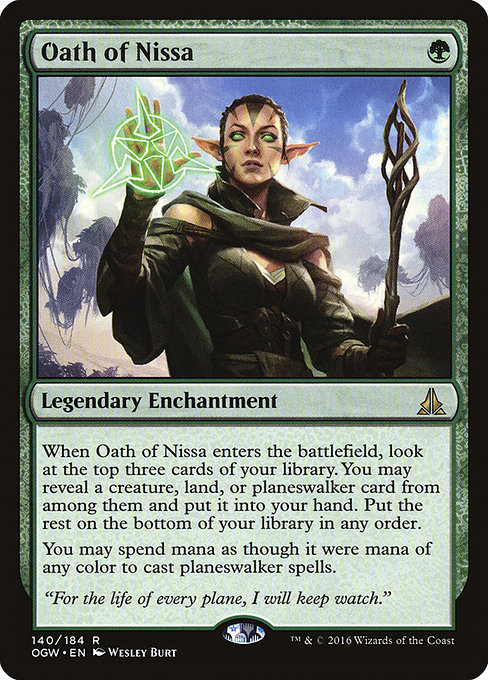 Oath of Nissa
When Oath of Nissa enters, look at the top three cards of your library. You may reveal a creature, land, or planeswalker card from among them and put it into your hand. Put the rest on the bottom of your library in any order.
Oath of Nissa
When Oath of Nissa enters, look at the top three cards of your library. You may reveal a creature, land, or planeswalker card from among them and put it into your hand. Put the rest on the bottom of your library in any order.
You may spend mana as though it were mana of any color to cast planeswalker spells.
, which is not on Arena, as well as
The Chain Veil
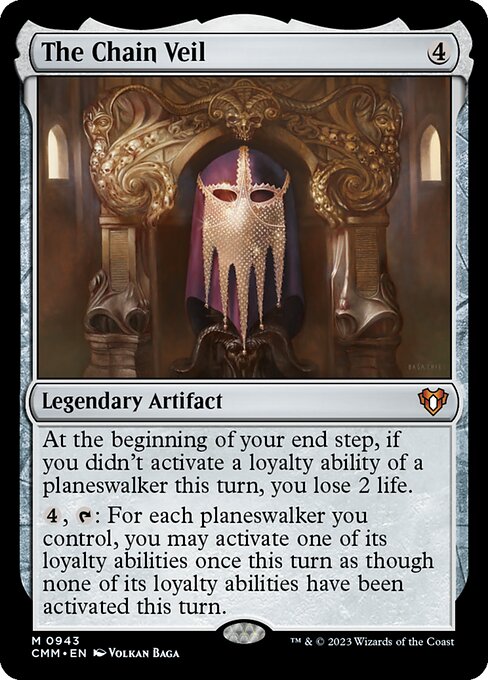 The Chain Veil
At the beginning of your end step, if you didn't activate a loyalty ability of a planeswalker this turn, you lose 2 life.
The Chain Veil
At the beginning of your end step, if you didn't activate a loyalty ability of a planeswalker this turn, you lose 2 life.
{4}, {T}: For each planeswalker you control, you may activate one of its loyalty abilities once this turn as though none of its loyalty abilities have been activated this turn.
, which makes producing infinite mana much easier. Many Historic decklists still utilize the backside of
Pestilent Cauldron
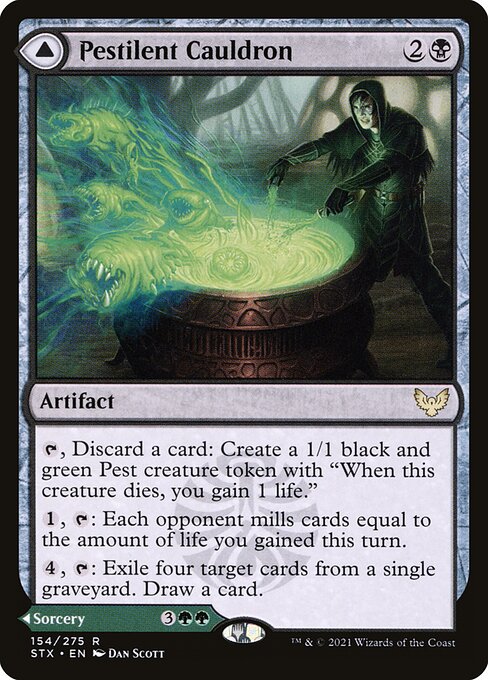 Pestilent Cauldron
{T}, Discard a card: Create a 1/1 black and green Pest creature token with "When this token dies, you gain 1 life."
Pestilent Cauldron
{T}, Discard a card: Create a 1/1 black and green Pest creature token with "When this token dies, you gain 1 life."
{1}, {T}: Each opponent mills cards equal to the amount of life you gained this turn.
{4}, {T}: Exile four target cards from a single graveyard. Draw a card.
to loop multiple copies of
Kiora, Behemoth Beckoner
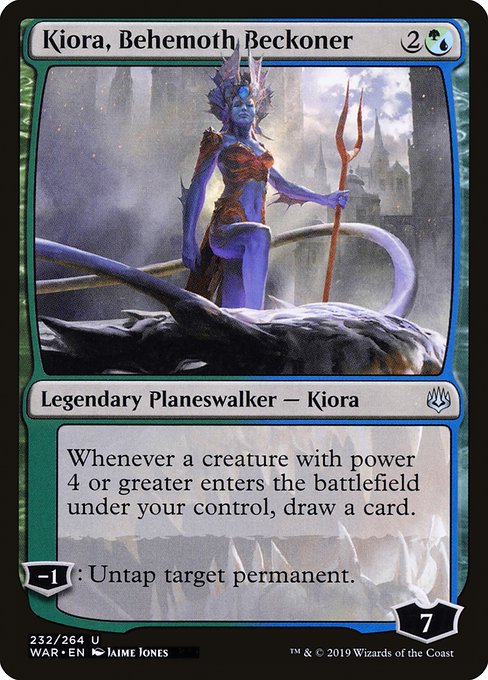 Kiora, Behemoth Beckoner
Whenever a creature you control with power 4 or greater enters, draw a card.
Kiora, Behemoth Beckoner
Whenever a creature you control with power 4 or greater enters, draw a card.
−1: Untap target permanent.
and Karn to generate infinite life and infinite mana, but this requires more Devotion to do so. This combo is rather convoluted, so for simplicity’s sake, we will not be explaining it in full.
Besides mono-green Devotion, Dimir control also had 6 players playing the deck. This deck abuses the fact that
Orcish Bowmasters
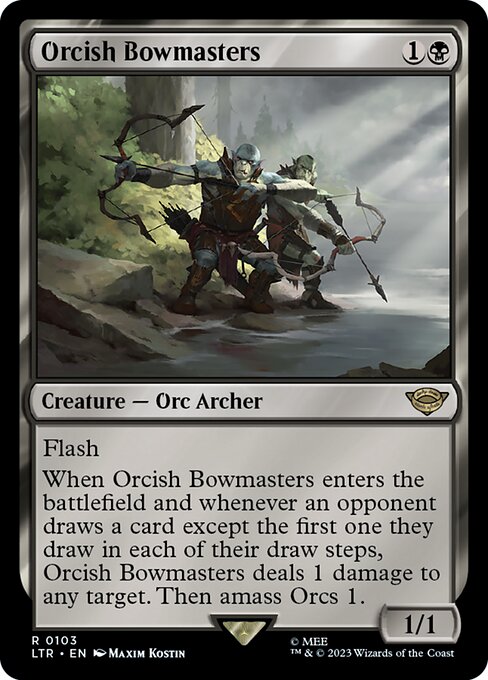 Orcish Bowmasters
Flash
Orcish Bowmasters
Flash
When this creature enters and whenever an opponent draws a card except the first one they draw in each of their draw steps, this creature deals 1 damage to any target. Then amass Orcs 1.
and
Sauron’s Ransom
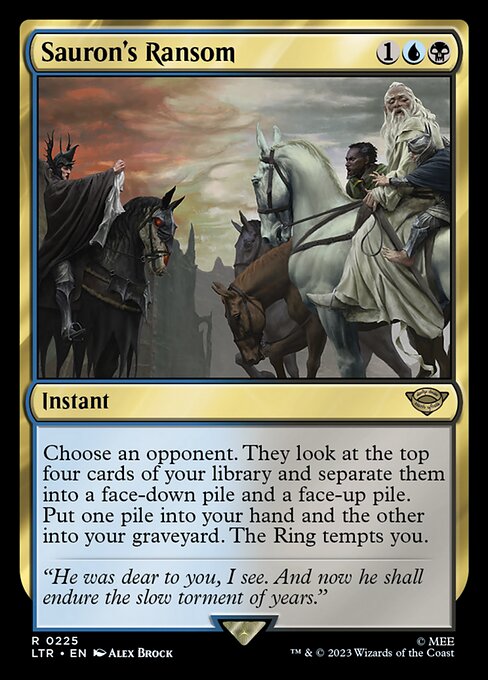 Sauron’s Ransom
Choose an opponent. They look at the top four cards of your library and separate them into a face-down pile and a face-up pile. Put one pile into your hand and the other into your graveyard. The Ring tempts you.
are on Arena. Snapcaster Mage and
Archmage’s Charm
Sauron’s Ransom
Choose an opponent. They look at the top four cards of your library and separate them into a face-down pile and a face-up pile. Put one pile into your hand and the other into your graveyard. The Ring tempts you.
are on Arena. Snapcaster Mage and
Archmage’s Charm
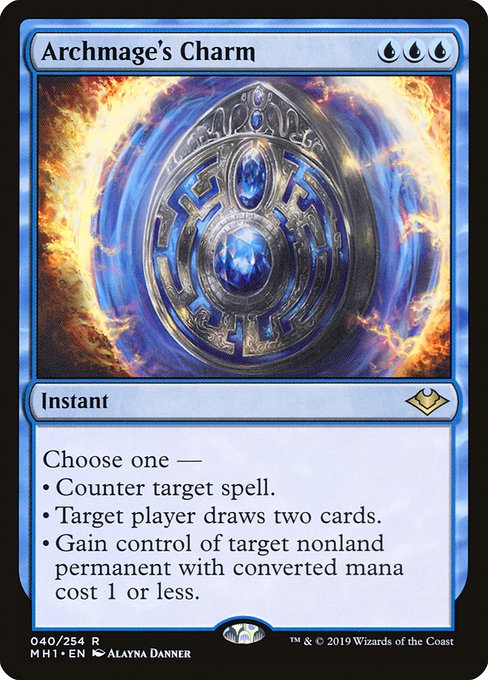 Archmage’s Charm
Choose one —
Archmage’s Charm
Choose one —
• Counter target spell.
• Target player draws two cards.
• Gain control of target nonland permanent with mana value 1 or less.
, two more Modern staples, were also added to Arena via special products, such as Jumpstart: Historic Horizons. This archetype is all about generating card advantage and interacting at Instant speed, while maximizing the fact that
Lurrus of the Dream-Den
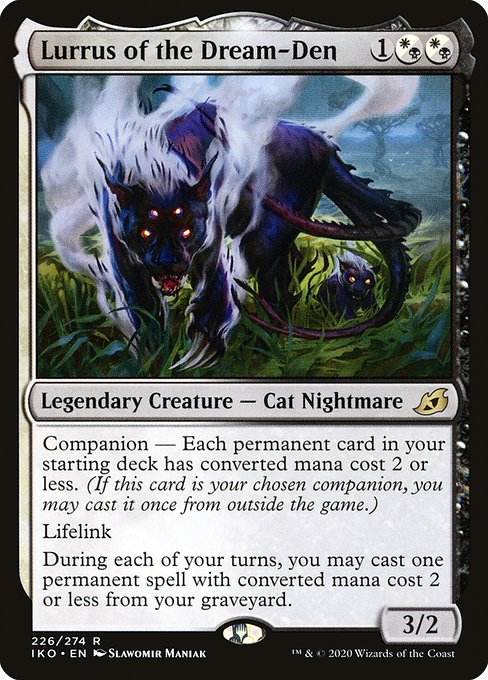 Lurrus of the Dream-Den
Companion — Each permanent card in your starting deck has mana value 2 or less. (If this card is your chosen companion, you may put it into your hand from outside the game for {3} as a sorcery.)
Lurrus of the Dream-Den
Companion — Each permanent card in your starting deck has mana value 2 or less. (If this card is your chosen companion, you may put it into your hand from outside the game for {3} as a sorcery.)
Lifelink
Once during each of your turns, you may cast a permanent spell with mana value 2 or less from your graveyard.
is legal in Historic.
Read More: Unusual Rat Deck Overperforms in Competitive Modern Event!
Combo-Heavy Metagame
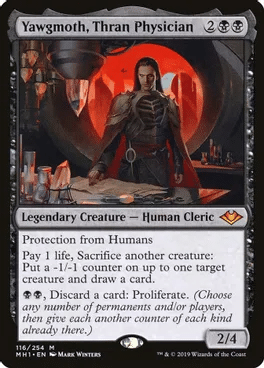
As mentioned, mono-green Devotion can function like a combo deck when necessary, but there are a bunch more combo decks featured at the Arena Championship as well. 5 players registered
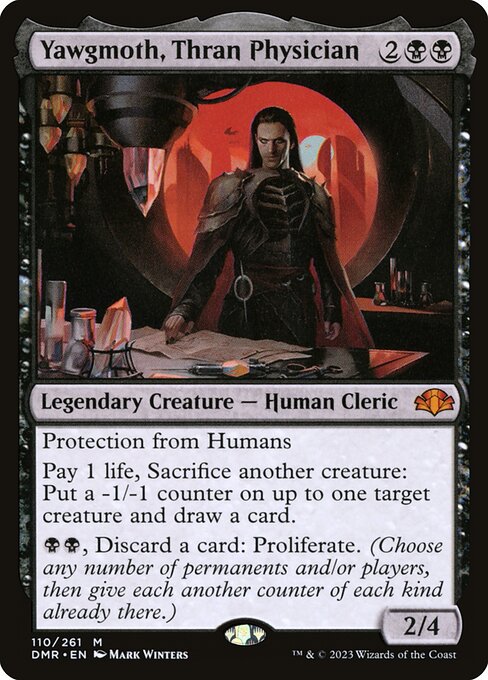
Yawgmoth, Thran Physician
 Yawgmoth, Thran Physician
Protection from Humans
Yawgmoth, Thran Physician
Protection from Humans
Pay 1 life, Sacrifice another creature: Put a -1/-1 counter on up to one target creature and draw a card.
{B}{B}, Discard a card: Proliferate. (Choose any number of permanents and/or players, then give each another counter of each kind already there.)
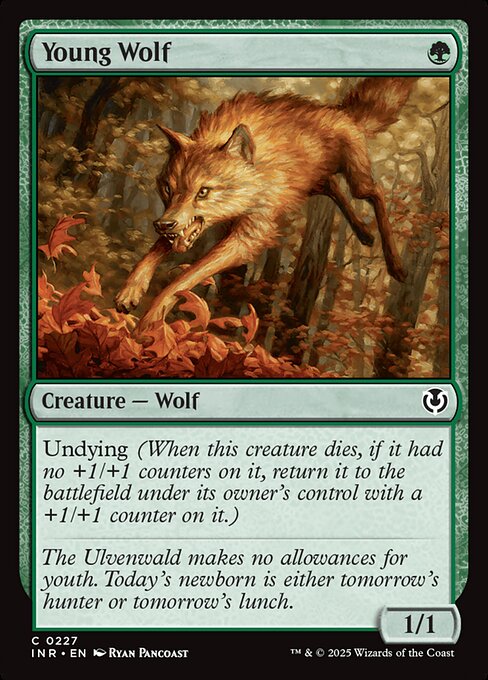
combo. Yawgmoth combo uses Undying Creatures, like
Young Wolf
 Young Wolf
Undying (When this creature dies, if it had no +1/+1 counters on it, return it to the battlefield under its owner's control with a +1/+1 counter on it.)
, alongside Yawgmoth and Zulaport Cutthroat to continuously draw cards and drain the opponent of life. This can be done by using the following steps:
Young Wolf
Undying (When this creature dies, if it had no +1/+1 counters on it, return it to the battlefield under its owner's control with a +1/+1 counter on it.)
, alongside Yawgmoth and Zulaport Cutthroat to continuously draw cards and drain the opponent of life. This can be done by using the following steps:
- First, sacrifice a Young Wolf with Yawgmoth’s activated ability. Do not target any of your creatures with the -1/-1 counter. The Young Wolf will come back with a +1/+1 counter thanks to Undying. This will trigger Zulaport Cutthroat, draining your opponent for one.
- Second, sacrifice your Young Wolf that does not have a counter, targeting the Young Wolf that does have a counter. Your counters will cancel out. Your other Young Wolf will come back with a +1/+1 counter thanks to Undying. This, once again, will trigger Zulaport Cutthroat.
- You can repeat step two over and over, sacrificing the Young Wolf without a counter, targeting the one that does have a counter, thanks to -1/-1 counters and +1/+1 counters canceling one another out.
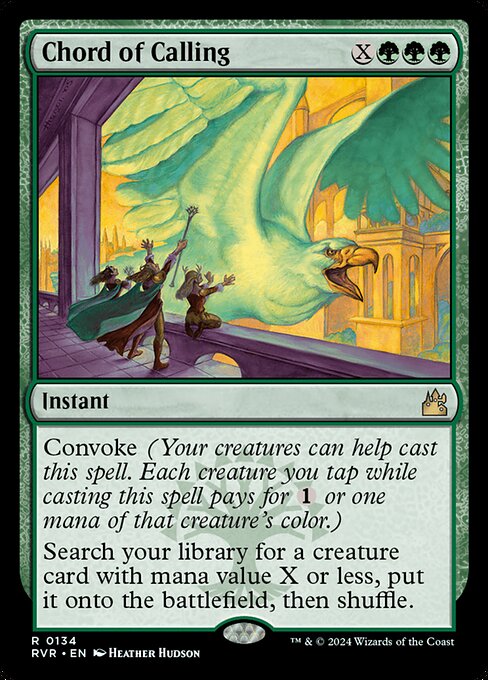
This deck has risen in the metagame significantly with the inclusion of
Chord of Calling
 Chord of Calling
Convoke (Your creatures can help cast this spell. Each creature you tap while casting this spell pays for {1} or one mana of that creature's color.)
Chord of Calling
Convoke (Your creatures can help cast this spell. Each creature you tap while casting this spell pays for {1} or one mana of that creature's color.)
Search your library for a creature card with mana value X or less, put it onto the battlefield, then shuffle.
in Explorer Anthology 3. While not having access to
Grist, the Hunger Tide
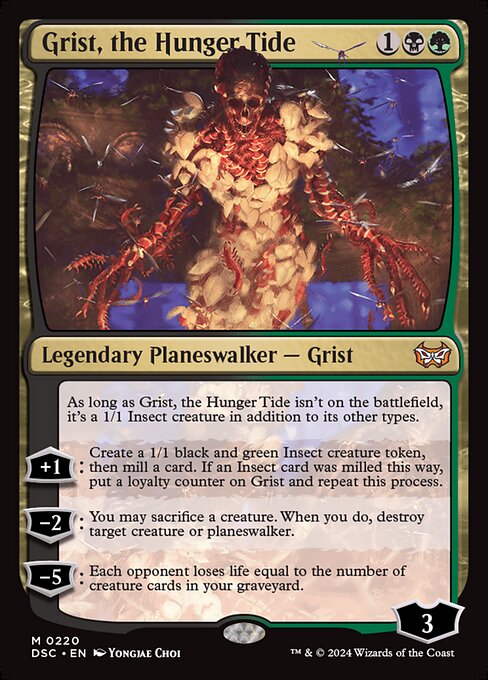 Grist, the Hunger Tide
As long as Grist isn't on the battlefield, it's a 1/1 Insect creature in addition to its other types.
Grist, the Hunger Tide
As long as Grist isn't on the battlefield, it's a 1/1 Insect creature in addition to its other types.
+1: Create a 1/1 black and green Insect creature token, then mill a card. If an Insect card was milled this way, put a loyalty counter on Grist and repeat this process.
−2: You may sacrifice a creature. When you do, destroy target creature or planeswalker.
−5: Each opponent loses life equal to the number of creature cards in your graveyard.
, like the Modern version of Yawgmoth combo, isn’t ideal, the deck is still extremely powerful in Historic nonetheless. Notably, the addition of Agatha’s Soul Cauldron in Wilds of Eldraine was a big deal for Yawgmoth combo in both its Modern and Historic variants, but perhaps even more so for the Historic one since it helps shore up the ease of pulling off the combo with other missing cards.
Beyond Yawgmoth combo,
Kethis, the Hidden Hand
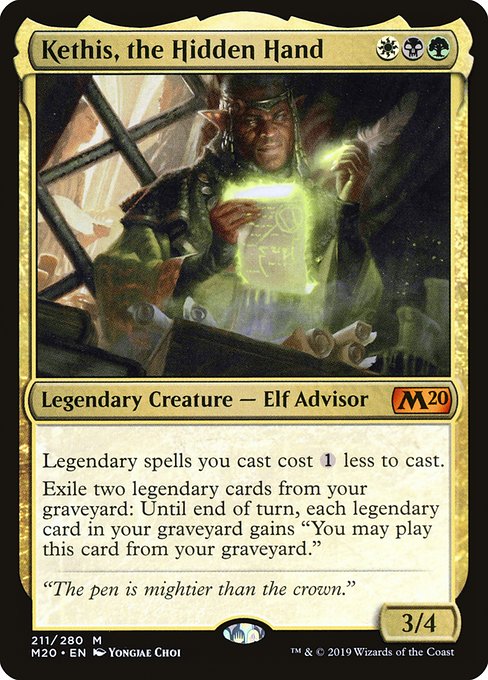 Kethis, the Hidden Hand
Legendary spells you cast cost {1} less to cast.
Kethis, the Hidden Hand
Legendary spells you cast cost {1} less to cast.
Exile two legendary cards from your graveyard: Until end of turn, each legendary card in your graveyard gains "You may play this card from your graveyard."
combo featured 4 players playing the deck. Kethis combo relies on filling your own graveyard with tons of legends. This allows you to use Kethis alongside multiple copies of
Mox Amber
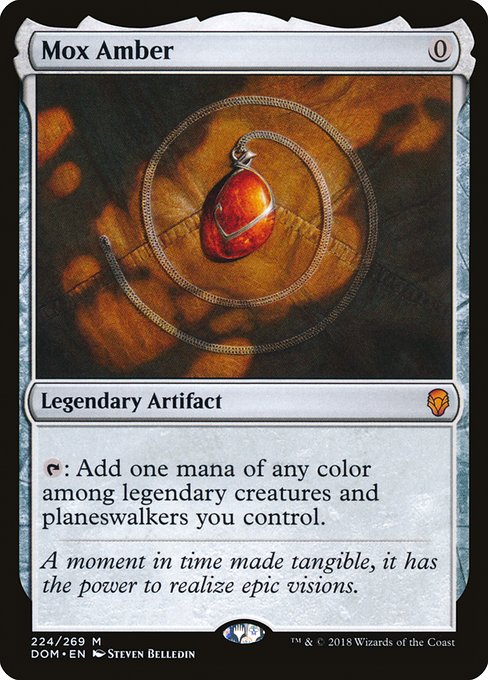 Mox Amber
{T}: Add one mana of any color among legendary creatures and planeswalkers you control.
to generate tons of mana.
Jace, the Perfected Mind
Mox Amber
{T}: Add one mana of any color among legendary creatures and planeswalkers you control.
to generate tons of mana.
Jace, the Perfected Mind
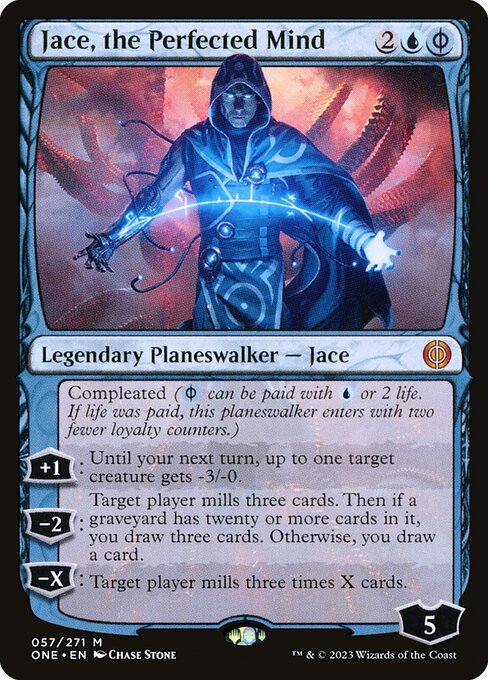 Jace, the Perfected Mind
Compleated ({U/P} can be paid with {U} or 2 life. If life was paid, this planeswalker enters with two fewer loyalty counters.)
Jace, the Perfected Mind
Compleated ({U/P} can be paid with {U} or 2 life. If life was paid, this planeswalker enters with two fewer loyalty counters.)
+1: Until your next turn, up to one target creature gets -3/-0.
−2: Target player mills three cards. Then if a graveyard has twenty or more cards in it, you draw three cards. Otherwise, you draw a card.
−X: Target player mills three times X cards.
can mill you for a bunch to help, and you can eventually use Jace to mill your opponent out.
Finally, there were also multiple players to register
Samwise Gamgee
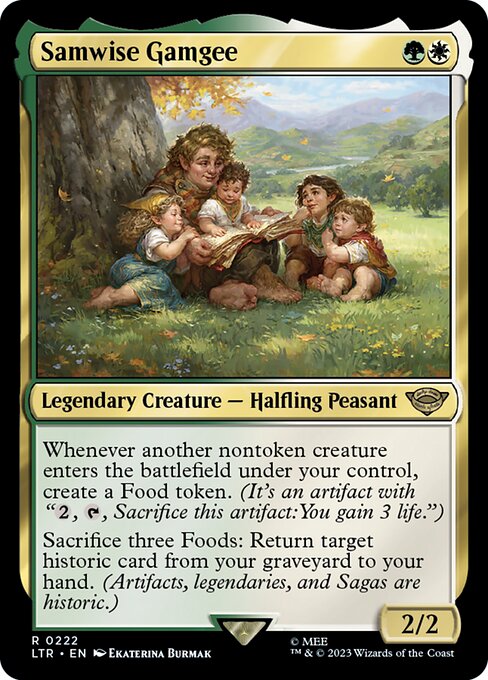 Samwise Gamgee
Whenever another nontoken creature you control enters, create a Food token. (It's an artifact with "{2}, {T}, Sacrifice this token: You gain 3 life.")
Samwise Gamgee
Whenever another nontoken creature you control enters, create a Food token. (It's an artifact with "{2}, {T}, Sacrifice this token: You gain 3 life.")
Sacrifice three Foods: Return target historic card from your graveyard to your hand. (Artifacts, legendaries, and Sagas are historic.)
combo, and lone players playing
Goblin Charbelcher
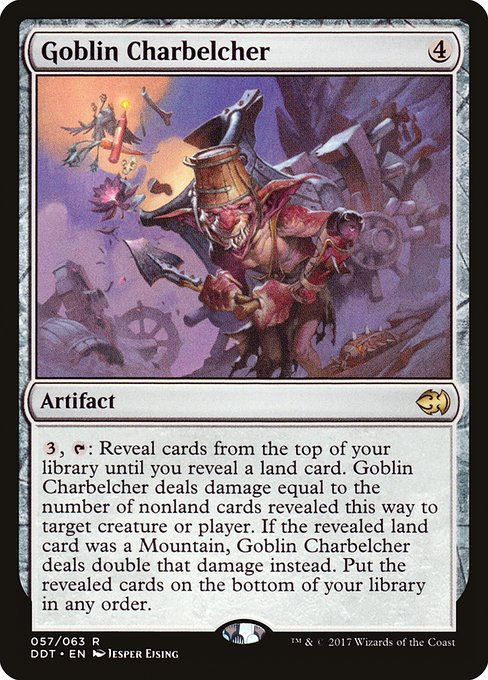 Goblin Charbelcher
{3}, {T}: Reveal cards from the top of your library until you reveal a land card. This artifact deals damage equal to the number of nonland cards revealed this way to any target. If the revealed land card was a Mountain, this artifact deals double that damage instead. Put the revealed cards on the bottom of your library in any order.
and
Putrid Goblin
Goblin Charbelcher
{3}, {T}: Reveal cards from the top of your library until you reveal a land card. This artifact deals damage equal to the number of nonland cards revealed this way to any target. If the revealed land card was a Mountain, this artifact deals double that damage instead. Put the revealed cards on the bottom of your library in any order.
and
Putrid Goblin
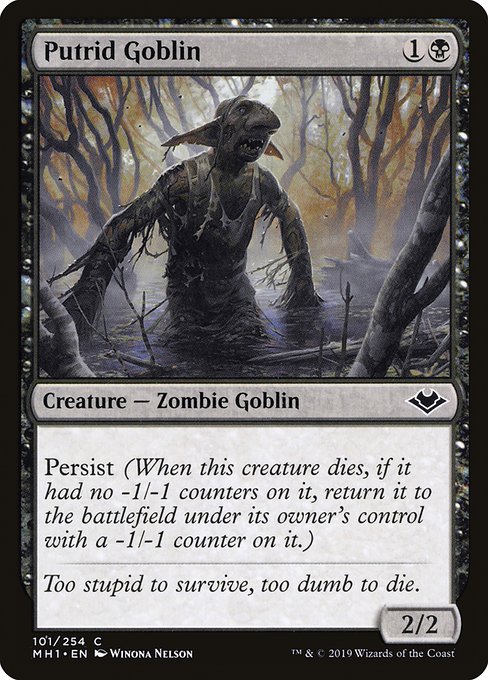 Putrid Goblin
Persist (When this creature dies, if it had no -1/-1 counters on it, return it to the battlefield under its owner's control with a -1/-1 counter on it.)
combo strategies. The Arena Championship was not overly dominated by one particular archetype, but it appears as though combo decks completely shined.
Putrid Goblin
Persist (When this creature dies, if it had no -1/-1 counters on it, return it to the battlefield under its owner's control with a -1/-1 counter on it.)
combo strategies. The Arena Championship was not overly dominated by one particular archetype, but it appears as though combo decks completely shined.
Read More: Elves are Becoming Competitive in MTG’s Regional Championship Format!
A Few Non-Combo Strategies
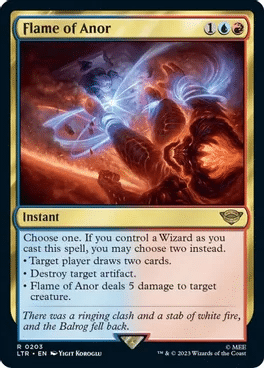
While it’s clear that combo decks were dominant at the event, there were some other non-combo decks registered, including Dimir Control.
Beyond Dimir, 4 players registered Izzet Wizards. This deck uses cheap Creatures like
Soul-Scar Mage
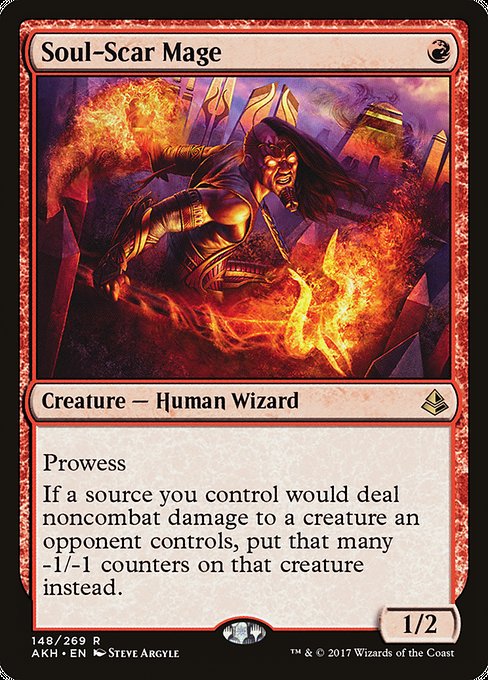 Soul-Scar Mage
Prowess
Soul-Scar Mage
Prowess
If a source you control would deal noncombat damage to a creature an opponent controls, put that many -1/-1 counters on that creature instead.
and
Balmor, Battlemage Captain
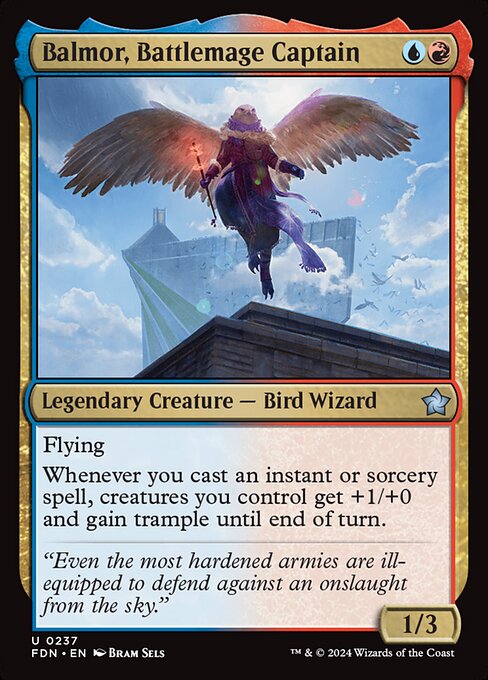 Balmor, Battlemage Captain
Flying
Balmor, Battlemage Captain
Flying
Whenever you cast an instant or sorcery spell, creatures you control get +1/+0 and gain trample until end of turn.
in conjunction with cheap spells like
Wizard’s Lightning
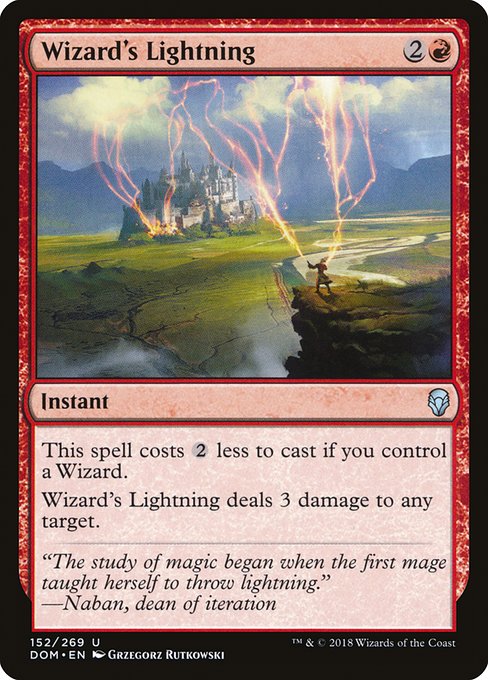 Wizard’s Lightning
This spell costs {2} less to cast if you control a Wizard.
Wizard’s Lightning
This spell costs {2} less to cast if you control a Wizard.
Wizard's Lightning deals 3 damage to any target.
to close the game in short order. Beyond Wizard’s Lightning, the biggest payoff for not straying from the Wizards theme is that you get to play
Flame of Anor
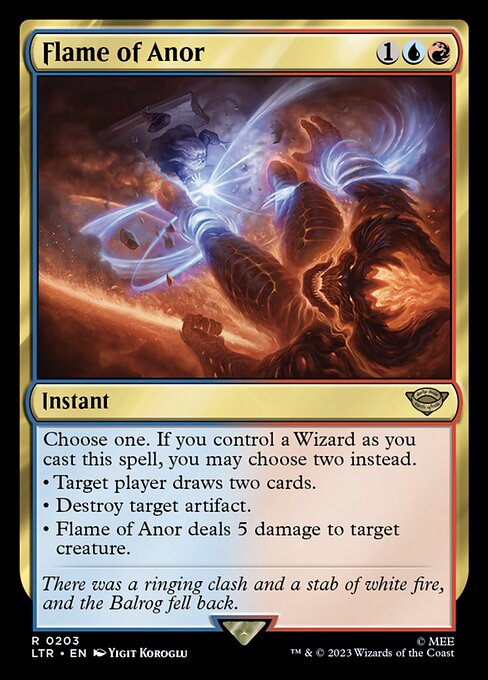 Flame of Anor
Choose one. If you control a Wizard as you cast this spell, you may choose two instead.
Flame of Anor
Choose one. If you control a Wizard as you cast this spell, you may choose two instead.
• Target player draws two cards.
• Destroy target artifact.
• Flame of Anor deals 5 damage to target creature.
. Flame of Anor is a strong and somewhat underrated card in Modern, and it absolutely shines in an archetype like this. The lone undefeated player after day 1 is, in fact, playing Wizards at the Arena Championship.
Beyond Dimir and Izzet, there were a couple players registering Rakdos Midrange. This deck is quite similar to Rakdos Midrange in Pioneer, using cheap interaction in the form of
Fatal Push
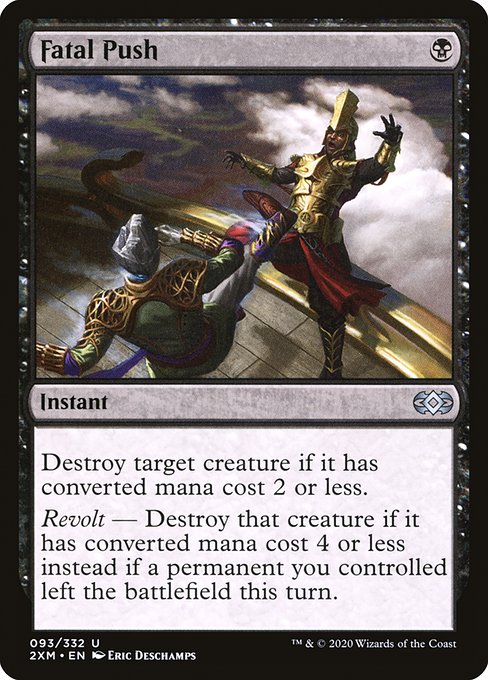 Fatal Push
Destroy target creature if it has mana value 2 or less.
Fatal Push
Destroy target creature if it has mana value 2 or less.
Revolt — Destroy that creature if it has mana value 4 or less instead if a permanent left the battlefield under your control this turn.
and
Thoughtseize
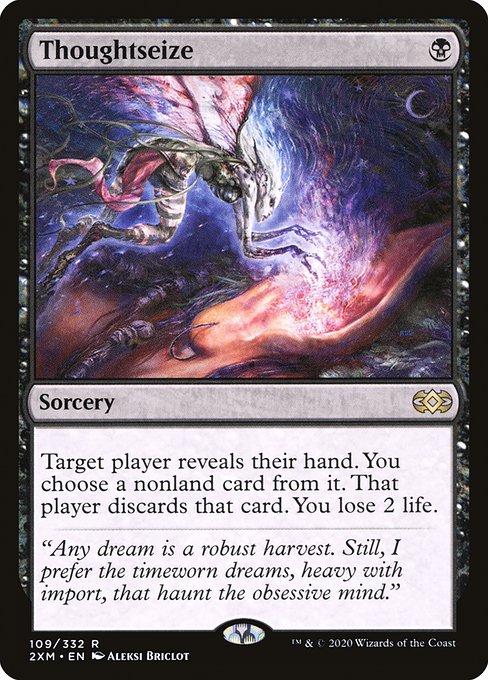 Thoughtseize
Target player reveals their hand. You choose a nonland card from it. That player discards that card. You lose 2 life.
to disrupt the opponent. From there, cards like
Fable of the Mirror-Breaker
Thoughtseize
Target player reveals their hand. You choose a nonland card from it. That player discards that card. You lose 2 life.
to disrupt the opponent. From there, cards like
Fable of the Mirror-Breaker
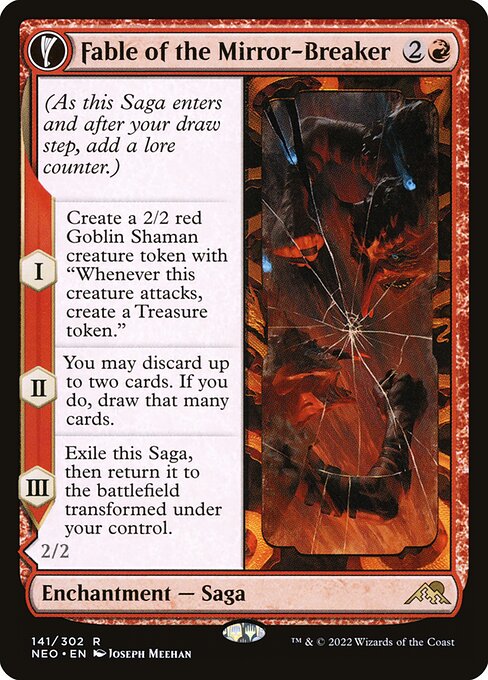 Fable of the Mirror-Breaker
(As this Saga enters and after your draw step, add a lore counter.)
Fable of the Mirror-Breaker
(As this Saga enters and after your draw step, add a lore counter.)
I — Create a 2/2 red Goblin Shaman creature token with "Whenever this token attacks, create a Treasure token."
II — You may discard up to two cards. If you do, draw that many cards.
III — Exile this Saga, then return it to the battlefield transformed under your control.
could help pull you ahead. With Orcish Bowmasters and The One Ring added into the mix, Rakdos Midrange in Historic certainly has some powerful tools at its disposal.
Still, Rakdos’ inability to close the game quickly may help explain, at least in part, why the deck was both underrepresented and underperformed in day 1. In a field full of combo decks, it makes sense why Dimir Control, a deck with access to Counterspells, would perform better. It’s nice to see the Historic format in the spotlight, though the dominance of combo is definitely something worth monitoring going forward.
Read More: Unique MTG Combo Deck Makes Waves at 600+ Player Event!