
Infinite combos in MTG are always as they should be in paper. One simple combination can lead a player to have eternal life, unlimited tokens, or infinite whatever they desire! Unfortunately, these can become problematic online. Two card combos that should win you the game will fail to do anything simply because you can’t execute the loop fast enough before your chess clock threatens a game loss altogether. The discussion around MTG infinite combo etiquette is long and controversial, but it ultimately comes down to a couple of interesting points.
A Moment of Weakness
A few years back, an MTG Streamer made an agreement with their opponent in a high-level tournament on MTGO (part of the MOCS series). To avoid the constraints of the MTGO client, they decided that the streamer’s opponent had infinite life due to the
Spike feeder
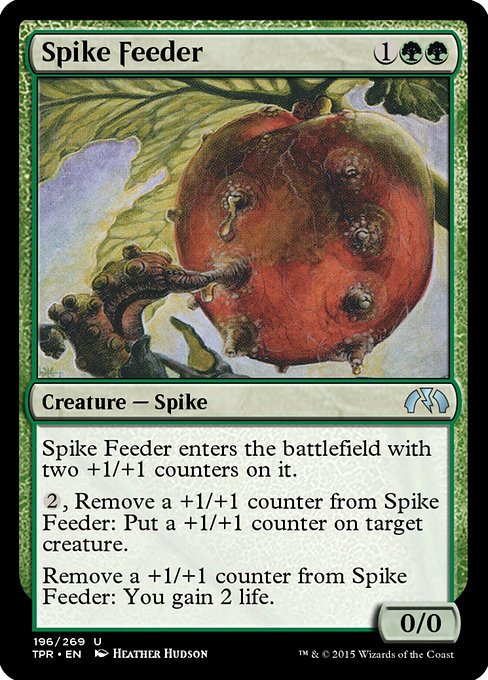 Spike feeder
This creature enters with two +1/+1 counters on it.
Spike feeder
This creature enters with two +1/+1 counters on it.
{2}, Remove a +1/+1 counter from this creature: Put a +1/+1 counter on target creature.
Remove a +1/+1 counter from this creature: You gain 2 life.
and
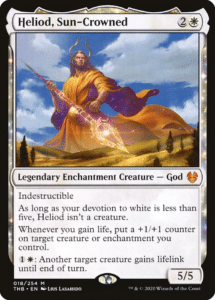
Heliod, Sun-Crowned
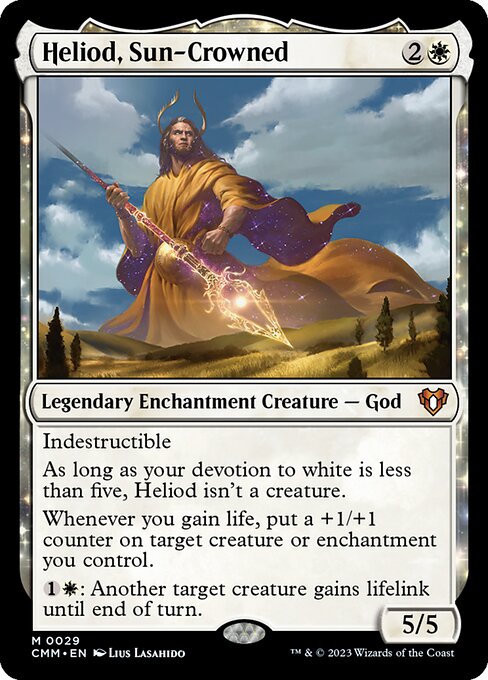 Heliod, Sun-Crowned
Indestructible
Heliod, Sun-Crowned
Indestructible
As long as your devotion to white is less than five, Heliod isn't a creature.
Whenever you gain life, put a +1/+1 counter on target creature or enchantment you control.
{1}{W}: Another target creature gains lifelink until end of turn.
combo they had on board. This agreement was made so the opponent could save time on their chess clock by not demonstrating the loop repeatedly (which isn’t something you would have to do in paper play). Long story short, the MTG streamer in question killed their opponent by putting their life total to zero because the opponent didn’t actually demonstrate a loop.
There’s much more at play in this instance than just the dishonoring of an agreement. Ultimately, because the agreement was made on stream in a high-profile tournament, the streamer is at fault. They apologized, so there is nothing to worry about there. The point behind bringing this event up is to branch into the discussion of infinite combo etiquette online. What is actually expected when facing down an opponent’s infinite combo or having an opponent face down yours?
Infinite Combo Etiquette
On MTGO, it’s a fairly common expectation for one to concede when they are facing an infinite that is guaranteed to kill them. You can still make your opponent play it out depending on time constraints, but that is a generally frowned upon act. Magic Arena is entirely different. There are no player expectations, and the function of the combo in question entirely depends on how the client deals with it. This leads to various situations that should result in instant wins that don’t work because of the client.
One example of this is the early days of the Jeskai Mutate deck in Standard. I piloted the crap out of this archetype and got incredibly sufficient with it. To make the deck work on MTG Arena, however, you had to train your APM (actions per minute) to a point where you could kill your opponent in time. If you failed to do so, your turn would rope out, and you would generally lose the game as the turn passes. Seeing as you would have the win in a paper game, there’s something wrong here.
Etiquette Impacts the Meta
Did you know that our current Standard format has a deadly infinite combo? You can gain infinite life if you get
Teferi, who Slows the Sunset
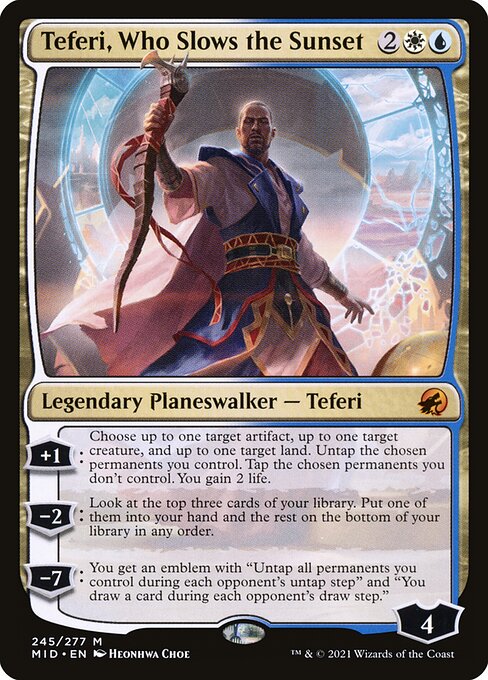 Teferi, who Slows the Sunset
+1: Choose up to one target artifact, up to one target creature, and up to one target land. Untap the chosen permanents you control. Tap the chosen permanents you don't control. You gain 2 life.
Teferi, who Slows the Sunset
+1: Choose up to one target artifact, up to one target creature, and up to one target land. Untap the chosen permanents you control. Tap the chosen permanents you don't control. You gain 2 life.
−2: Look at the top three cards of your library. Put one of them into your hand and the rest on the bottom of your library in any order.
−7: You get an emblem with "Untap all permanents you control during each opponent's untap step" and "You draw a card during each opponent's draw step."
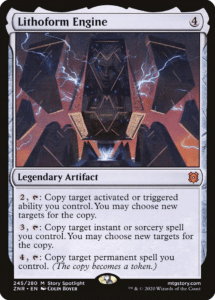
out with a
Lithoform Engine
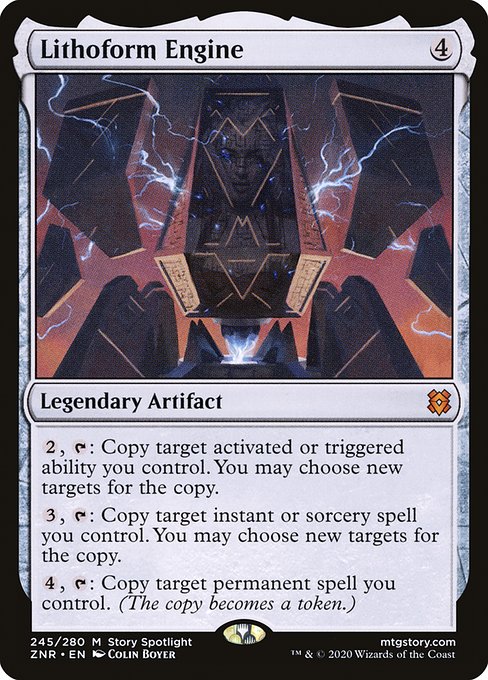 Lithoform Engine
{2}, {T}: Copy target activated or triggered ability you control. You may choose new targets for the copy.
Lithoform Engine
{2}, {T}: Copy target activated or triggered ability you control. You may choose new targets for the copy.
{3}, {T}: Copy target instant or sorcery spell you control. You may choose new targets for the copy.
{4}, {T}: Copy target permanent spell you control. (The copy becomes a token.)
and a source that taps for two mana (between one creature and one land maximum). Additionally, if you can untap one land and one nonland permanent that adds more than two mana, you can also gain endless mana. This combo should be a viable deck. With cards like
Storm the Festival
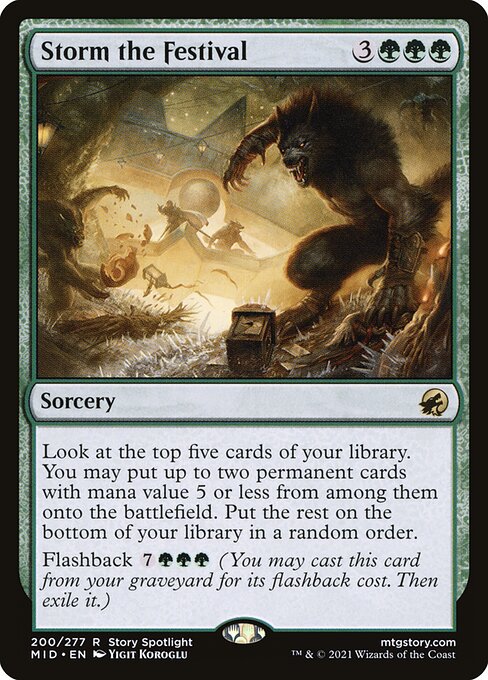 Storm the Festival
Look at the top five cards of your library. You may put up to two permanent cards with mana value 5 or less from among them onto the battlefield. Put the rest on the bottom of your library in a random order.
Storm the Festival
Look at the top five cards of your library. You may put up to two permanent cards with mana value 5 or less from among them onto the battlefield. Put the rest on the bottom of your library in a random order.
Flashback {7}{G}{G}{G} (You may cast this card from your graveyard for its flashback cost. Then exile it.)
that can cheat all of your pieces into play, assembling this combo is much easier than you may think. With the best deck in the format being a deck full of counterspells, this archetype probably missed its time. However, there was a long period where all of Standard was just midrange. This combo would have dominated that format.
Read More: Thieves Steal $200,000 worth of Magic Cards
Why didn’t it? Well, MTG Arena kind of ruined the whole deck. The highest amount of life you could get to before your timer passed the turn was about 200, which is not enough to be a win condition on its own. Theoretically, should you have trillions and trillions of life, you should be able to win by making your opponent deck out before you do.
Going back to the title of this video, if you manage to win against a life gain player in Historic by reducing their life total to zero after they pull off the
Scurry Oak
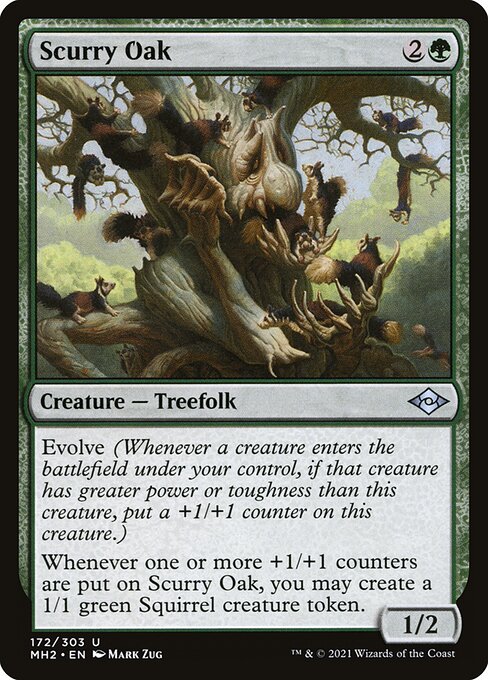 Scurry Oak
Evolve (Whenever a creature you control enters, if that creature has greater power or toughness than this creature, put a +1/+1 counter on this creature.)
Scurry Oak
Evolve (Whenever a creature you control enters, if that creature has greater power or toughness than this creature, put a +1/+1 counter on this creature.)
Whenever one or more +1/+1 counters are put on this creature, you may create a 1/1 green Squirrel creature token.
infinite (providing you don’t have infinite damage), did you really win the game? No agreement between you and your opponent was made, but if you were playing in paper, it would be impossible to win that way. This can, therefore, be seen as cheating. However, the client said it was ok, so is it really cheating? Its time we faced a fact that may be tough to swallow:
Each MTG Client is an Entirely Different Game
If you’re playing MTG Arena or MTGO, are you really playing MTG? Most rules are generally the same, but there is enough variation between paper and Arena play that the argument is viable. There’s nothing wrong with MTGA and paper MTG being different games. If one comes to that conclusion, this entire article loses its premise, but that’s a good thing. At that point, we accept that some strategies that work in paper don’t work online.
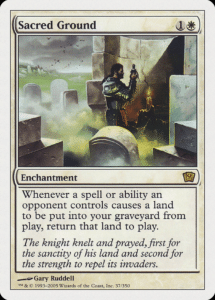
The flip side is that cards that don’t work as intended online can now become entirely different game pieces from their paper counterparts. Remember the ridiculous Sacred Ground glitch that allowed you to blow up all of your opponent’s lands (it got patched the day before this article was written)? If each iteration of MTG became its own game, there is also sound reason to state that those abusing the bug aren’t cheating at all. This is how online
Sacred Ground
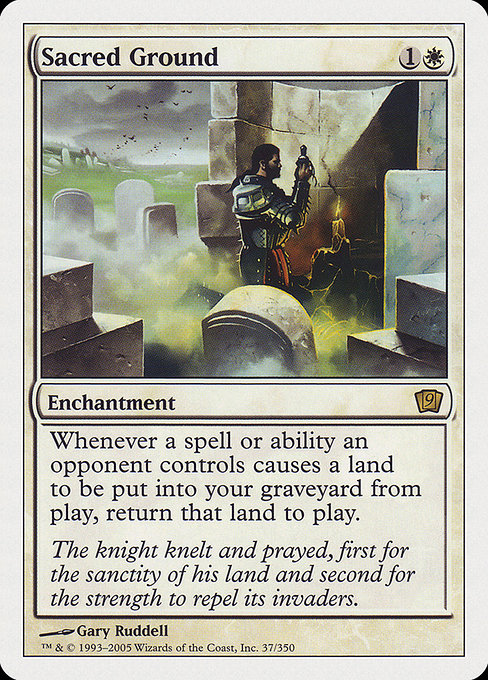 Sacred Ground
Whenever a spell or ability an opponent controls causes a land to be put into your graveyard from the battlefield, return that card to the battlefield.
works, and that’s how paper Sacred Ground works. These are two different games, after all. This line can be defined by an act of intent on the developer’s part, but would the developer then intend for specific paper strategies not to be viable online?
Sacred Ground
Whenever a spell or ability an opponent controls causes a land to be put into your graveyard from the battlefield, return that card to the battlefield.
works, and that’s how paper Sacred Ground works. These are two different games, after all. This line can be defined by an act of intent on the developer’s part, but would the developer then intend for specific paper strategies not to be viable online?
Read More: MTG Rotation and Renewal Guide 2022
Disqualifying Unfun Play
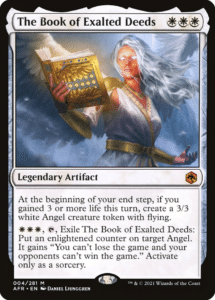
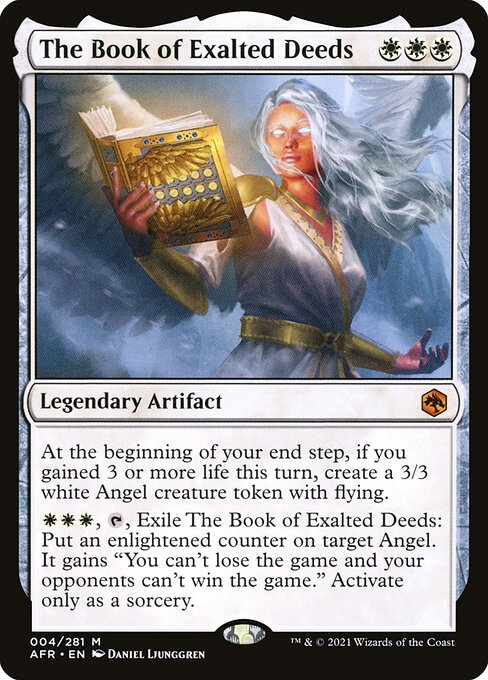
Magic Arena has made bans due to extremely unfun play patterns. The best example of this is
The Book of Exalted Deeds
 The Book of Exalted Deeds
At the beginning of your end step, if you gained 3 or more life this turn, create a 3/3 white Angel creature token with flying.
The Book of Exalted Deeds
At the beginning of your end step, if you gained 3 or more life this turn, create a 3/3 white Angel creature token with flying.
{W}{W}{W}, {T}, Exile The Book of Exalted Deeds: Put an enlightened counter on target Angel. It gains "You can't lose the game and your opponents can't win the game." Activate only as a sorcery.
and
Faceless Haven
 Faceless Haven
{T}: Add {C}.
Faceless Haven
{T}: Add {C}.
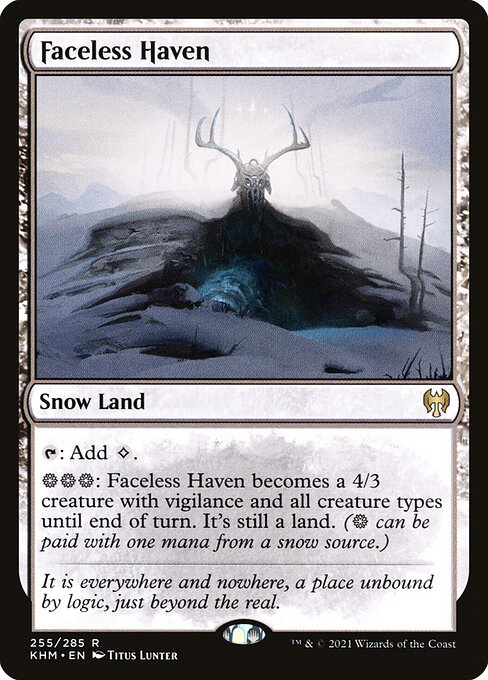
{S}{S}{S}: This land becomes a 4/3 creature with vigilance and all creature types until end of turn. It's still a land. ({S} can be paid with one mana from a snow source.)
interaction. This combo was banned in best of one Standard because of how unfun the result of the combo was and the inability to have counterplay available in one’s sideboard. If you activate The Book of Exalted Deeds’ ability and put a counter on your animated Faceless Haven (which counts as an Angel), you would be unable to lose the game. This wouldn’t be so bad if Faceless Haven remained a creature, but it will turn back into a land at the end of the turn. You can’t lose the game unless your opponent can blow up lands.
Should your opponent decide to play it out, they will have to deck out naturally before losing the game. We all know how salty MTG players can be, so this happened more than one may expect. If the infinite life combos like the Teferi one mentioned above were to work, we might see the return of the ‘death by deck out’ play pattern. As shown by past actions, this is not a play pattern that MTG Arena wants to support. Unfortunately, bans like this just grow the differentiation between paper and online Magic. It’s not difficult for a player who doesn’t keep up with every bit of detail to make a mistake and complain that the combo is banned during their best of three sets at an LGS. It wasn’t banned (
Faceless Haven
Faceless Haven
{T}: Add {C}.
{S}{S}{S}: This land becomes a 4/3 creature with vigilance and all creature types until end of turn. It's still a land. ({S} can be paid with one mana from a snow source.)
is now banned in Standard for entirely different reasons), but that individual is going to feel cheated because, in their mind, it was banned.
Read More: Best MTG Arena Decks July 2022
So, is Winning Against a Timed-Out Infinite Cheating?
The only conclusion I can come up with is that this is a difficult question to answer. The inherent issue has nothing to do with players but the client itself. If paper magic didn’t exist, there would be no premise here. That’s because, in every iteration of the game, the combo doesn’t work. That would be the end of the discussion. It’s only because we have two different versions of the game that offer vastly different outcomes that this becomes a talking point.
Personally, I hope that online clients become as close to paper play as possible. The upsides to online play is you don’t have to worry about blatant cheating or accidental rules violations since the client takes care of that for you. I am also a rather lazy person, so I would like to not leave my house to play MTG when possible.