
Pioneer, for much of its existence, has been a pretty controversial format. Many players deemed the format somewhat dull for a while given the domination of Rakdos Midrange and Mino-Green Devotion. While the recent bans as well as the release of The Lost Caverns of Ixalan helped shake up the format to a degree, Rakdos Midrange remains a dominant force within the metagame.
Players have also previously complained about the play/draw dynamic of Pioneer where, in many games, losing the die roll against great starts from the opponent can feel like a death sentence. The emergence of Boros Convoke only seemed to exacerbate these feelings.
One thing that has drawn players to the format, however, is the fact that it is essentially comprised of sets that were at one point Standard legal. This meant that Pioneer largely resembled a format that wasn’t overwhelmingly powerful, but still gave players a chance to immerse themselves in a non-rotating environment.
According to a recent response by MTG head designer Mark Rosewater on a Blogatog post, though, there’s a real possibility that a Pioneer Horizons set could be coming in the future. To be clear, Rosewater is only stating that something like Pioneer Horizons could be a real possibility.
To be clear, though, there is no confirmation that this will actually happen. This could also indicate a different Horizons set like Legacy Horizons is a possibility since the question was simply addressing whether a Horizons set for a non-Modern format was a realistic possibility. Either way, this got some players talking about the possibility of a Pioneer Horizons set.
This would have major ramifications for the format, for better or for worse. To understand exactly what this could mean, it’s important to take a closer look at exactly what various “Horizons” sets bring to the table and the impact they have on their associated formats.
Impact of Modern Horizons Sets
The most famous, or perhaps infamous, of the Horizons sets are definitely Modern Horizons I and Modern Horizons II. Supposedly, the main goal of these Modern Horizons sets in general was to print cards directly into the format without them entering Standard. Part of the issue with trying to design cards that are powerful enough to see play in formats like Modern that have comparatively vast card pools is that it could be way too strong in a Standard environment.
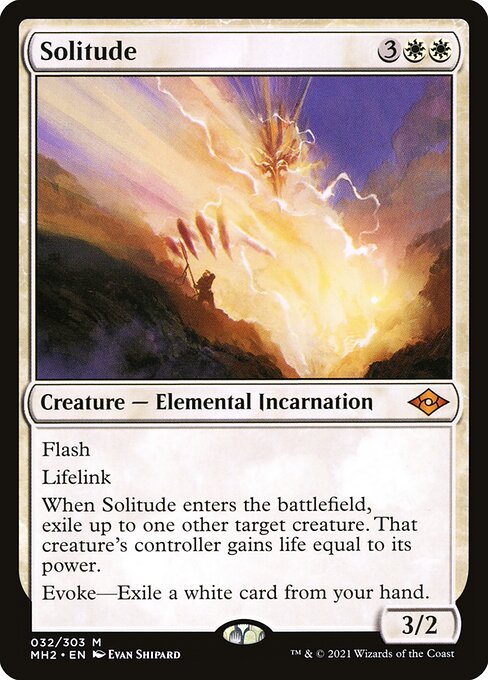
For instance, printing a card like
Solitude
 Solitude
Flash
Solitude
Flash
Lifelink
When this creature enters, exile up to one other target creature. That creature's controller gains life equal to its power.
Evoke—Exile a white card from your hand.
into Standard could be disastrous and would likely result in the card getting banned in short order. By focusing a set on printing cards directly into Modern while bypassing Standard and Pioneer, you have a bit more freedom to push specific cards and mechanics.
In theory, this sounds like a reasonable idea. In practice, though, these Modern Horizons sets resulted in a multitude of overpowered cards that eventually needed to get banned. While
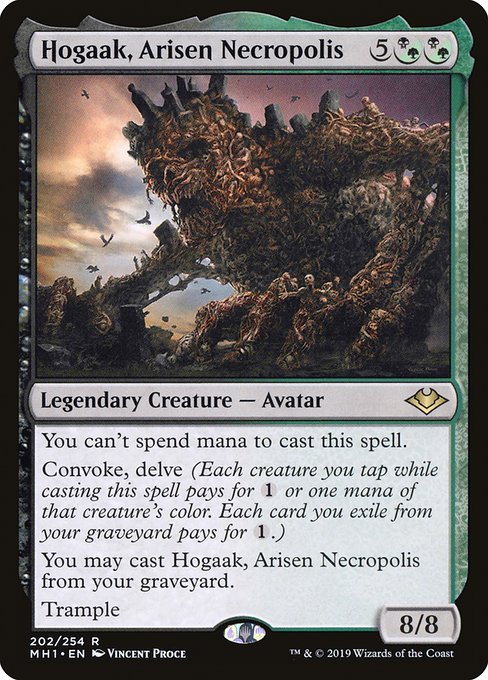
Hogaak, Arisen Necropolis
 Hogaak, Arisen Necropolis
You can't spend mana to cast this spell.
Hogaak, Arisen Necropolis
You can't spend mana to cast this spell.
Convoke, delve (Each creature you tap while casting this spell pays for {1} or one mana of that creature's color. Each card you exile from your graveyard pays for {1}.)
You may cast this card from your graveyard.
Trample
is perhaps the most egregious design from either Modern Horizons set,
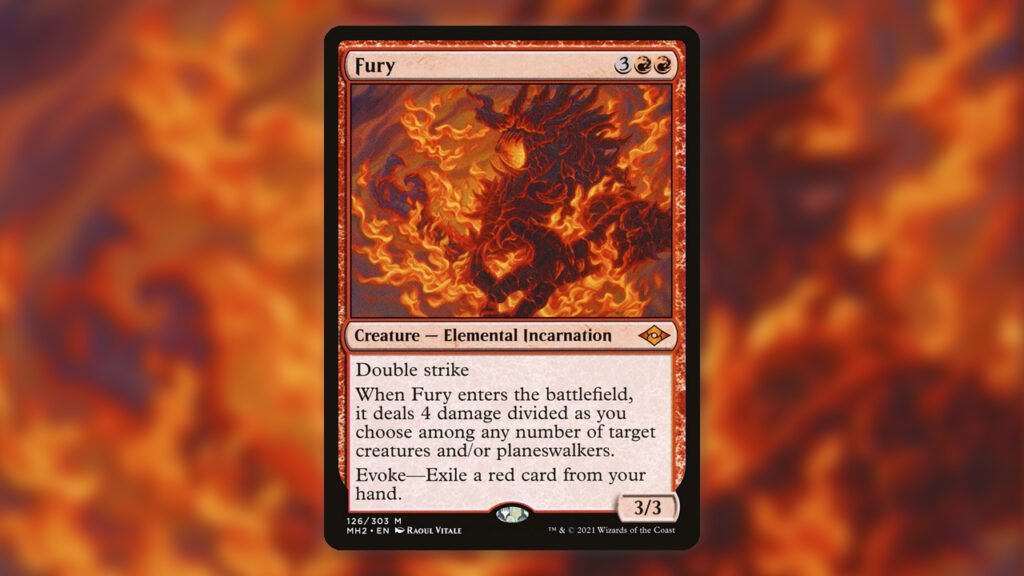
Fury
 Fury
Double strike
Fury
Double strike
When this creature enters, it deals 4 damage divided as you choose among any number of target creatures and/or planeswalkers.
Evoke—Exile a red card from your hand.
ended up eventually getting the axe as well.
Modern Horizons II, in particular, came with a lot of criticism. The reality is, for better or for worse, tons of these cards were so pushed that the metagame quickly morphed around the best of the best from the set. It has been over two years since the release of Modern Horizons II and over four years since the release of Modern Horizons I.
Yet, even today, almost every tier one deck is defined by cards from these sets. From
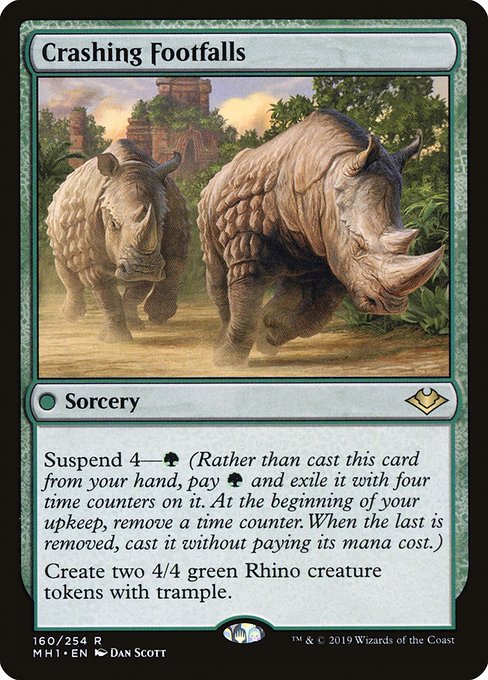
Crashing Footfalls
 Crashing Footfalls
Suspend 4—{G} (Rather than cast this card from your hand, pay {G} and exile it with four time counters on it. At the beginning of your upkeep, remove a time counter. When the last is removed, you may cast it without paying its mana cost.)
Crashing Footfalls
Suspend 4—{G} (Rather than cast this card from your hand, pay {G} and exile it with four time counters on it. At the beginning of your upkeep, remove a time counter. When the last is removed, you may cast it without paying its mana cost.)
Create two 4/4 green Rhino creature tokens with trample.
to
Murktide Regent
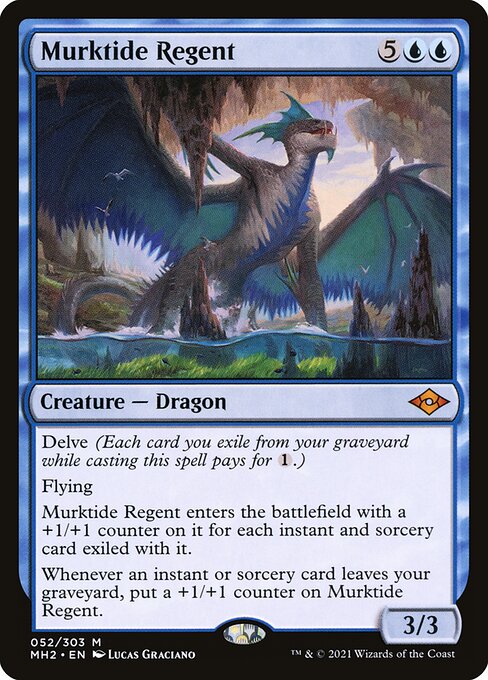 Murktide Regent
Delve (Each card you exile from your graveyard while casting this spell pays for {1}.)
Murktide Regent
Delve (Each card you exile from your graveyard while casting this spell pays for {1}.)
Flying
This creature enters with a +1/+1 counter on it for each instant and sorcery card exiled with it.
Whenever an instant or sorcery card leaves your graveyard, put a +1/+1 counter on this creature.
to
Urza’s Saga
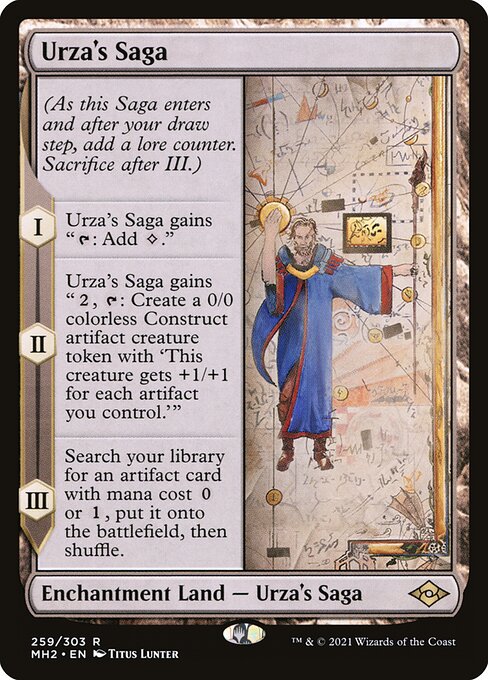 Urza’s Saga
(As this Saga enters and after your draw step, add a lore counter. Sacrifice after III.)
Urza’s Saga
(As this Saga enters and after your draw step, add a lore counter. Sacrifice after III.)
I — This Saga gains "{T}: Add {C}."
II — This Saga gains "{2}, {T}: Create a 0/0 colorless Construct artifact creature token with 'This token gets +1/+1 for each artifact you control.'"
III — Search your library for an artifact card with mana cost {0} or {1}, put it onto the battlefield, then shuffle.
and beyond, these cards revolutionized Modern forever. Many previous tier one decks, such as Humans or Infect, essentially became obsolete.
Read More: New MTG Mentor Deck Surprisingly Dominates Event!
Potential Upsides of Horizons Sets
Where sets like Modern Horizons do deliver, though, is in shaking up formats to help keep them less stale over time. Every time a Horizons set comes out, the associated format is bound to change. Even post-Hogaak ban, Modern was in a very different place with the release of Modern Horizons I. The release of Modern Horizons II only shook up the format once more. Later in 2024, Modern Horizons III is set to release, likely to have a similar impact.
This is where having a Pioneer Horizons set could come in handy. While the banning of
Karn, the Great Creator
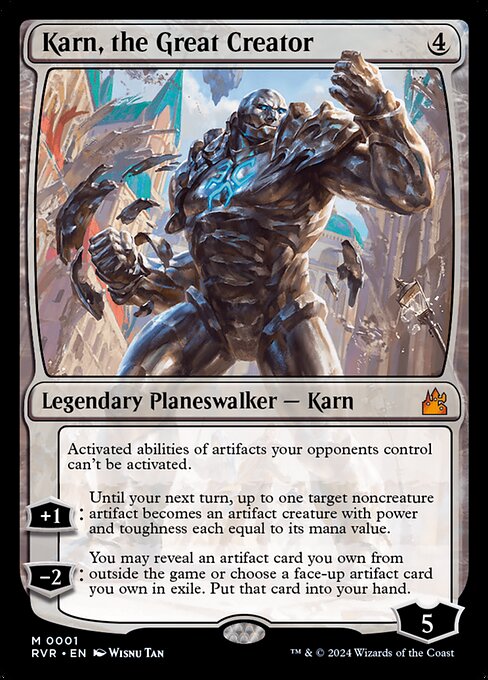 Karn, the Great Creator
Activated abilities of artifacts your opponents control can't be activated.
Karn, the Great Creator
Activated abilities of artifacts your opponents control can't be activated.
+1: Until your next turn, up to one target noncreature artifact becomes an artifact creature with power and toughness each equal to its mana value.
−2: You may reveal an artifact card you own from outside the game or choose a face-up artifact card you own in exile. Put that card into your hand.
and
Geological Appraiser
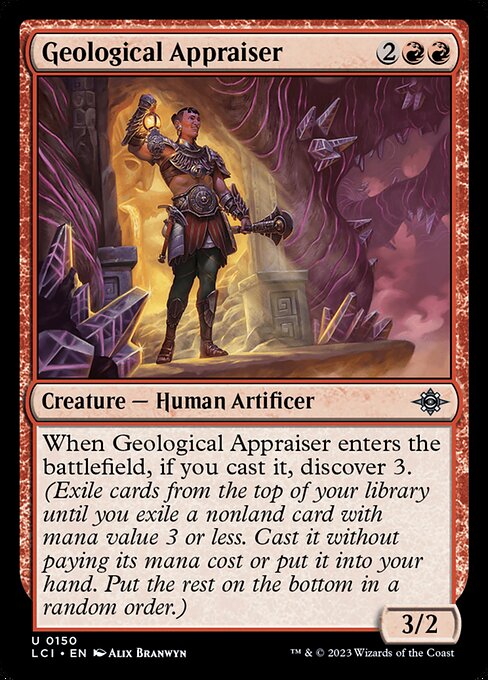 Geological Appraiser
When this creature enters, if you cast it, discover 3. (Exile cards from the top of your library until you exile a nonland card with mana value 3 or less. Cast it without paying its mana cost or put it into your hand. Put the rest on the bottom in a random order.)
helped remove some “unfun” play patterns from the format, many players would argue
Lotus Field
Geological Appraiser
When this creature enters, if you cast it, discover 3. (Exile cards from the top of your library until you exile a nonland card with mana value 3 or less. Cast it without paying its mana cost or put it into your hand. Put the rest on the bottom in a random order.)
helped remove some “unfun” play patterns from the format, many players would argue
Lotus Field
 Lotus Field
Hexproof
Lotus Field
Hexproof
This land enters tapped.
When this land enters, sacrifice two lands.
{T}: Add three mana of any one color.
combo and
Fable of the Mirror-Breaker
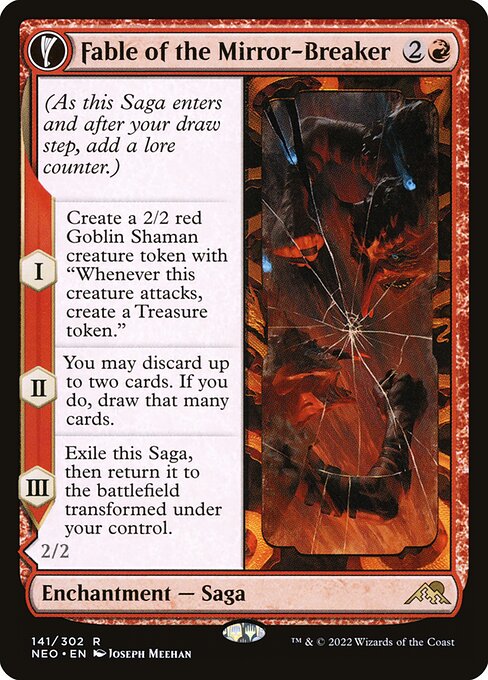 Fable of the Mirror-Breaker
(As this Saga enters and after your draw step, add a lore counter.)
Fable of the Mirror-Breaker
(As this Saga enters and after your draw step, add a lore counter.)
I — Create a 2/2 red Goblin Shaman creature token with "Whenever this token attacks, create a Treasure token."
II — You may discard up to two cards. If you do, draw that many cards.
III — Exile this Saga, then return it to the battlefield transformed under your control.
out of Rakdos midrange don’t lend themselves to the most fun situations.
As Brad Nelson points out, the goal is often to keep formats both fun and replayable, which isn’t always easy. From the days of
Inverter of Truth
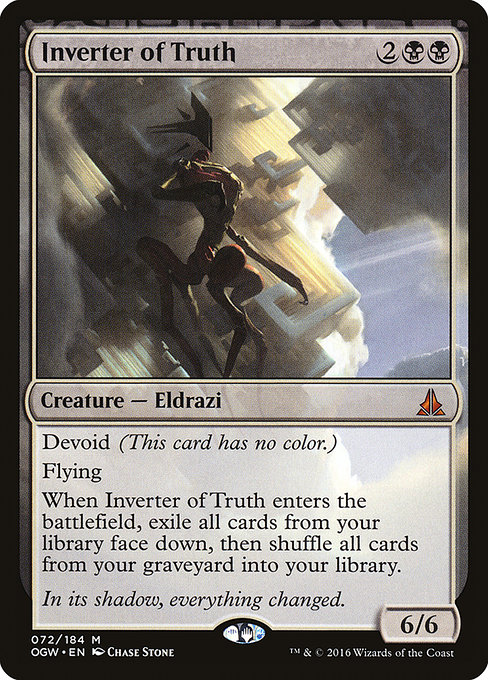 Inverter of Truth
Devoid (This card has no color.)
Inverter of Truth
Devoid (This card has no color.)
Flying
When this creature enters, exile all cards from your library face down, then shuffle all cards from your graveyard into your library.
onward, Pioneer has been quite combo heavy. While combo can be an important pillar of a format, too much combo can lead to plenty of non-interactive games where being on the play feels even more important. Horizons sets can keep a format fresh, which might help lure players into the format in question.
Read More: Four New Two-Card MTG Death Combos With Cards from 2023!
Issues of Price
One of the glaring issues with Horizons sets, though, which was omnipresent with Modern Horizons II, is the price of high rarity staples. When
Ragavan, Nimble Pilferer
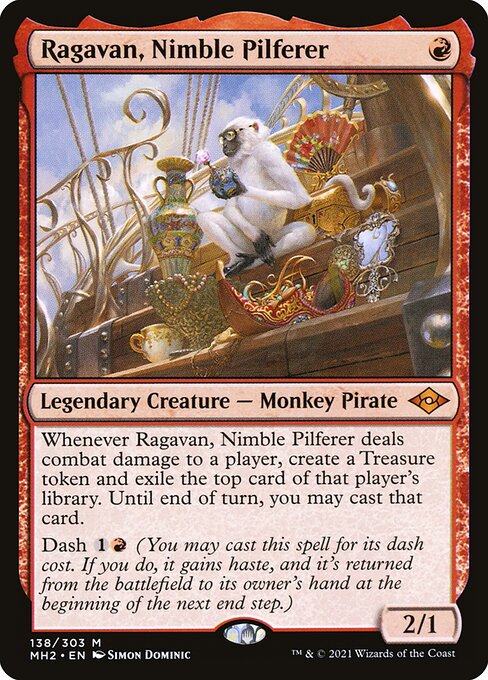 Ragavan, Nimble Pilferer
Whenever Ragavan deals combat damage to a player, create a Treasure token and exile the top card of that player's library. Until end of turn, you may cast that card.
Ragavan, Nimble Pilferer
Whenever Ragavan deals combat damage to a player, create a Treasure token and exile the top card of that player's library. Until end of turn, you may cast that card.
Dash {1}{R} (You may cast this spell for its dash cost. If you do, it gains haste, and it's returned from the battlefield to its owner's hand at the beginning of the next end step.)
first came out, the card was worth a huge sum of money. Simultaneously, tons of decks used a playset, requiring players to shell out roughly $400 to optimize certain strategies. Up until Ragavan was featured as a Multiverse Legend on the March of the Machine bonus sheet back in April 2023, the card maintained a price tag well over $60 each according to TCGplayer market price history.
Even beyond the price of picking up singles, the meta-warping nature of Horizons sets forced players to purchase new cards to adapt. There was a long period where decks like Jund and mono-green Tron remained relatively unchanged. This meant that, despite a large initial investment, players could continue bringing the same deck to Friday Night Magic week in and week out. With the constant influx of cards, this seems impossible moving forward.
Read More: Nostalgic MTG Arena Inclusion Was an Unexpected Flop!
Downsides of Pioneer Horizons Sets and Player Reaction
“since when has this changed???? what happened to the “pioneer is always going to be standard legal sets” statements we always hear???”
yaoiketamin
One of the biggest gripes players seem to have over the idea of a Pioneer Horizons set is that it would ruin the maintenance of a non-rotating format made up of only Standard sets. Obviously, the Modern Horizons sets themselves were relatively controversial. For players that enjoyed the metagame shifts provided and the overall increase in power level of the format, Modern remained a solid format of choice. For players that weren’t a big fan of these Horizons sets in general, Pioneer was a perfect place to turn to.
By introducing Pioneer Horizons, Wizards of the Coast threatens to turn Pioneer into Modern-lite. Many players believe a huge appeal of Pioneer is the low-powered nature of the format overall, which would likely be completely tarnished by a Pioneer Horizons set.
“I hope not. we have modern for that, let pioneer be pioneer”
theothin
Generally speaking, a lot of players seem to be heavily against the addition of a Pioneer Horizons set. It’s nice to maintain Pioneer’s identity, which a Pioneer Horizons set threatens to dismantle. This would perhaps be more reasonable years down the line as the Pioneer card pool continues to grow. Either way, it’s worth monitoring if any additional hints get spoiled in the future, as a Pioneer Horizons set could have massive consequences.
Read More: MTG Arena Players Angered by Absurdly Expensive Standard Decks!