
When it comes to Constructed MTG formats as a whole, one of the common complaints that many players have is that, in some cases, matches become very routine. Not only is it likely to play against a lot of the same archetypes repeatedly, but many individual strategies feature minimal innovation within them. For instance, if you play against a well-tuned deck like Izzet Phoenix in Pioneer, chances are you won’t see any interesting tech that would make the deck stand out.
Furthermore, if an archetype is consistently performing well, players are often hesitant to change much of anything in their decklist. While the term “netdecking” is a bit overused and players are unnecessarily ridiculed for taking advantage of it, it can certainly feel a bit boring when all decklists look the same. Sometimes, staying complacent in a format can do you a disservice, especially as the metagame fluctuates. It may take thinking outside the box to have the most success, even within a well-established strategy.
With this in mind, we thought it would be worthwhile to discuss recent intriguing deckbuilding decisions that have translated to high-level performances. These seemingly minor changes can have a big impact on how games play out between top-tier decks. Let’s start by looking at some intriguing Rakdos Vampires tech in Pioneer.
Two-Drop Vampire Selection
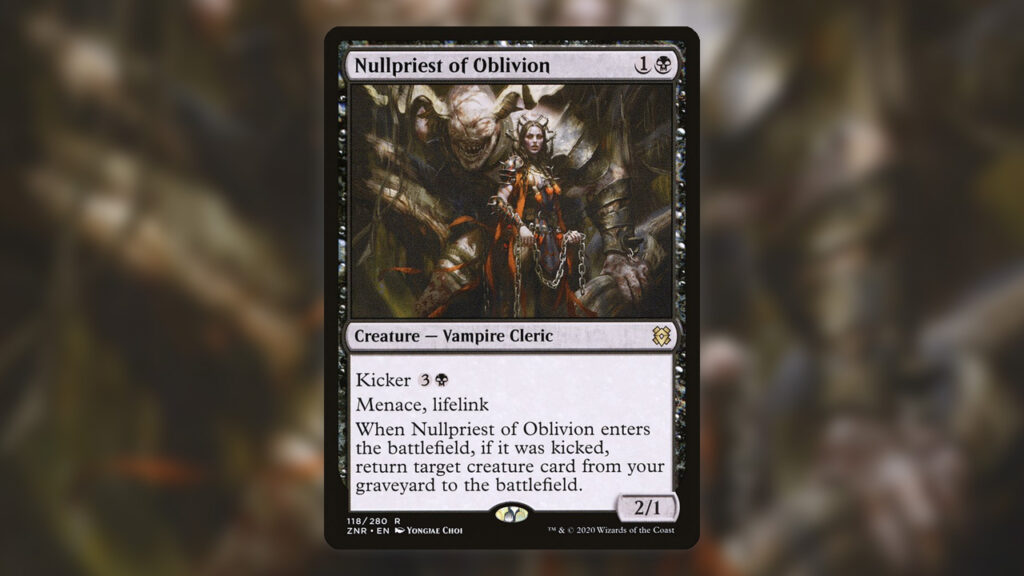
In a recent Magic Online Pioneer Challenge, one player made top eight with some intriguing card choices. First and foremost, what immediately caught my eye was the inclusion of three copies of Nullpriest of Oblivion. Up to this point, the general consensus amongst Vampires players has been to play
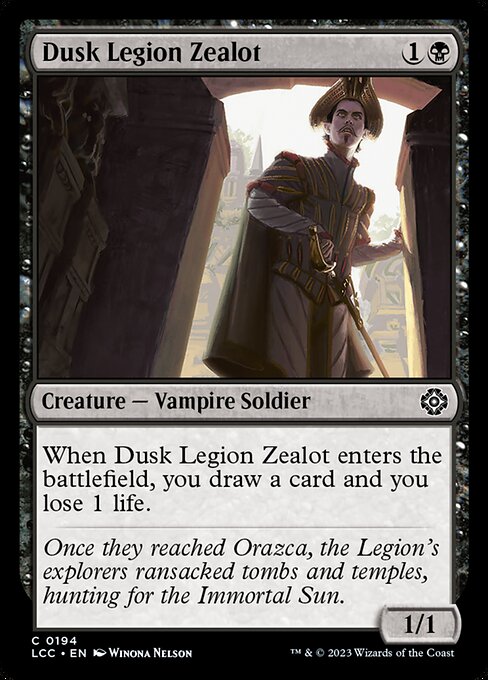
Dusk Legion Zealot
 Dusk Legion Zealot
When this creature enters, you draw a card and you lose 1 life.
alongside
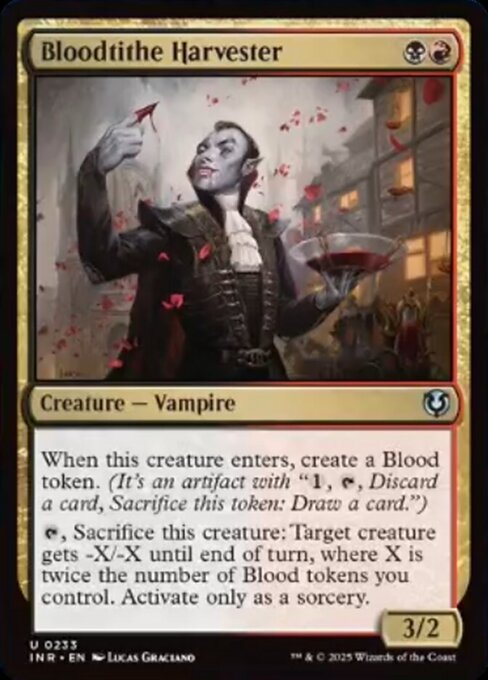
Bloodtithe Harvester
Dusk Legion Zealot
When this creature enters, you draw a card and you lose 1 life.
alongside
Bloodtithe Harvester
 Bloodtithe Harvester
When this creature enters, create a Blood token. (It's an artifact with "{1}, {T}, Discard a card, Sacrifice this token: Draw a card.")
Bloodtithe Harvester
When this creature enters, create a Blood token. (It's an artifact with "{1}, {T}, Discard a card, Sacrifice this token: Draw a card.")
{T}, Sacrifice this creature: Target creature gets -X/-X until end of turn, where X is twice the number of Blood tokens you control. Activate only as a sorcery.
to help increase the deck’s overall Vampire count.
All things considered, Dusk Legion Zealot has never been a very impressive card. The fact that it replaces itself by drawing you a card when it enters has always made the card serviceable as a second option to Bloodtithe. Bloodtithe is clearly leagues better than Zealot, but in order to maximize the power of
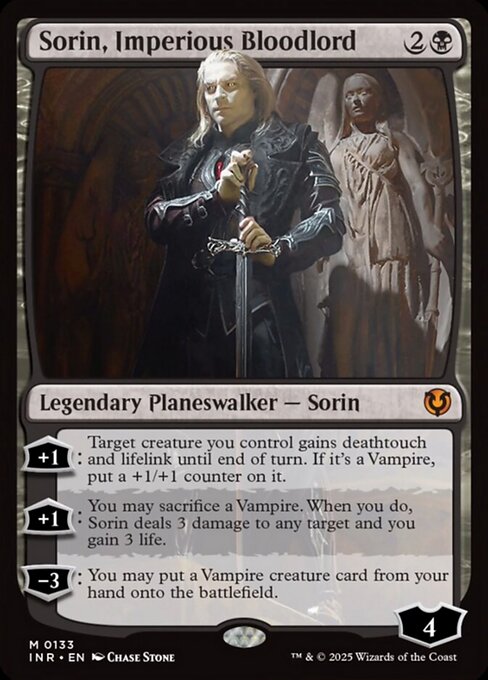
Sorin, Imperious Bloodlord
 Sorin, Imperious Bloodlord
+1: Target creature you control gains deathtouch and lifelink until end of turn. If it's a Vampire, put a +1/+1 counter on it.
Sorin, Imperious Bloodlord
+1: Target creature you control gains deathtouch and lifelink until end of turn. If it's a Vampire, put a +1/+1 counter on it.
+1: You may sacrifice a Vampire. When you do, Sorin deals 3 damage to any target and you gain 3 life.
−3: You may put a Vampire creature card from your hand onto the battlefield.
, the deck needs a reasonable density of Vampires. After all, not every draw you have with Sorin features
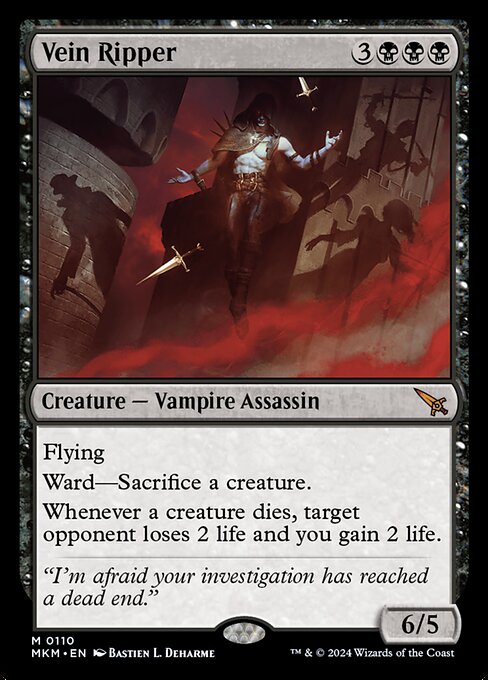
Vein Ripper
 Vein Ripper
Flying
Vein Ripper
Flying
Ward—Sacrifice a creature.
Whenever a creature dies, target opponent loses 2 life and you gain 2 life.
to go alongside it.
The problem is that, in games where you don’t draw Sorin, Dusk Legion Zealot is pretty mediocre. A 1/1 just doesn’t impact the board enough for the opponent to care about its presence in most games. Nullpriest changes this dynamic. A 2/1 with Menace and Lifelink is just scary enough that the opponent has to respect it.
Additionally, in the late game, getting to return
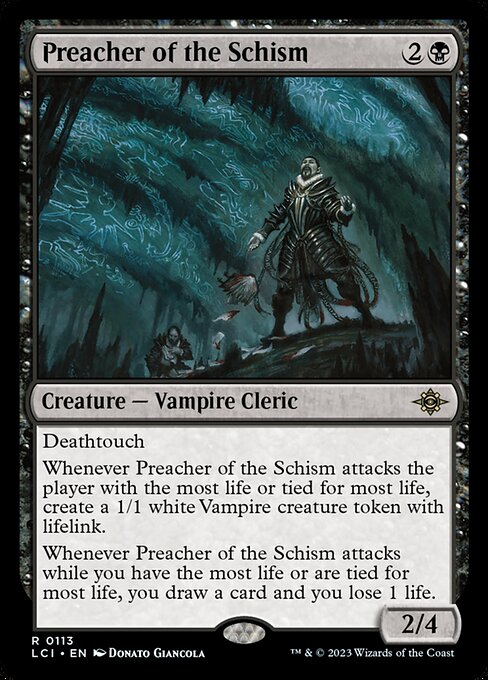
Preacher of the Schism
 Preacher of the Schism
Deathtouch
Preacher of the Schism
Deathtouch
Whenever this creature attacks the player with the most life or tied for most life, create a 1/1 white Vampire creature token with lifelink.
Whenever this creature attacks while you have the most life or are tied for most life, you draw a card and you lose 1 life.
or Vein Ripper to play is a great option to have. With
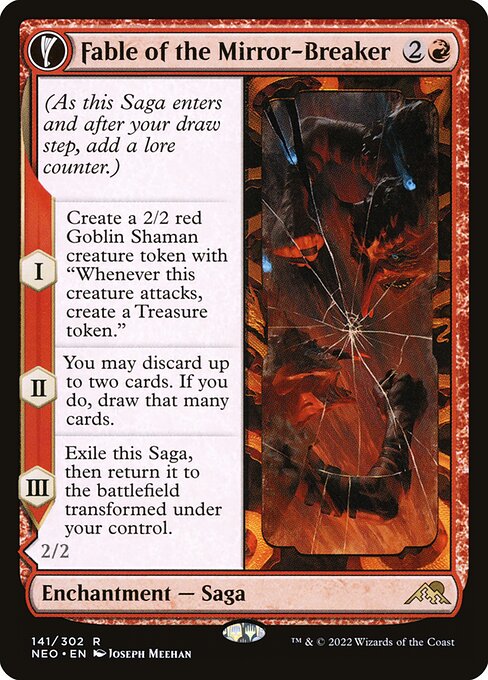
Fable of the Mirror-Breaker
 Fable of the Mirror-Breaker
(As this Saga enters and after your draw step, add a lore counter.)
Fable of the Mirror-Breaker
(As this Saga enters and after your draw step, add a lore counter.)
I — Create a 2/2 red Goblin Shaman creature token with "Whenever this token attacks, create a Treasure token."
II — You may discard up to two cards. If you do, draw that many cards.
III — Exile this Saga, then return it to the battlefield transformed under your control.
in the mix, getting to six mana is certainly not out of the question. If anything, Nullpriest deserves consideration simply based on the weaknesses of the other two-drop Vampire options.
Read More: 5 Surprise Hits From Outlaws of Thunder Junction Limited
Answers to Vein Ripper
The sheer dominance of Rakdos Vampires overall has also forced players to adapt. Cards like
Sheoldred’s Edict
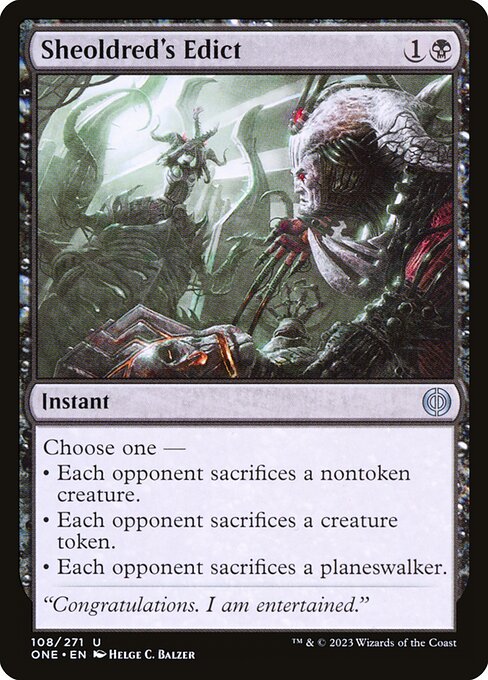 Sheoldred’s Edict
Choose one —
Sheoldred’s Edict
Choose one —
• Each opponent sacrifices a nontoken creature of their choice.
• Each opponent sacrifices a creature token of their choice.
• Each opponent sacrifices a planeswalker of their choice.
that can potentially answer a turn-three Vein Ripper have risen in popularity as a result. Even Edict effects have their limitations, though. If your Rakdos Vampires opponent even has a Dusk Legion Zealot in play alongside Vein Ripper, your Edict won’t solve the problem without a
Fatal Push
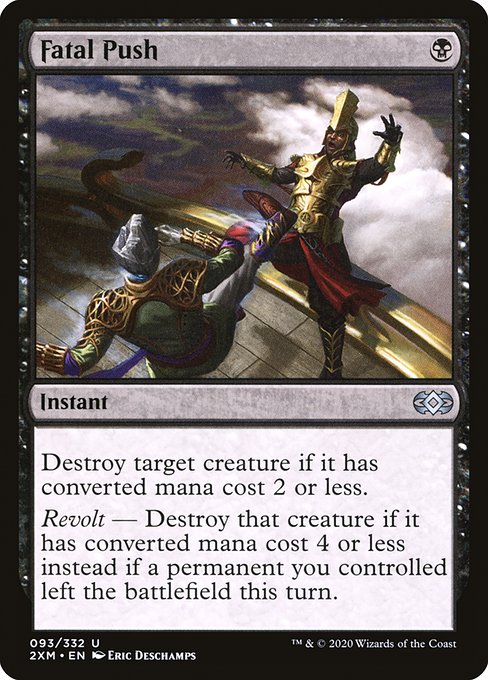 Fatal Push
Destroy target creature if it has mana value 2 or less.
Fatal Push
Destroy target creature if it has mana value 2 or less.
Revolt — Destroy that creature if it has mana value 4 or less instead if a permanent left the battlefield under your control this turn.
to go with it.
As such, many players have started adding
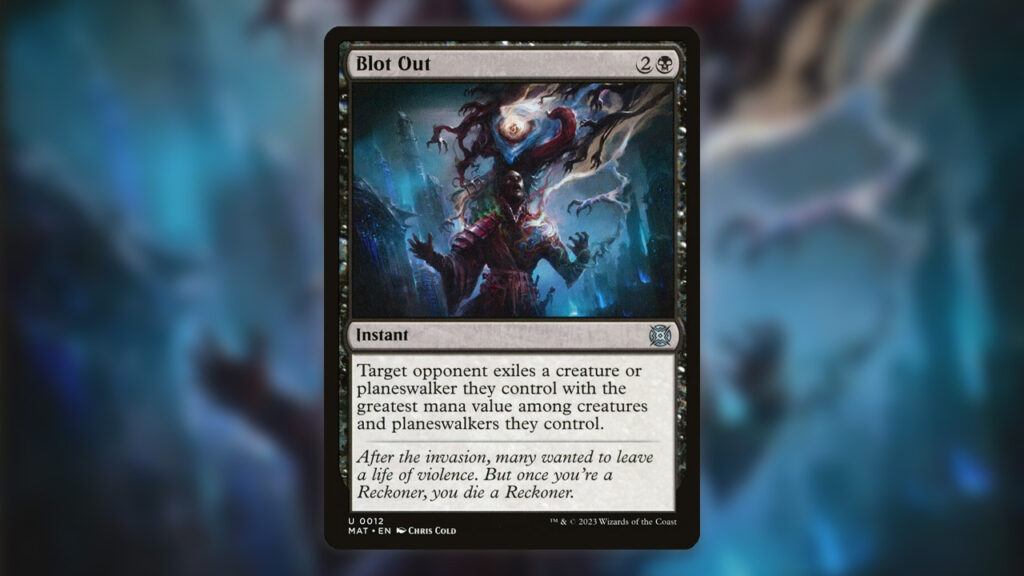
Blot Out
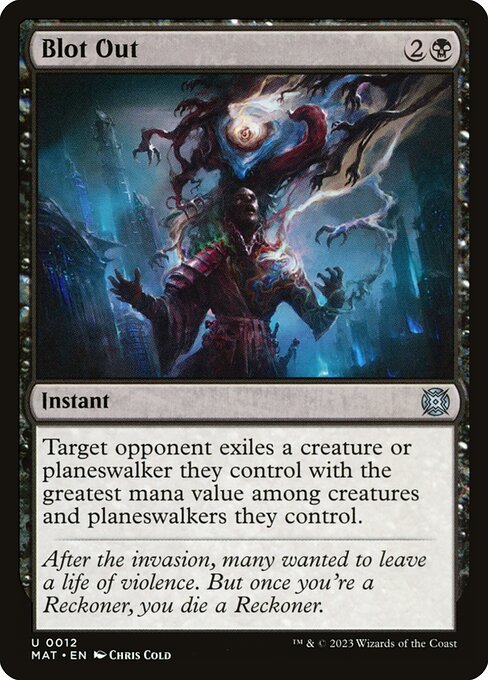 Blot Out
Target opponent exiles a creature or planeswalker they control with the greatest mana value among creatures and planeswalkers they control.
to their sideboards. Not only can Blot Out always tag Vein Ripper when needed, it even exiles the Creature so you won’t lose extra life by removing it. Blot Out can also answer Sorin when Vein Ripper isn’t present, which is very useful.
Blot Out
Target opponent exiles a creature or planeswalker they control with the greatest mana value among creatures and planeswalkers they control.
to their sideboards. Not only can Blot Out always tag Vein Ripper when needed, it even exiles the Creature so you won’t lose extra life by removing it. Blot Out can also answer Sorin when Vein Ripper isn’t present, which is very useful.
In a similar sense, some Izzet Phoenix decks have started incorporating
Tears of Valakut
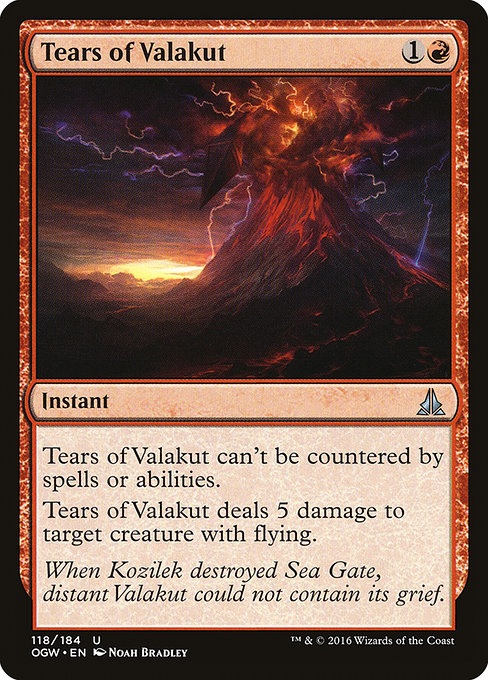 Tears of Valakut
This spell can't be countered.
Tears of Valakut
This spell can't be countered.
Tears of Valakut deals 5 damage to target creature with flying.
into the sideboard as a way to get around Vein Ripper’s Ward ability. Tears of Valakut is obviously narrower, but can be vital against the best Vampires starts. Plus, Izzet Phoenix decks always have the out of discarding Tears of Valakut to
Ledger Shredder
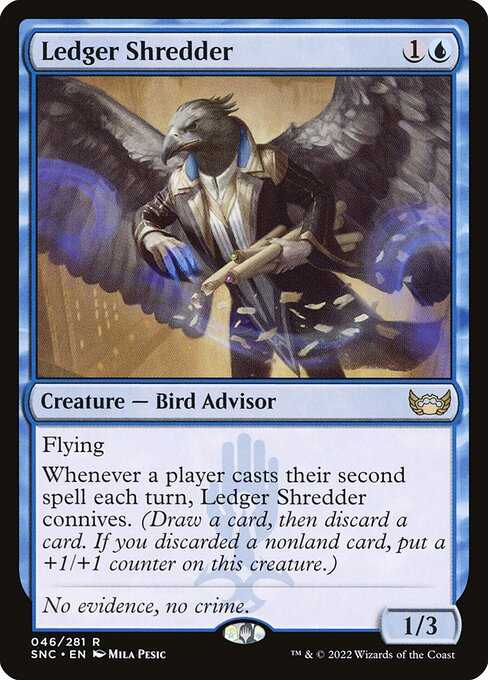 Ledger Shredder
Flying
Ledger Shredder
Flying
Whenever a player casts their second spell each turn, this creature connives. (Draw a card, then discard a card. If you discarded a nonland card, put a +1/+1 counter on this creature.)
or
Lightning Axe
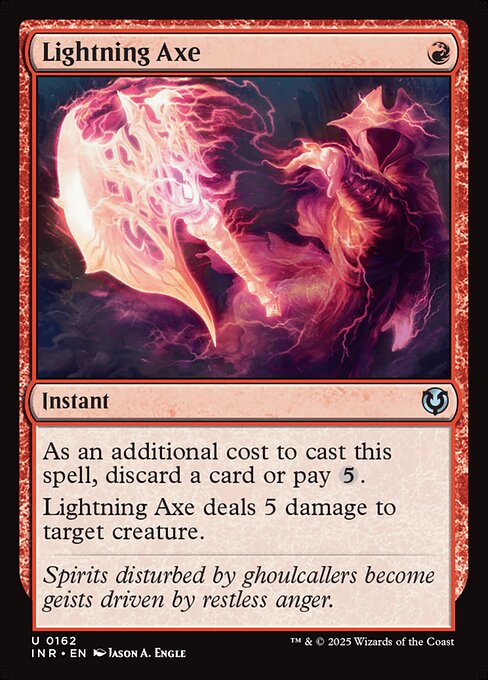 Lightning Axe
As an additional cost to cast this spell, discard a card or pay {5}.
Lightning Axe
As an additional cost to cast this spell, discard a card or pay {5}.
Lightning Axe deals 5 damage to target creature.
when applicable.
Read More: MTG Players Push Back Against Problematic Bonus Sheet
A Replacement for Wrenn and Six?
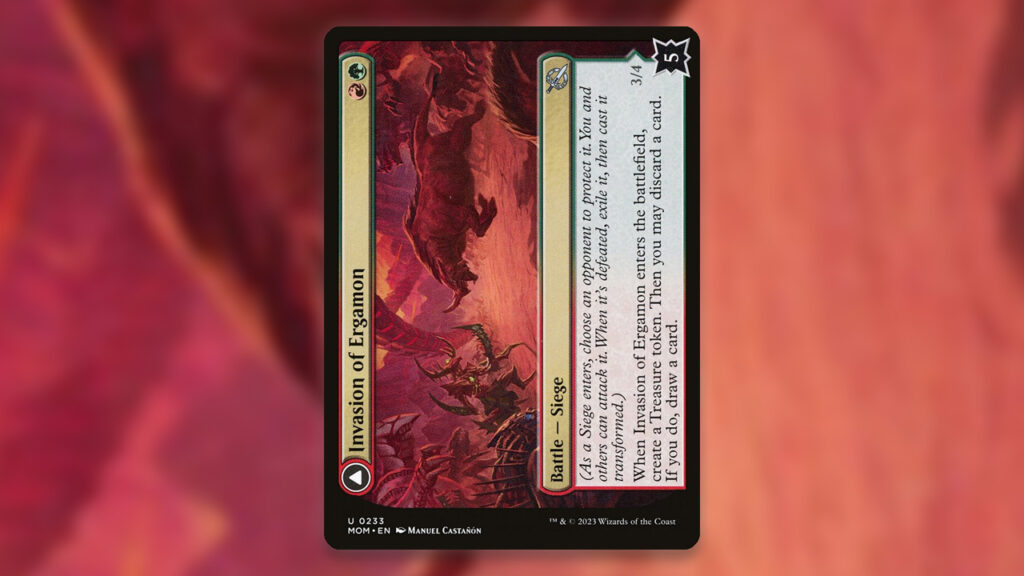
This change I am rather skeptical of given how powerful
Wrenn and Six
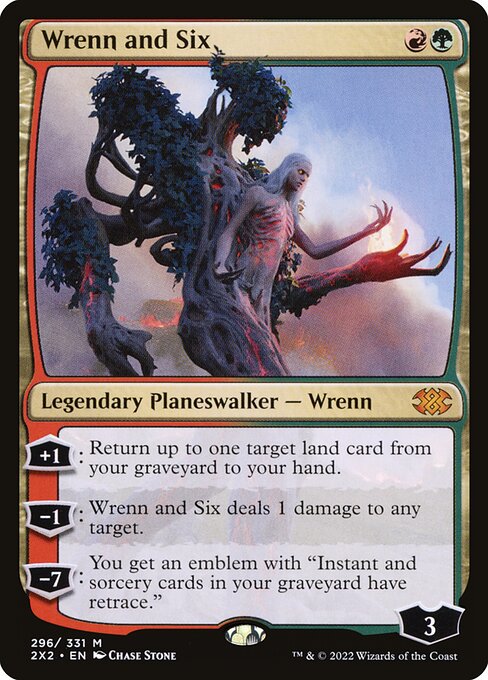 Wrenn and Six
+1: Return up to one target land card from your graveyard to your hand.
Wrenn and Six
+1: Return up to one target land card from your graveyard to your hand.
−1: Wrenn and Six deals 1 damage to any target.
−7: You get an emblem with "Instant and sorcery cards in your graveyard have retrace." (You may cast instant and sorcery cards from your graveyard by discarding a land card in addition to paying their other costs.)
is in Modern
Indomitable Creativity
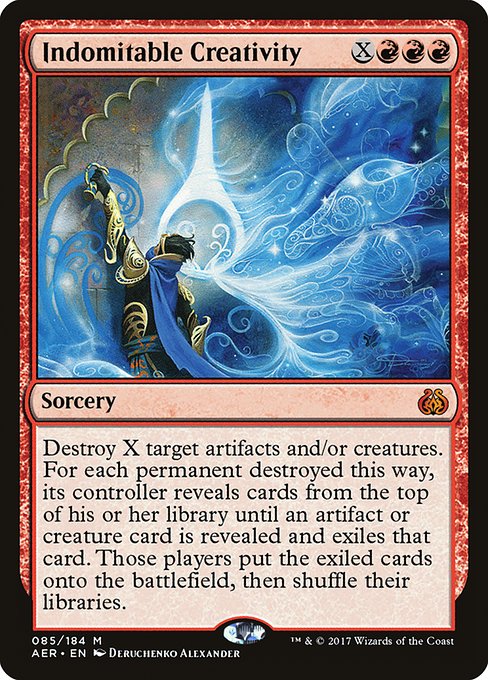 Indomitable Creativity
Destroy X target artifacts and/or creatures. For each permanent destroyed this way, its controller reveals cards from the top of their library until an artifact or creature card is revealed and exiles that card. Those players put the exiled cards onto the battlefield, then shuffle.
shells, but
Invasion of Ergamon
Indomitable Creativity
Destroy X target artifacts and/or creatures. For each permanent destroyed this way, its controller reveals cards from the top of their library until an artifact or creature card is revealed and exiles that card. Those players put the exiled cards onto the battlefield, then shuffle.
shells, but
Invasion of Ergamon
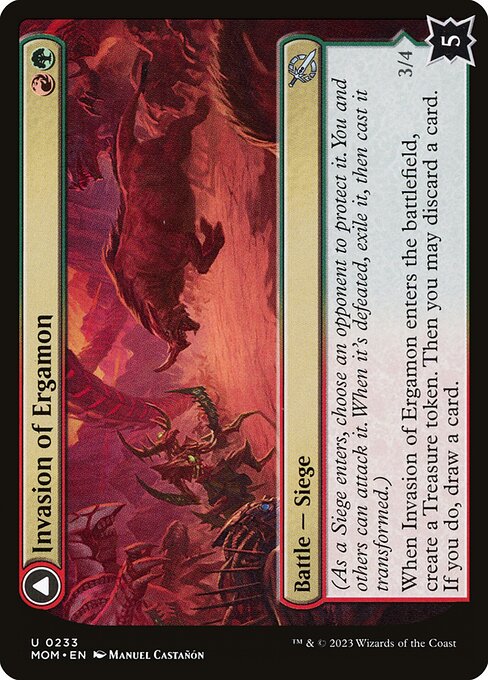 Invasion of Ergamon
(As a Siege enters, choose an opponent to protect it. You and others can attack it. When it's defeated, exile it, then cast it transformed.)
Invasion of Ergamon
(As a Siege enters, choose an opponent to protect it. You and others can attack it. When it's defeated, exile it, then cast it transformed.)
When this Siege enters, create a Treasure token. Then you may discard a card. If you do, draw a card.
is starting to garner some hype in the deck as a replacement. Despite the mana costs of both cards being identical, they function quite differently.
Wrenn and Six is used primarily as a way to ensure your ability to keep hitting Land drops. First of all, this deck usually needs to hit its initial four Land drops at minimum. This both enables
Dwarven Mine
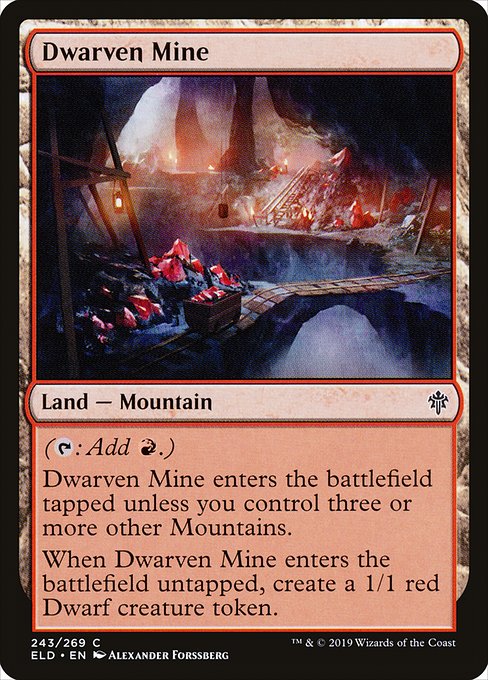 Dwarven Mine
({T}: Add {R}.)
Dwarven Mine
({T}: Add {R}.)
This land enters tapped unless you control three or more other Mountains.
When this land enters untapped, create a 1/1 red Dwarf creature token.
to enter the battlefield untapped, make a token, and ensures you have the mana to cast Indomitable Creativity in the first place.
Wrenn and Six keeps the Lands flowing, and excess Fetchlands can be used to grab additional copies of
Dwarven Mine
Dwarven Mine
({T}: Add {R}.)
This land enters tapped unless you control three or more other Mountains.
When this land enters untapped, create a 1/1 red Dwarf creature token.
in grindy games. Not to mention, chapter two of
Fable of the Mirror-Breaker
Fable of the Mirror-Breaker
(As this Saga enters and after your draw step, add a lore counter.)
I — Create a 2/2 red Goblin Shaman creature token with "Whenever this token attacks, create a Treasure token."
II — You may discard up to two cards. If you do, draw that many cards.
III — Exile this Saga, then return it to the battlefield transformed under your control.
can allow you to convert unwanted Lands into new cards.
As such, Wrenn and Six helps enable this deck to play a longer game. On the flip side, Invasion of Ergamon can help speed this deck up. The Treasure token Invasion creates provides a great target for Indomitable Creativity that, unlike Dwarven Mine tokens, isn’t vulnerable to typical removal spells like
Lightning Bolt
 Lightning Bolt
 deals 3 damage to any target.
.
Lightning Bolt
Lightning Bolt deals 3 damage to any target.
.
Additionally, Invasion allows you to discard copies of
Archon of Cruelty
 Archon of Cruelty
Flying
Archon of Cruelty
Flying
Whenever this creature enters or attacks, target opponent sacrifices a creature or planeswalker of their choice, discards a card, and loses 3 life. You draw a card and gain 3 life.
from your hand to bring back with
Persist
 Persist
Return target nonlegendary creature card from your graveyard to the battlefield with a -1/-1 counter on it.
. The fact that Invasion fills both roles makes it the ultimate combo enabler for two mana. Wrenn and Six is a hard card to beat out for sure, but perhaps Invasion has been unnecessarily overlooked.
Persist
Return target nonlegendary creature card from your graveyard to the battlefield with a -1/-1 counter on it.
. The fact that Invasion fills both roles makes it the ultimate combo enabler for two mana. Wrenn and Six is a hard card to beat out for sure, but perhaps Invasion has been unnecessarily overlooked.
Read More: Best MTG Outlaws of All Time
Neat Sideboard Tech
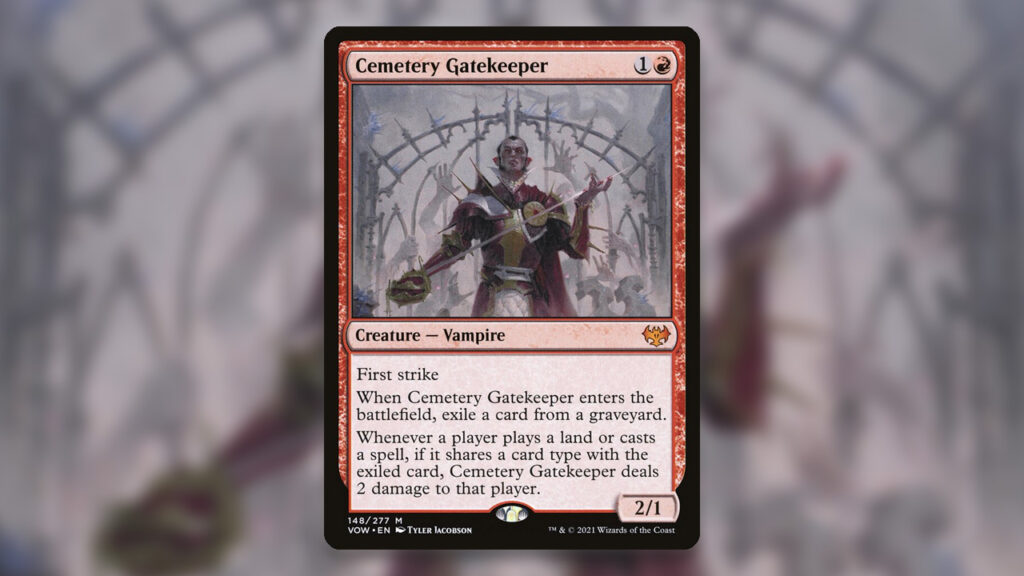
Our last card worth discussing is a card that, despite being hyped up during spoiler season, largely fell short in the competitive scene. As it turns out,
Cemetery Gatekeeper
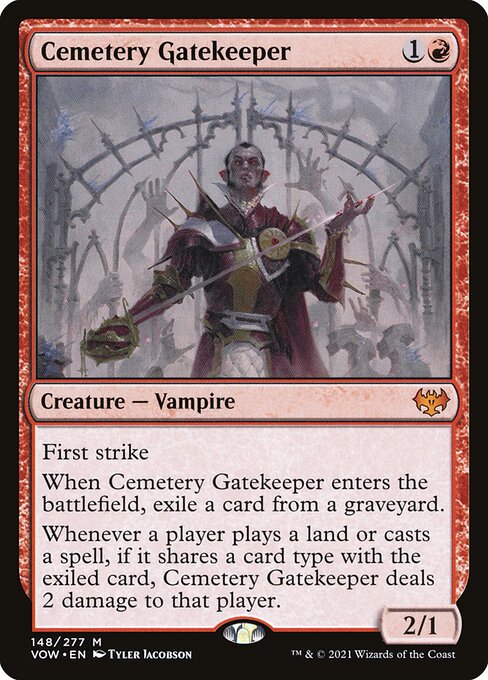 Cemetery Gatekeeper
First strike
Cemetery Gatekeeper
First strike
When this creature enters, exile a card from a graveyard.
Whenever a player plays a land or casts a spell, if it shares a card type with the exiled card, this creature deals 2 damage to that player.
wasn’t quite good enough for red aggro decks in most formats. As it turns out, however, there may be a role for the card in Standard after all.
A recent Magic Online Standard Challenge winning decklist showcased three copies of Cemetery Gatekeeper in the sideboard, and the inclusion actually makes a lot of sense. Typically, Cemetery Gatekeeper is a bit tough to enable, since you need a card in your opponent’s graveyard to exile in order to maximize its abilities. That being said, the Temur ramp decks in Standard make use of Lands like
Brokers Hideout
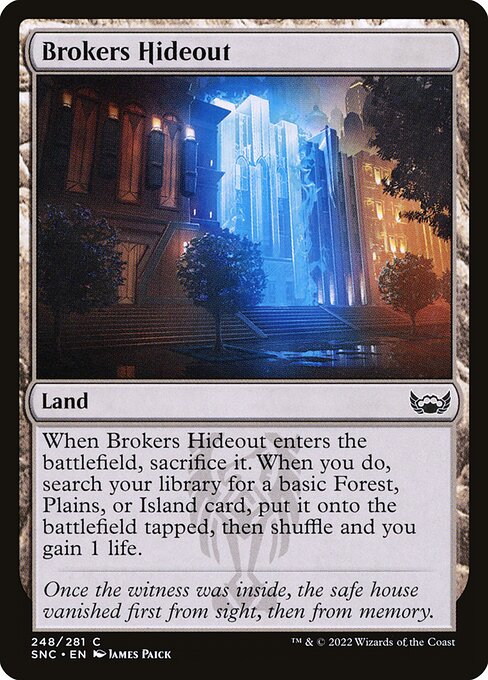 Brokers Hideout
When this land enters, sacrifice it. When you do, search your library for a basic Forest, Plains, or Island card, put it onto the battlefield tapped, then shuffle and you gain 1 life.
that go to the graveyard on their own.
Brokers Hideout
When this land enters, sacrifice it. When you do, search your library for a basic Forest, Plains, or Island card, put it onto the battlefield tapped, then shuffle and you gain 1 life.
that go to the graveyard on their own.
With this in mind, if you can slam Gatekeeper on turn two and nab one of these Lands, your opponent will quickly feel pressured to kill it or risk taking a ton of damage over the course of the game. Seeing this card pop up again is cool, since it helps show that even cards that were written off can still have a home in specific contexts.
Magic is certainly a complicated game. It can be difficult to know when to stray from the norm, but if you can find that hidden gem, the reward may be bigger than you expect.
Read More: Strange Mono-White Tron Deck Surprisingly Dazzles in Major Event!