
In the world of MTG, every Constructed format has its own unique feel. As a rotating format that utilizes a minimal number of sets, Standard is constantly in flux with regards to the overall metagame. Pioneer provides players with a chance to play a non-rotating format, but one that only features sets that were previously legal in Standard. Modern opens the door for extremely powerful sets like Modern Horizons II and Lord of the Rings: Tales of Middle-earth to add a slew of elite cards.
Legacy takes this idea even further, allowing players to use any card throughout MTG’s history, minus a handful of banned cards, of course. All in all, each format has a different identity that helps maintain their uniqueness. That being said, this doesn’t mean there aren’t opportunities to take cards from older formats and reprint them in a way that makes them legal in formats with smaller card pools. For instance,
Imperial Recruiter
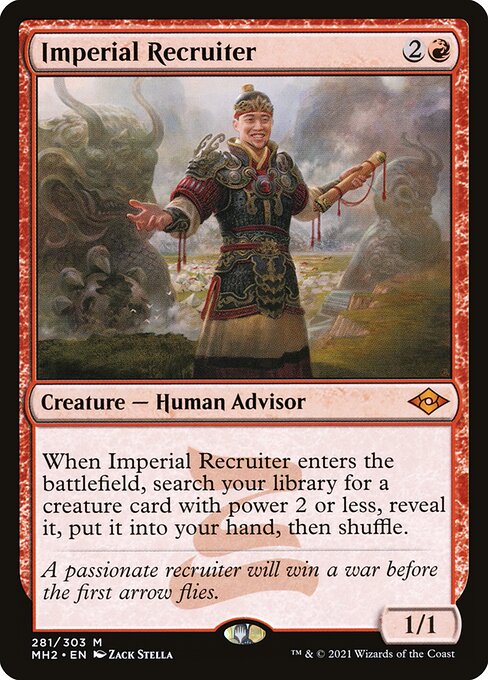 Imperial Recruiter
When this creature enters, search your library for a creature card with power 2 or less, reveal it, put it into your hand, then shuffle.
was reprinted in Modern Horizons II, making it legal in Modern for the first time.
Imperial Recruiter
When this creature enters, search your library for a creature card with power 2 or less, reveal it, put it into your hand, then shuffle.
was reprinted in Modern Horizons II, making it legal in Modern for the first time.
With Modern Horizons III coming up on us rather quickly, this is a perfect chance for some highly sought after cards to make their way into Modern. Recently, a Reddit post sparked some discussion about what some neat inclusions to the format could be. Today, we’re going to take a look at some of the cards with the highest potential to make their way into Modern, as well as some that could theoretically help address certain issues the format is currently facing as a whole.
Aura Mutation
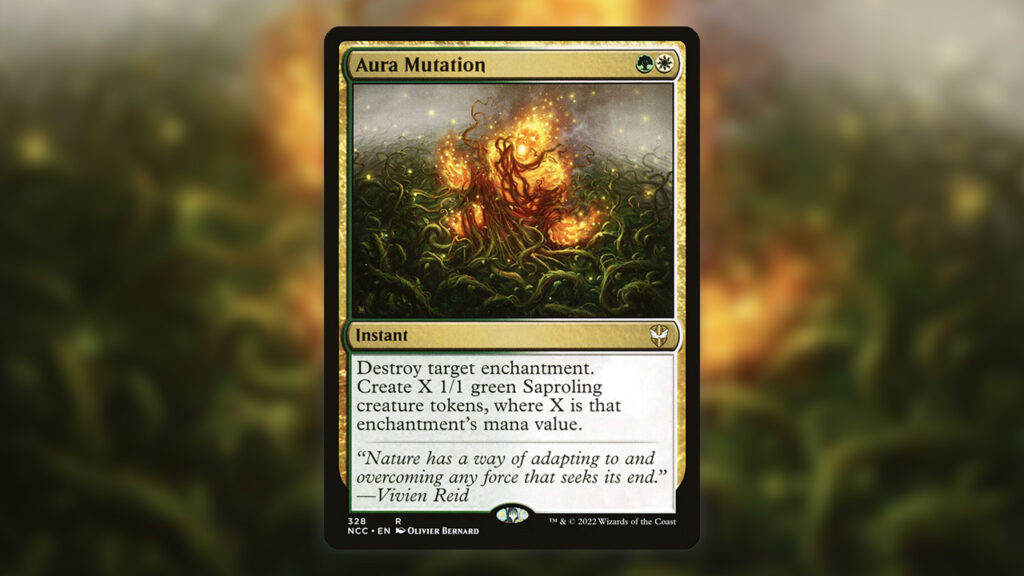
My initial thought on Aura Mutation, as well as
Artifact Mutation
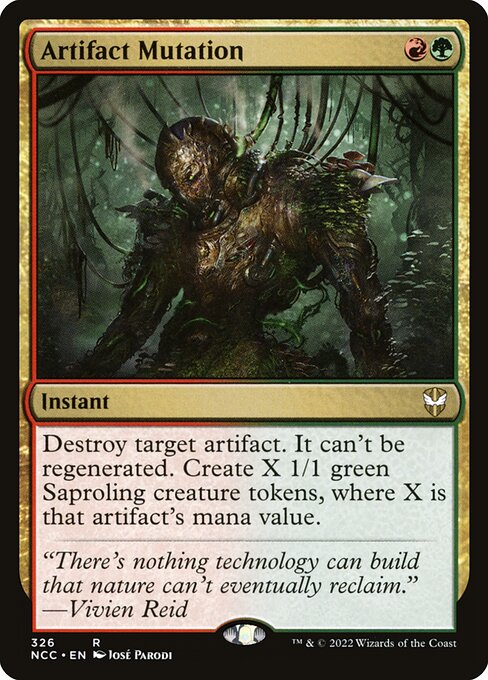 Artifact Mutation
Destroy target artifact. It can't be regenerated. Create X 1/1 green Saproling creature tokens, where X is that artifact's mana value.
, were that these cards were simply too efficient for the effect they provided. Two mana to answer an opposing permanent is pretty reasonable, but the added bonus of developing your board, potentially in a significant way, was too much. However, there are a few factors that might ultimately make these cards reasonable to reprint.
Artifact Mutation
Destroy target artifact. It can't be regenerated. Create X 1/1 green Saproling creature tokens, where X is that artifact's mana value.
, were that these cards were simply too efficient for the effect they provided. Two mana to answer an opposing permanent is pretty reasonable, but the added bonus of developing your board, potentially in a significant way, was too much. However, there are a few factors that might ultimately make these cards reasonable to reprint.
First of all, these cards are pretty restrictive in what they can target, especially Aura Mutation. There simply aren’t that many Enchantments that regularly see play. In many cases, you will be removing something with a small mana value, such as
Urza’s Saga
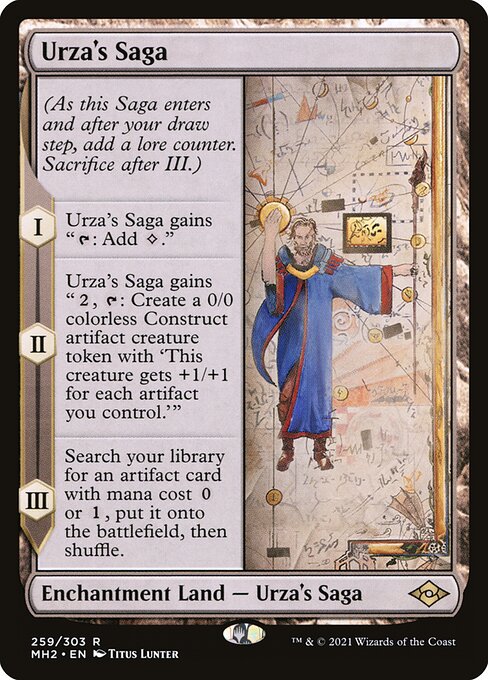 Urza’s Saga
(As this Saga enters and after your draw step, add a lore counter. Sacrifice after III.)
Urza’s Saga
(As this Saga enters and after your draw step, add a lore counter. Sacrifice after III.)
I — This Saga gains "{T}: Add {C}."
II — This Saga gains "{2}, {T}: Create a 0/0 colorless Construct artifact creature token with 'This token gets +1/+1 for each artifact you control.'"
III — Search your library for an artifact card with mana cost {0} or {1}, put it onto the battlefield, then shuffle.
or
Sigarda’s Aid
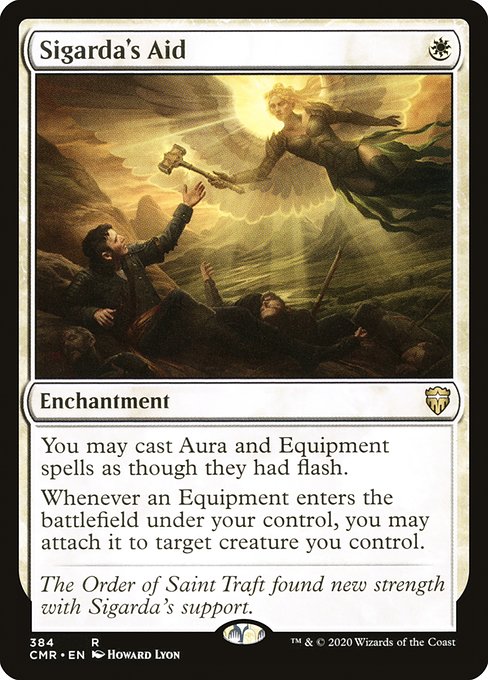 Sigarda’s Aid
You may cast Aura and Equipment spells as though they had flash.
Sigarda’s Aid
You may cast Aura and Equipment spells as though they had flash.
Whenever an Equipment you control enters, you may attach it to target creature you control.
, netting very few Saprolings in the process.
Additionally, the competition is extremely high for Artifact and Enchantment hate for green decks nowadays, as
Force of Vigor
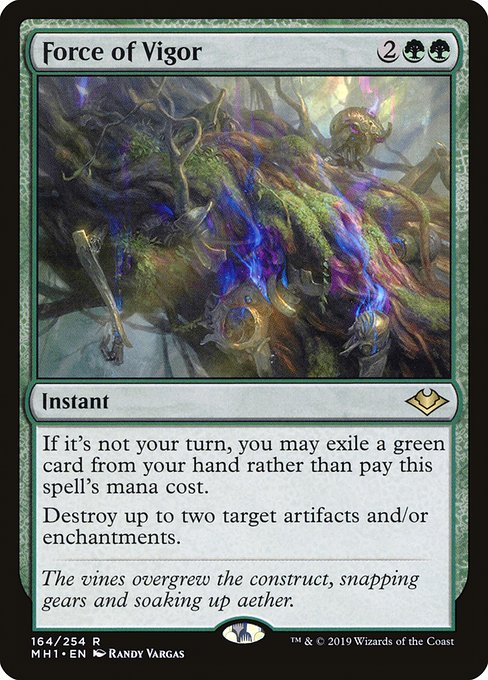 Force of Vigor
If it's not your turn, you may exile a green card from your hand rather than pay this spell's mana cost.
Force of Vigor
If it's not your turn, you may exile a green card from your hand rather than pay this spell's mana cost.
Destroy up to two target artifacts and/or enchantments.
is outrageously efficient and versatile. Aura Mutation at least opens the door for some cool tricks, like answering an early
Leyline Binding
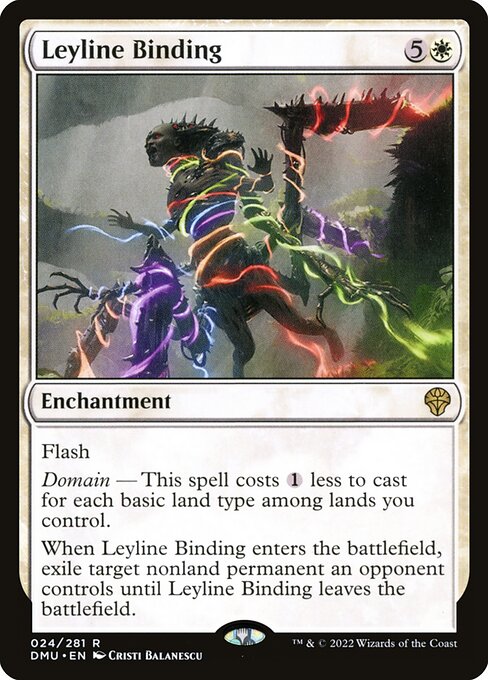 Leyline Binding
Flash
Leyline Binding
Flash
Domain — This spell costs {1} less to cast for each basic land type among lands you control.
When this enchantment enters, exile target nonland permanent an opponent controls until this enchantment leaves the battlefield.
and netting a bunch of Saprolings for your troubles.
Going even deeper, five-color Zoo decks could run Artifact Mutation in conjunction with
Scion of Draco
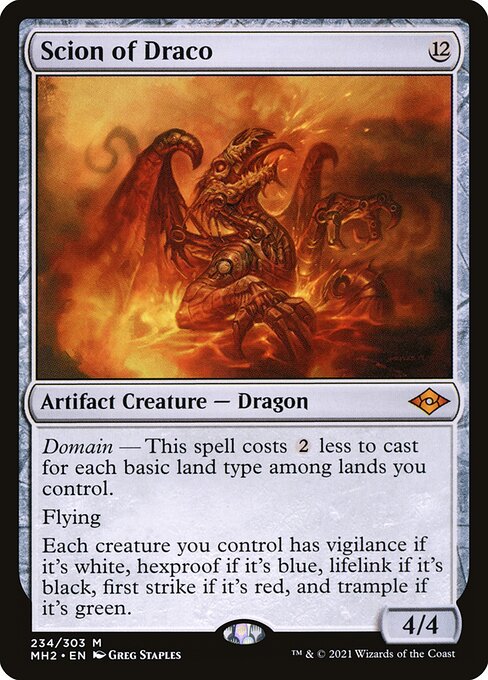 Scion of Draco
Domain — This spell costs {2} less to cast for each basic land type among lands you control.
Scion of Draco
Domain — This spell costs {2} less to cast for each basic land type among lands you control.
Flying
Each creature you control has vigilance if it's white, hexproof if it's blue, lifelink if it's black, first strike if it's red, and trample if it's green.
as a way to generate 12 Saprolings, while still being able to answer opposing Artifacts when necessary. As such, these seem like relatively cool additions to the format that aren’t overwhelmingly broken by any stretch.
Read More: Persistent Problems Cause Near 24-Hour MTG Online Outage!
Cabal Therapy
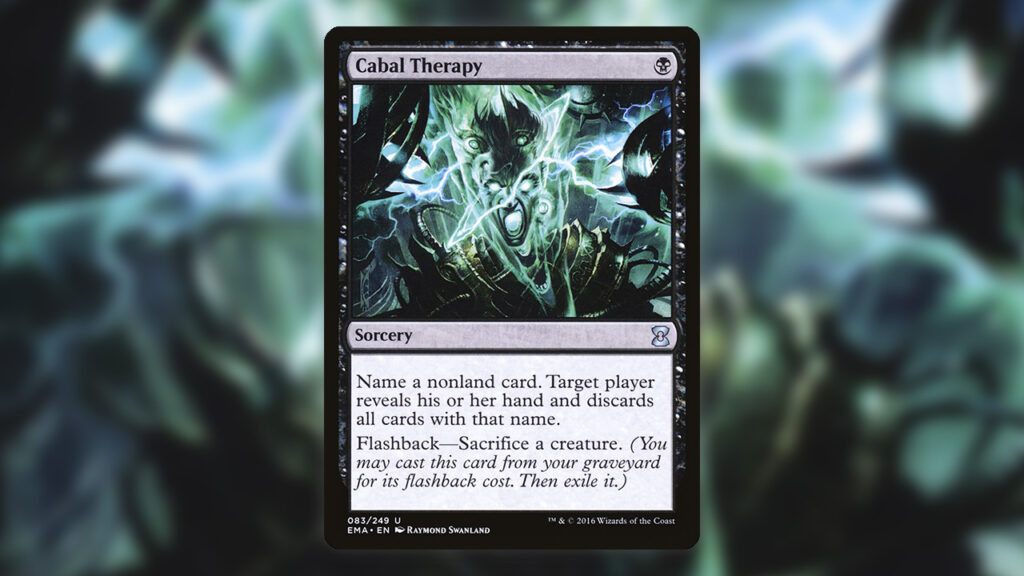
Since the printing of
Cabal Therapist
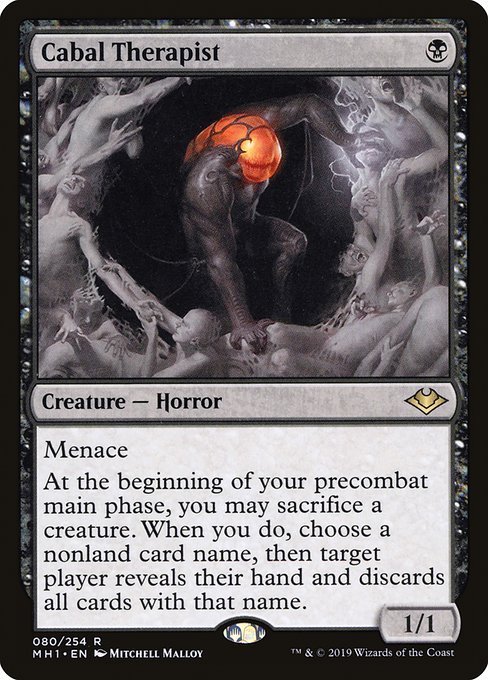 Cabal Therapist
Menace
Cabal Therapist
Menace
At the beginning of your first main phase, you may sacrifice a creature. When you do, choose a nonland card name, then target player reveals their hand and discards all cards with that name.
was a complete flop, there’s at least some potential that Cabal Therapy could make its way into Modern. On the surface, Cabal Therapy is an interesting and rather skill-intensive card. Being able to nab cards from the opponent’s hand twice thanks to Flashback is incredibly powerful, and the drawback of having to name a card ahead of time means that you may end up whiffing completely the first time you cast it.
As such, when used as intended, Cabal Therapy is certainly a cool card. Where things get awkward, though, is when the card is used unfairly. For instance, graveyard-centric decks can end up with a [Thoughtseize[/tooltips] effect that they can regularly cast for zero mana. By milling over Cabal Therapy with
Stitcher’s Supplier
 Stitcher’s Supplier
When this creature enters or dies, mill three cards. (Put the top three cards of your library into your graveyard.)
or Dredge cards like
Stinkweed Imp
Stitcher’s Supplier
When this creature enters or dies, mill three cards. (Put the top three cards of your library into your graveyard.)
or Dredge cards like
Stinkweed Imp
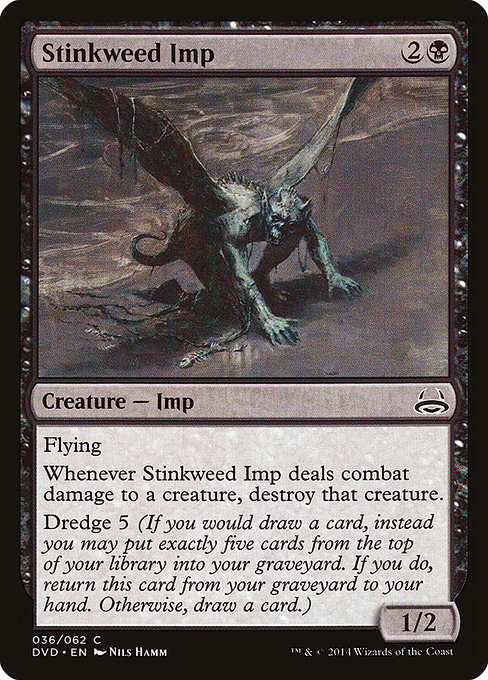 Stinkweed Imp
Flying
Stinkweed Imp
Flying
Whenever this creature deals combat damage to a creature, destroy that creature.
Dredge 5 (If you would draw a card, you may mill five cards instead. If you do, return this card from your graveyard to your hand.)
, you now have access to a powerful effect at very little cost.
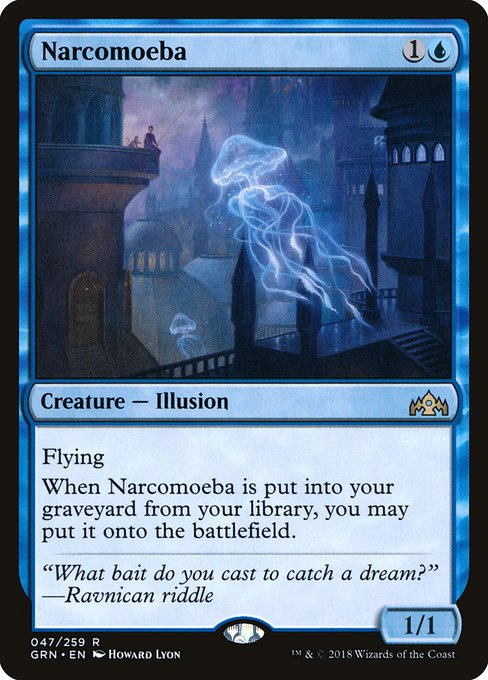
Not to mention, given that these styles of decks typically run recursive threats like
Prized Amalgam
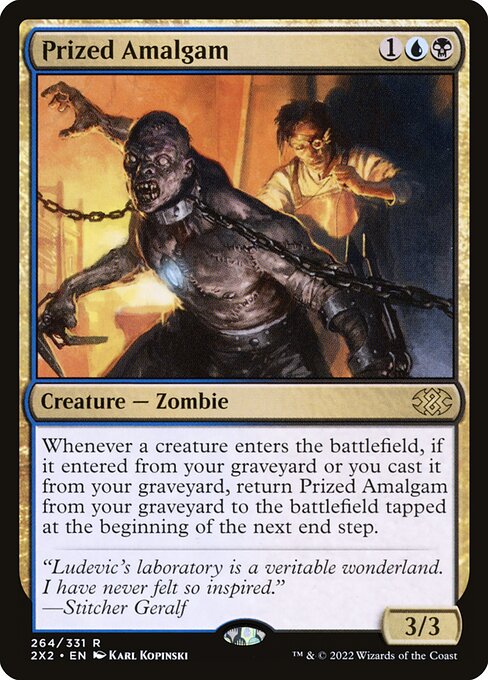 Prized Amalgam
Whenever a creature enters, if it entered from your graveyard or you cast it from your graveyard, return this card from your graveyard to the battlefield tapped at the beginning of the next end step.
or
Vengevine
Prized Amalgam
Whenever a creature enters, if it entered from your graveyard or you cast it from your graveyard, return this card from your graveyard to the battlefield tapped at the beginning of the next end step.
or
Vengevine
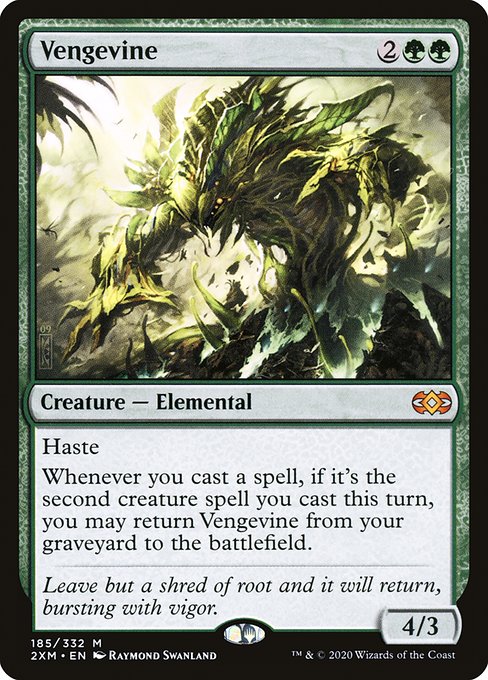 Vengevine
Haste
Vengevine
Haste
Whenever you cast a spell, if it's the second creature spell you cast this turn, you may return this card from your graveyard to the battlefield.
alongside
Narcomoeba
 Narcomoeba
Flying
Narcomoeba
Flying
When this card is put into your graveyard from your library, you may put it onto the battlefield.
which comes into play for free, paying the cost of sacrificing a Creature to Flashback Cabal Therapy is rather trivial. In this sense, adding it to the format may not be the best idea, even if it seems interesting at first glance.
Read More: Wizards of the Coast Cancels Karlov Manor Early Access Event!
Price of Progress
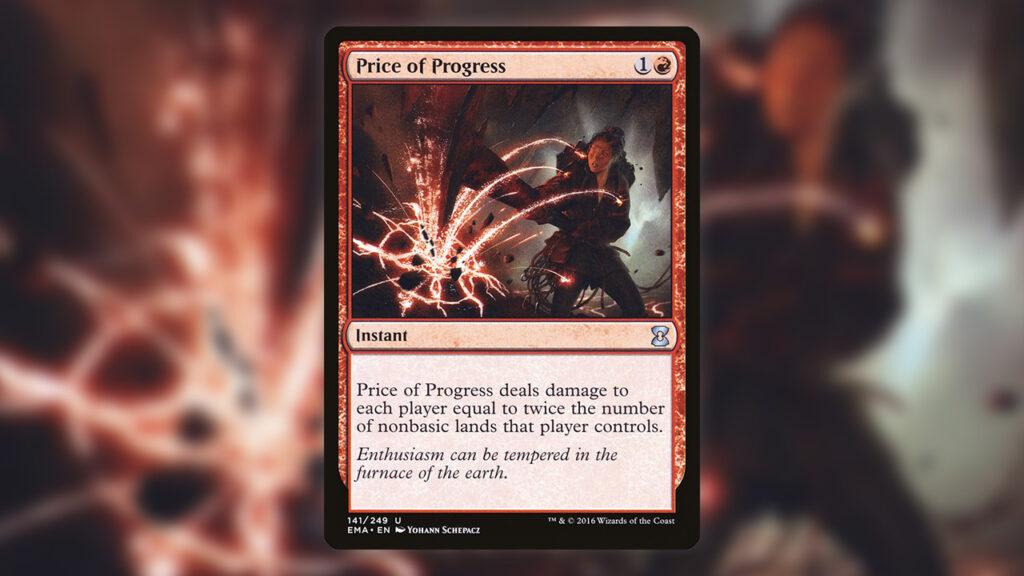
Price of Progress is an interesting card that would likely be super controversial. In Legacy, the card is sometimes used as a sideboard card to punish slower decks with greedy manabases. Sometimes, casting a single copy of Price of Progress can deal the opponent 10 damage or more, which obviously has a massive swing on the game. Given that the card is technically a symmetrical effect, not every deck can play it.
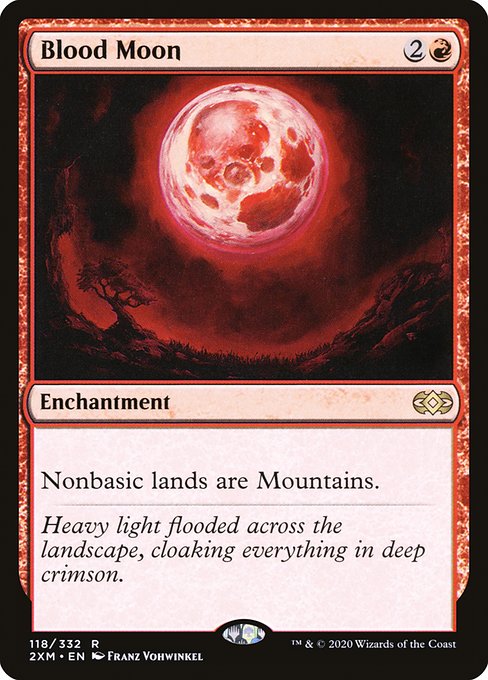
Similarly, if you go out of your way to accommodate the card within your manabase, then it can end up being quite strong. The hope is that the card adds another way to punish players for freely Fetching Triomes and Shocklands at will, much like
Blood Moon
 Blood Moon
Nonbasic lands are Mountains.
. Unfortunately, I don’t think Price of Progress would ultimately have a beneficial effect on the format.
Blood Moon
Nonbasic lands are Mountains.
. Unfortunately, I don’t think Price of Progress would ultimately have a beneficial effect on the format.
Dealing two damage per non-basic Land is incredible on rate. Burn decks having access to a card that can win the game almost singlehandedly would be a bit concerning. As such, Price of Progress is a card that I think should be avoided when adding cards to Modern.
Read More: MTG Players Disappointed With New Lackluster Secret Lair Cards
Helping Typal Creature Decks
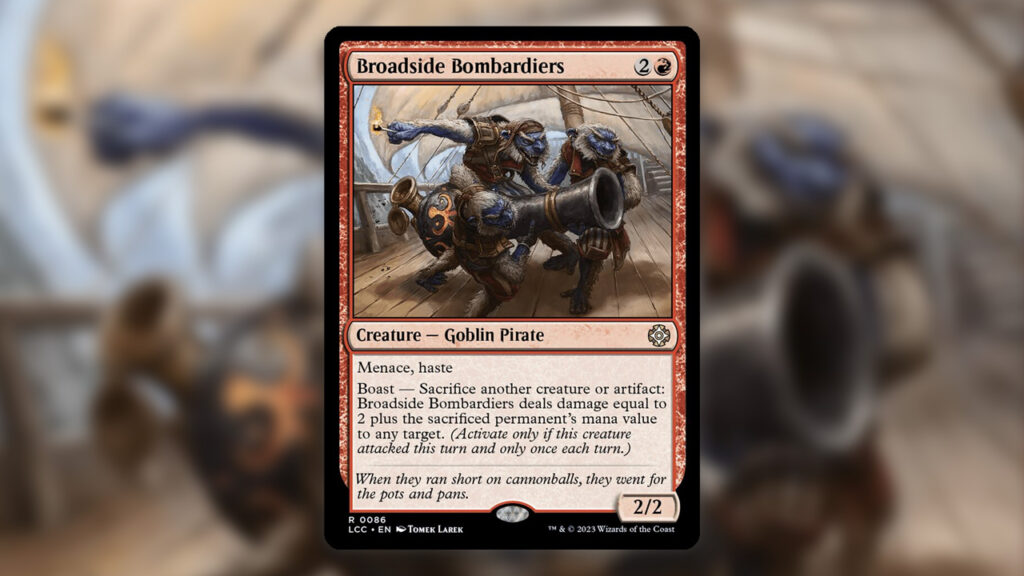
The type of cards that I personally most want to see added to Modern are those that might help give Creature decks an edge. Even with the banning of
Fury
 Fury
Double strike
Fury
Double strike
When this creature enters, it deals 4 damage divided as you choose among any number of target creatures and/or planeswalkers.
Evoke—Exile a red card from your hand.
, non-combo decks that try to go wide with Creatures have mostly fallen by the wayside. Merfolk has gotten a bit more popular, but other typal decks like Humans and Goblins have been mostly nonexistent over the course of the past few years.
In this sense, these strategies clearly need a bit more help, especially in a format with elite, reactive spells like Solitude[tooltips]. One cool addition to help aggressive Creature decks could be [tooltips]Broadside Bombardiers. Broadside Bombardiers is unique in the sense that it both adds pressure to the board while simultaneously allowing you to interact with pesky blockers from the opponent. The card has been an elite addition in Legacy, but without cards like
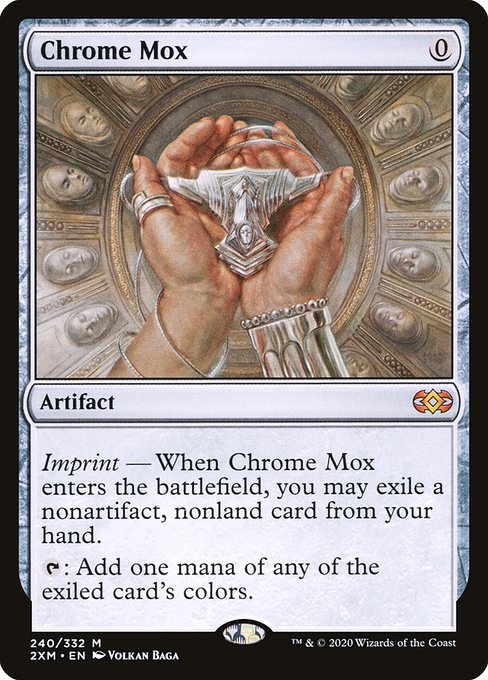
Chrome Mox
 Chrome Mox
Imprint — When this artifact enters, you may exile a nonartifact, nonland card from your hand.
Chrome Mox
Imprint — When this artifact enters, you may exile a nonartifact, nonland card from your hand.
{T}: Add one mana of any of the exiled card's colors.
and
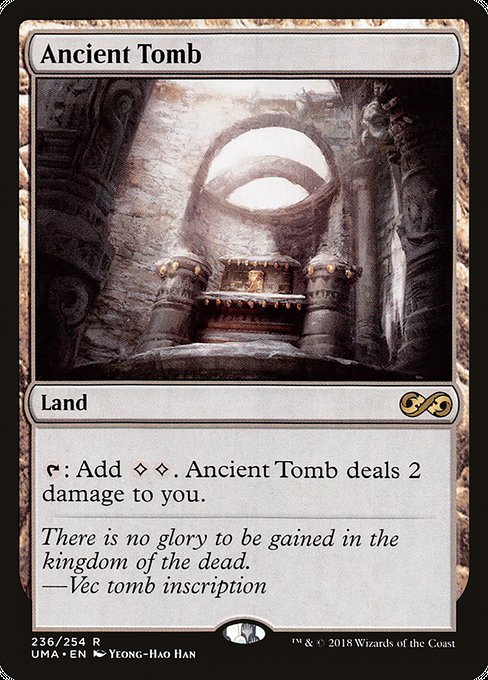
Ancient Tomb
 Ancient Tomb
{T}: Add {C}{C}. This land deals 2 damage to you.
in the mix, is likely much fairer in Modern.
Ancient Tomb
{T}: Add {C}{C}. This land deals 2 damage to you.
in the mix, is likely much fairer in Modern.
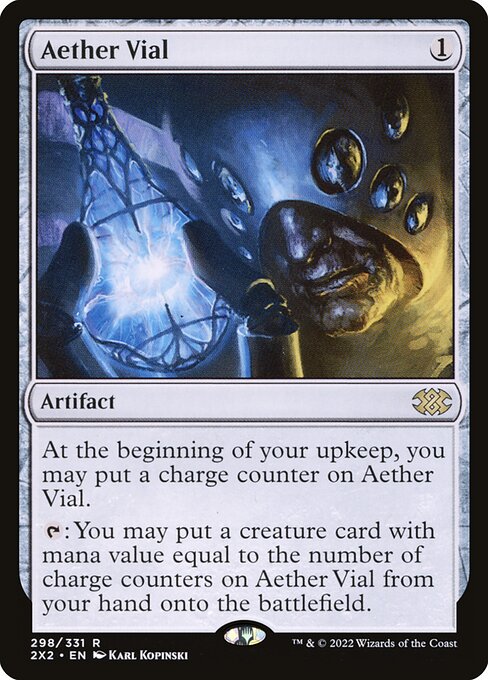
To specifically help bolster
Aether Vial
 Aether Vial
At the beginning of your upkeep, you may put a charge counter on this artifact.
Aether Vial
At the beginning of your upkeep, you may put a charge counter on this artifact.
{T}: You may put a creature card with mana value equal to the number of charge counters on this artifact from your hand onto the battlefield.
decks that once upon a time were relevant tier one strategies,
Recruiter of the Guard
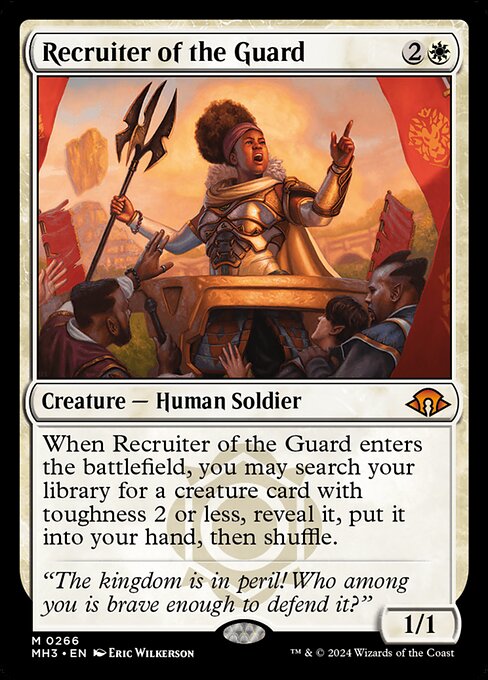 Recruiter of the Guard
When this creature enters, you may search your library for a creature card with toughness 2 or less, reveal it, put it into your hand, then shuffle.
could be a nice addition to the format. It’s a bit slow but works perfectly with Vial. Being able to search for Solitude or
Flickerwisp
Recruiter of the Guard
When this creature enters, you may search your library for a creature card with toughness 2 or less, reveal it, put it into your hand, then shuffle.
could be a nice addition to the format. It’s a bit slow but works perfectly with Vial. Being able to search for Solitude or
Flickerwisp
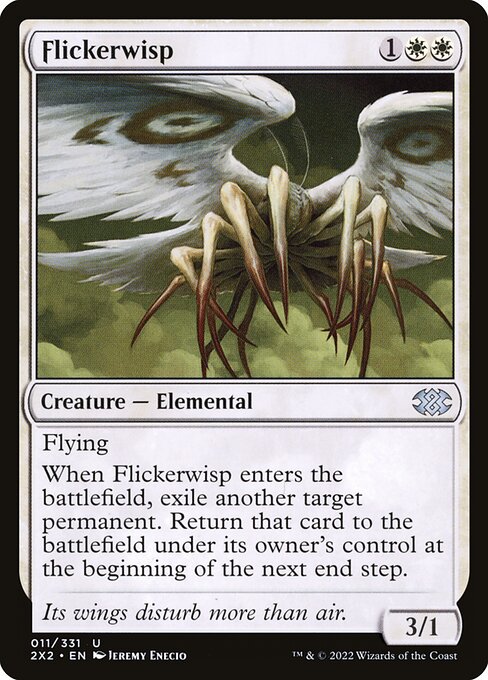 Flickerwisp
Flying
Flickerwisp
Flying
When this creature enters, exile another target permanent. Return that card to the battlefield under its owner's control at the beginning of the next end step.
is a huge boon in its favor in comparison to Imperial Recruiter.
Furthermore, even something like
Rishadan Port
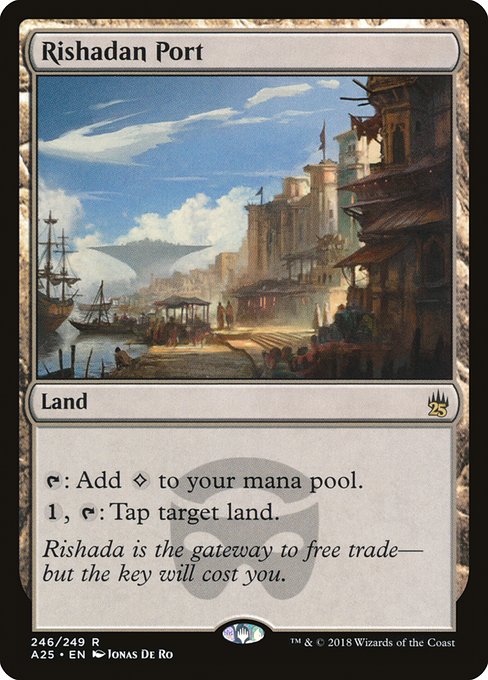 Rishadan Port
{T}: Add {C}.
Rishadan Port
{T}: Add {C}.
{1}, {T}: Tap target land.
could help give Aether Vial decks a bit of an edge. Unlike
Wasteland
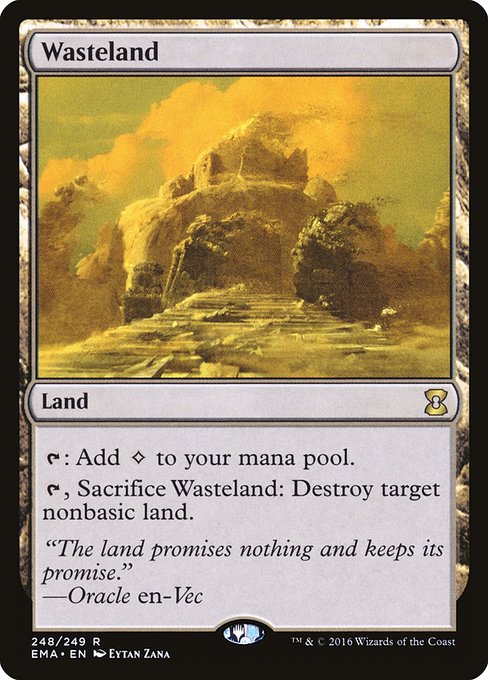 Wasteland
{T}: Add {C}.
Wasteland
{T}: Add {C}.
{T}, Sacrifice this land: Destroy target nonbasic land.
, Port takes a more specific approach to maximize. It requires extra mana investment from your end to use, making it much fairer. With Vial in play, though, you can advance your board while still using Port to slow the opponent down.
The reality is, there are a ton of potential cards that could make their way into Modern in the coming years. It’ll be interesting to see if any of these cards await us in Modern Horizons III.
Read More: These Absurdly Expensive MTG Cards Desperately Need a 2024 Reprint!