
Just recently,
Violent Outburst
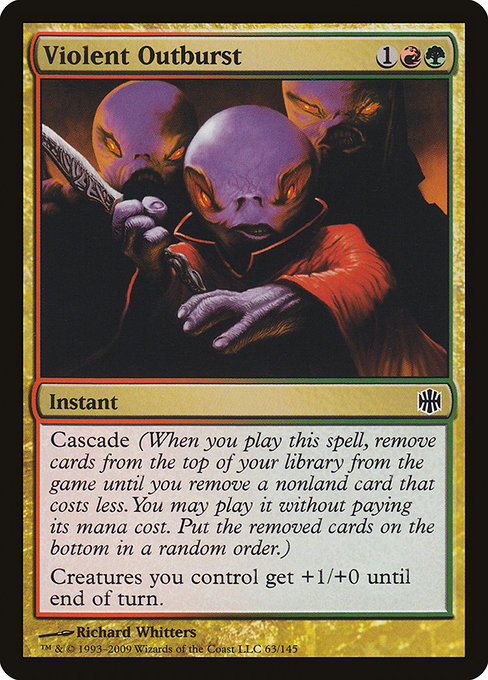 Violent Outburst
Cascade (When you cast this spell, exile cards from the top of your library until you exile a nonland card that costs less. You may cast it without paying its mana cost. Put the exiled cards on the bottom in a random order.)
Violent Outburst
Cascade (When you cast this spell, exile cards from the top of your library until you exile a nonland card that costs less. You may cast it without paying its mana cost. Put the exiled cards on the bottom in a random order.)
Creatures you control get +1/+0 until end of turn.
was given the axe in Modern. Some players have been quick to look for replacements within Cascade shells, turning to
Ardent Plea
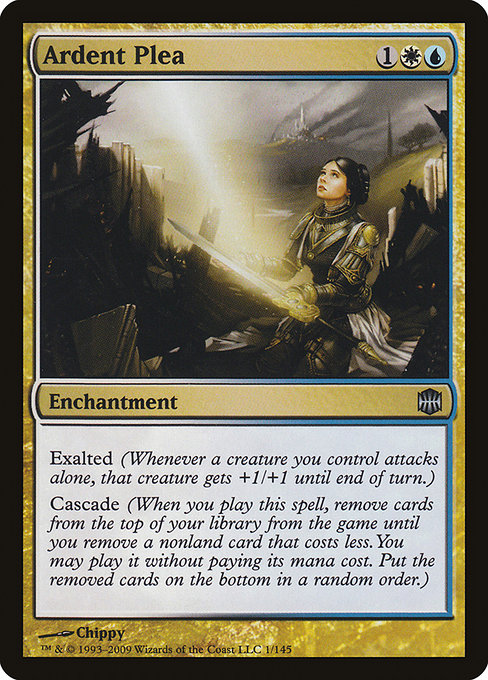 Ardent Plea
Exalted (Whenever a creature you control attacks alone, that creature gets +1/+1 until end of turn.)
Ardent Plea
Exalted (Whenever a creature you control attacks alone, that creature gets +1/+1 until end of turn.)
Cascade (When you cast this spell, exile cards from the top of your library until you exile a nonland card that costs less. You may cast it without paying its mana cost. Put the exiled cards on the bottom in a random order.)
or even
Bloodbraid Marauder
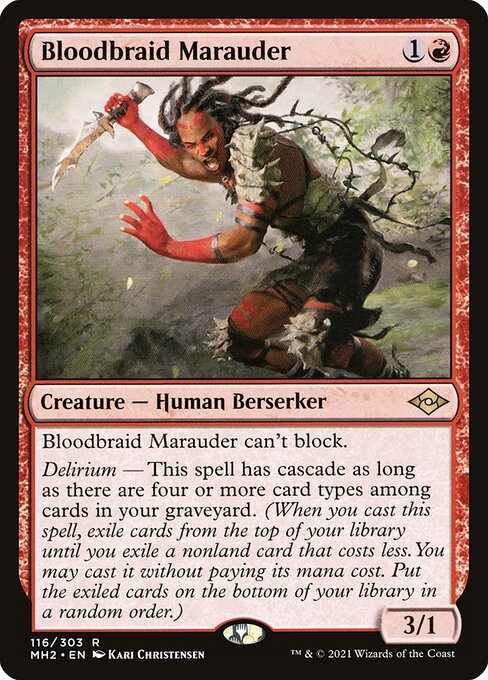 Bloodbraid Marauder
This creature can't block.
Bloodbraid Marauder
This creature can't block.
Delirium — This spell has cascade as long as there are four or more card types among cards in your graveyard. (When you cast this spell, exile cards from the top of your library until you exile a nonland card that costs less. You may cast it without paying its mana cost. Put the exiled cards on the bottom in a random order.)
. Meanwhile, other players have turned towards strategies like Golgari
Yawgmoth, Thran Physician
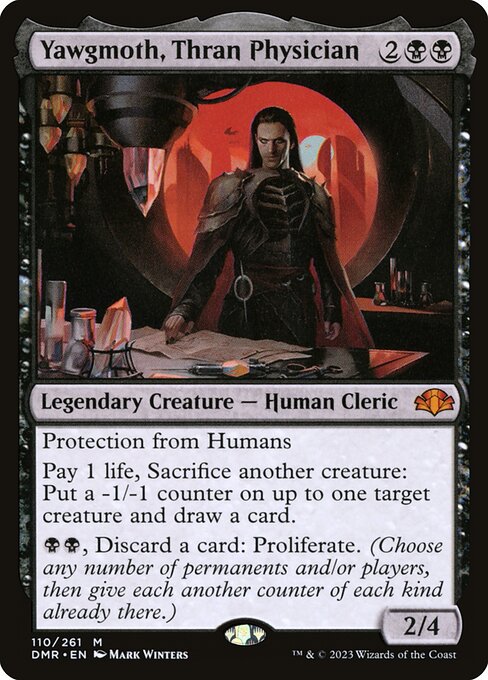 Yawgmoth, Thran Physician
Protection from Humans
Yawgmoth, Thran Physician
Protection from Humans
Pay 1 life, Sacrifice another creature: Put a -1/-1 counter on up to one target creature and draw a card.
{B}{B}, Discard a card: Proliferate. (Choose any number of permanents and/or players, then give each another counter of each kind already there.)
combo that, while already strong, had weak matchups against Cascade decks.
Even though the banning of Violent Outburst isn’t the end all be all for
Crashing Footfalls
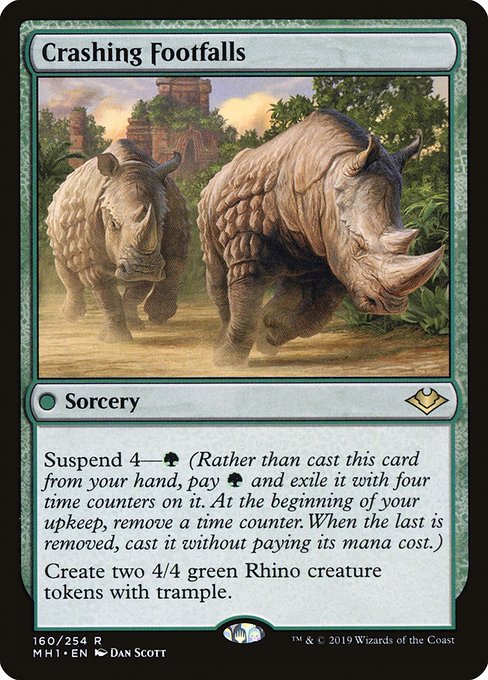 Crashing Footfalls
Suspend 4—{G} (Rather than cast this card from your hand, pay {G} and exile it with four time counters on it. At the beginning of your upkeep, remove a time counter. When the last is removed, you may cast it without paying its mana cost.)
Crashing Footfalls
Suspend 4—{G} (Rather than cast this card from your hand, pay {G} and exile it with four time counters on it. At the beginning of your upkeep, remove a time counter. When the last is removed, you may cast it without paying its mana cost.)
Create two 4/4 green Rhino creature tokens with trample.
and
Living End
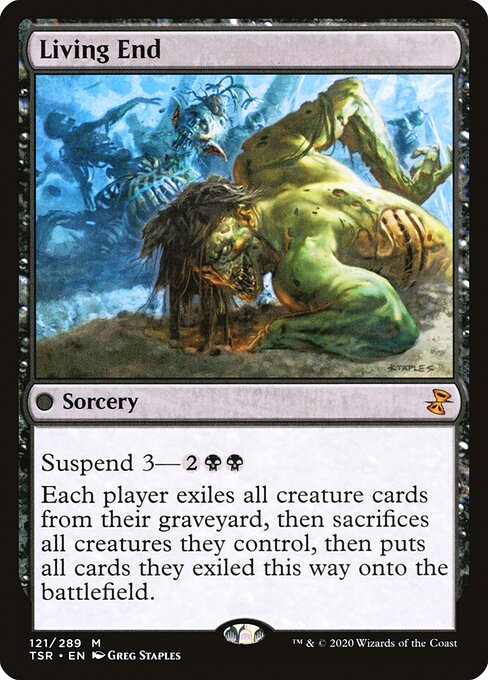 Living End
Suspend 3—{2}{B}{B}
Living End
Suspend 3—{2}{B}{B}
Each player exiles all creature cards from their graveyard, then sacrifices all creatures they control, then puts all cards they exiled this way onto the battlefield.
decks in Modern, perhaps these archetypes won’t be quite as dominant as they have been. This could theoretically open the door for a handful of decks that were completely held down by these Cascade variants.
One strategy that fits this mold that has been almost nonexistent over the past couple years is
Gifts Ungiven
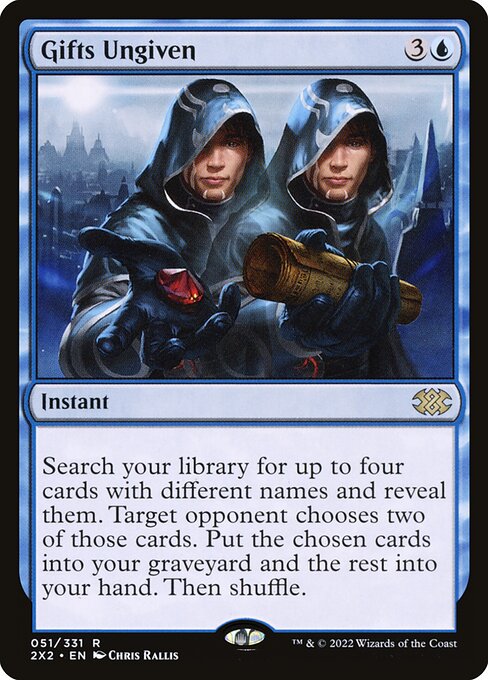 Gifts Ungiven
Search your library for up to four cards with different names and reveal them. Target opponent chooses two of those cards. Put the chosen cards into your graveyard and the rest into your hand. Then shuffle.
Storm. Gifts Ungiven Storm decks used to be extremely popular years ago but have since fallen out of favor. However, the printing of a powerful Karlov Manor Enchantment alongside the recent ban announcement may have presented the perfect opportunity for its resurrection. Just this week, the deck went undefeated in a Magic Online Modern League. At minimum, this signals its rising potential in the format.
Gifts Ungiven
Search your library for up to four cards with different names and reveal them. Target opponent chooses two of those cards. Put the chosen cards into your graveyard and the rest into your hand. Then shuffle.
Storm. Gifts Ungiven Storm decks used to be extremely popular years ago but have since fallen out of favor. However, the printing of a powerful Karlov Manor Enchantment alongside the recent ban announcement may have presented the perfect opportunity for its resurrection. Just this week, the deck went undefeated in a Magic Online Modern League. At minimum, this signals its rising potential in the format.
Gifts Ungiven Core
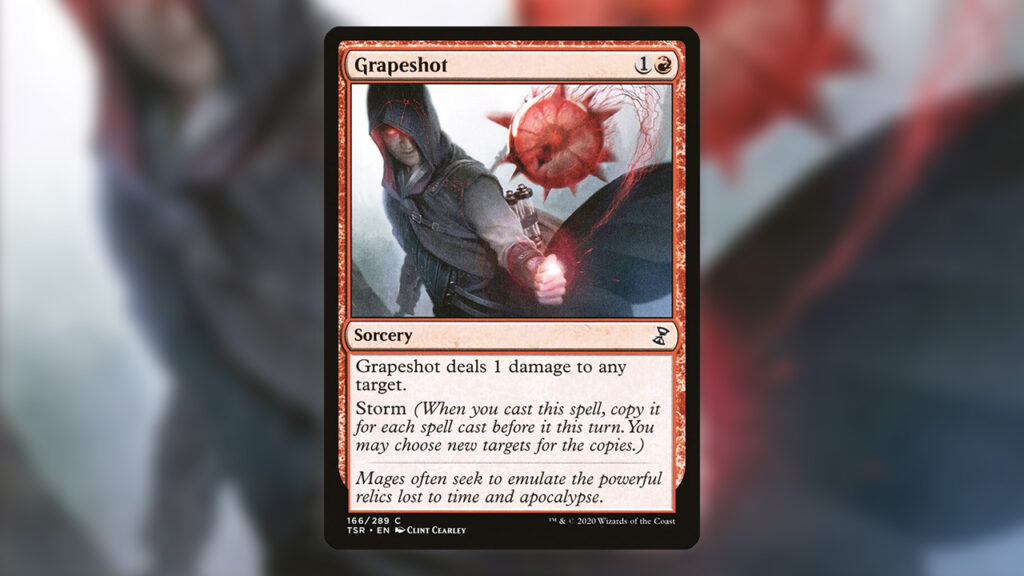
The main goal with Gifts Ungiven Storm is to cast the namesake card while you have a way to reduce the cost of your Instants and Sorceries in play. Historically, these cards have been
Baral, Chief of Compliance
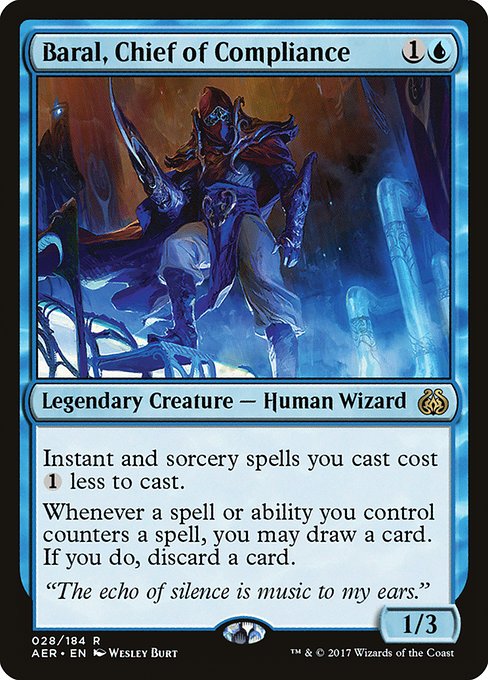 Baral, Chief of Compliance
Instant and sorcery spells you cast cost {1} less to cast.
Baral, Chief of Compliance
Instant and sorcery spells you cast cost {1} less to cast.
Whenever a spell or ability you control counters a spell, you may draw a card. If you do, discard a card.
and
Goblin Electromancer
 Goblin Electromancer
Instant and sorcery spells you cast cost {1} less to cast.
. In the current Storm list shown above, Goblin Electromancer is eschewed for
Case of the Ransacked Lab
Goblin Electromancer
Instant and sorcery spells you cast cost {1} less to cast.
. In the current Storm list shown above, Goblin Electromancer is eschewed for
Case of the Ransacked Lab
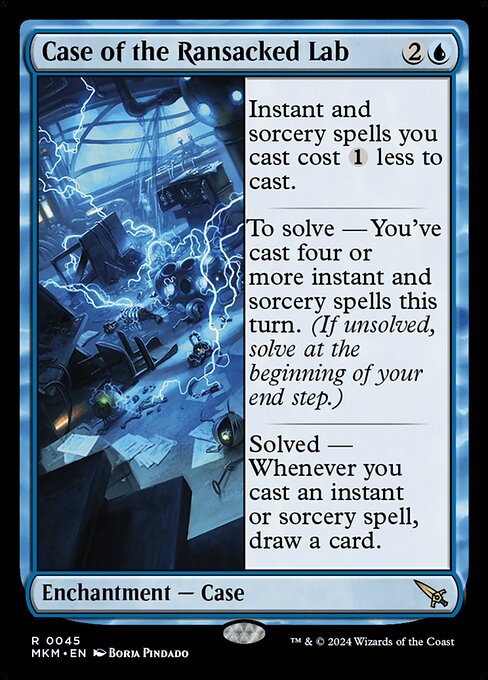 Case of the Ransacked Lab
Instant and sorcery spells you cast cost {1} less to cast.
Case of the Ransacked Lab
Instant and sorcery spells you cast cost {1} less to cast.
To solve — You've cast four or more instant and sorcery spells this turn. (If unsolved, solve at the beginning of your end step.)
Solved — Whenever you cast an instant or sorcery spell, draw a card.
. As we will get to later, this is a huge change in this deck’s favor that gives it a better shot at winning in attrition-based matchups.
In either instance, winning the game becomes trivial when you add Gifts Ungiven into the mix. With three mana available after resolving Gifts Ungiven, you can typically win the game that turn. To help make sure you have extra mana reliably, this deck makes use of
Desperate Ritual
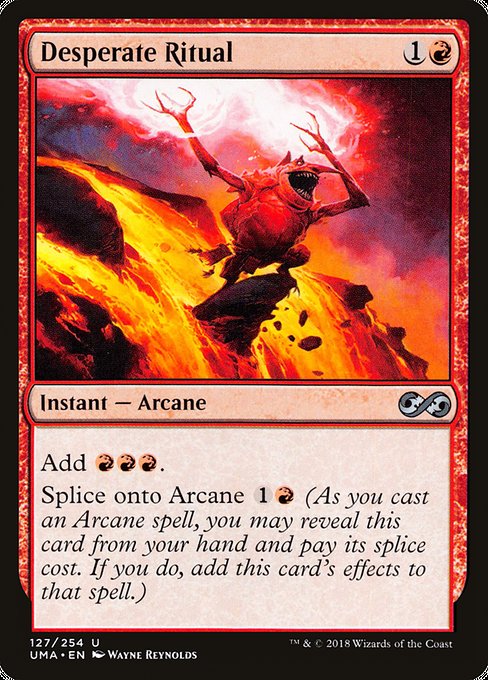 Desperate Ritual
Add {R}{R}{R}.
Desperate Ritual
Add {R}{R}{R}.
Splice onto Arcane {1}{R} (As you cast an Arcane spell, you may reveal this card from your hand and pay its splice cost. If you do, add this card's effects to that spell.)
,
Pyretic Ritual
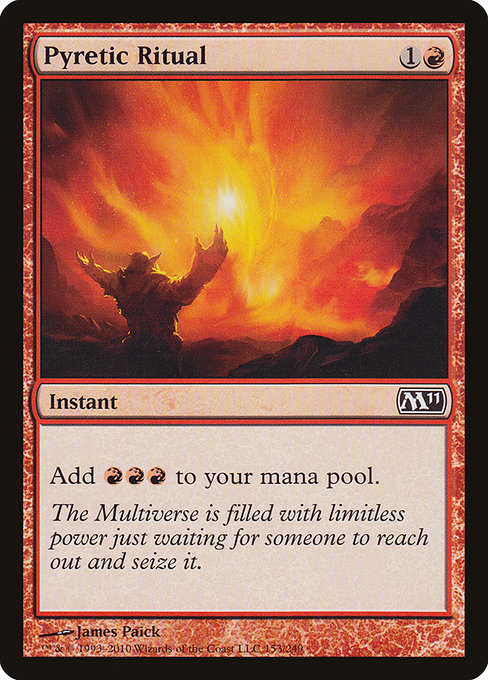 Pyretic Ritual
Add {R}{R}{R}.
, and
Manamorphose
Pyretic Ritual
Add {R}{R}{R}.
, and
Manamorphose
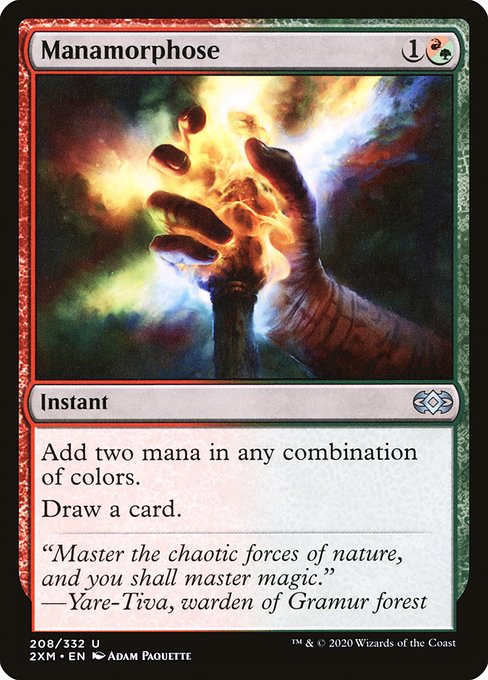 Manamorphose
Add two mana in any combination of colors.
Manamorphose
Add two mana in any combination of colors.
Draw a card.
. With Baral or Case in play, each Ritual nets you two mana and Manamorphose nets you one mana (which notably can be blue).
As such, a common play pattern is to play Baral on turn two. If you get to untap with it, you can cast either two Rituals or a Ritual and Manamorphose, and follow up with Gifts Ungiven. Assuming you hit your Land drop, you will have at least three mana floating when you cast Gifts Ungiven. Now, simply search for one of each Ritual, Manamorphose, and
Past in Flames
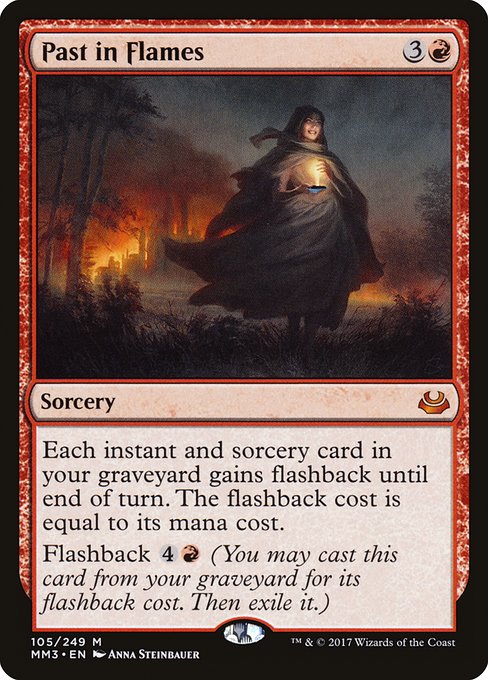 Past in Flames
Each instant and sorcery card in your graveyard gains flashback until end of turn. The flashback cost is equal to its mana cost.
Past in Flames
Each instant and sorcery card in your graveyard gains flashback until end of turn. The flashback cost is equal to its mana cost.
Flashback {4}{R} (You may cast this card from your graveyard for its flashback cost. Then exile it.)
. Whether your opponent gives you Rituals or Past in Flames and Manamorphose, because Past in Flames has Flashback, you will get to cast Past in Flames either way.
From there, you get to recast all of your Rituals, use Manamorphose to filter into blue mana, and cast Gifts Ungiven once again. With a big enough Storm count, this time, you can find Grapeshot and dome your opponent for a ton of damage. For more information on combo lines and alternate avenues to victory in previous iterations of Gifts Ungiven Storm, take a look at the extensive guide here.
Read More: Bizarre Infinite Combo takes Over MTG Format
New Additions
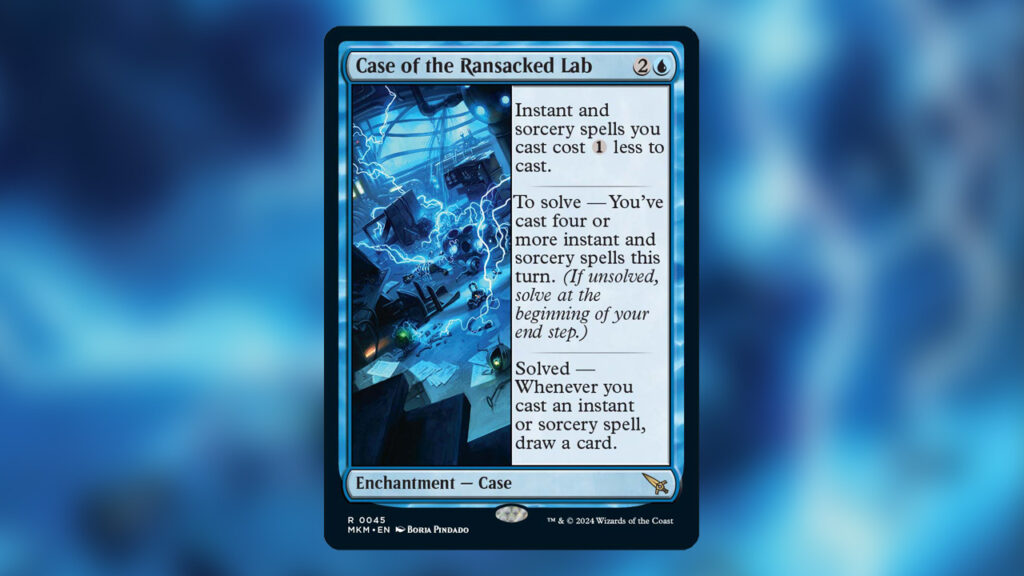
Where things get interesting is with the inclusion of Case of the Ransacked Lab. Case acts as a combo piece just like Baral does, maximizing your Rituals and making it easier to win via Gifts Ungiven. While it costs one more mana than Goblin Electromancer, it is much more effective in a wide variety of matchups.
First and foremost, Case doesn’t die to Creature removal, something old Storm lists were surprisingly a bit vulnerable too. Considering that removal has gotten significantly more efficient in recent years (think
Solitude
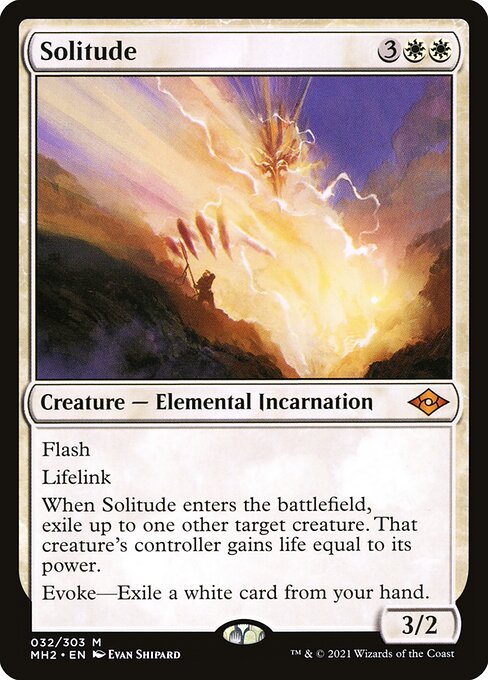 Solitude
Flash
Solitude
Flash
Lifelink
When this creature enters, exile up to one other target creature. That creature's controller gains life equal to its power.
Evoke—Exile a white card from your hand.
for example), holding up
Remand
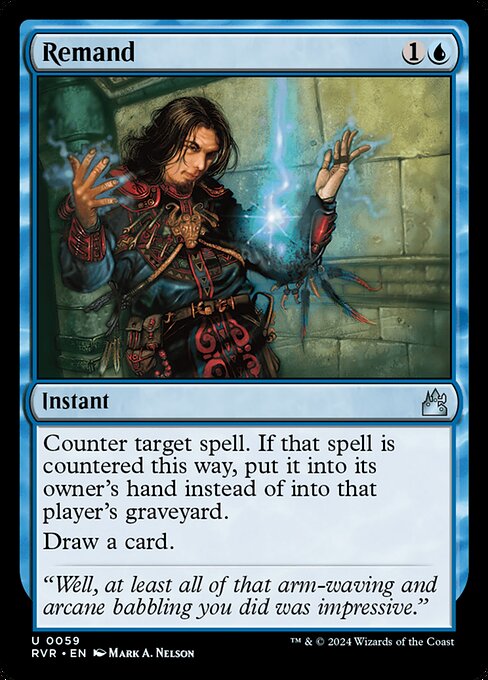 Remand
Counter target spell. If that spell is countered this way, put it into its owner's hand instead of into that player's graveyard.
Remand
Counter target spell. If that spell is countered this way, put it into its owner's hand instead of into that player's graveyard.
Draw a card.
or
Flusterstorm
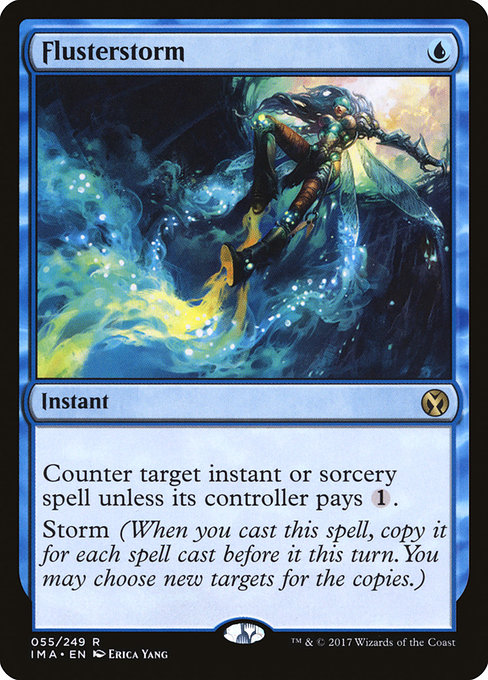 Flusterstorm
Counter target instant or sorcery spell unless its controller pays {1}.
Flusterstorm
Counter target instant or sorcery spell unless its controller pays {1}.
Storm (When you cast this spell, copy it for each spell cast before it this turn. You may choose new targets for the copies.)
isn’t always a reliable way to protect your cost reducers.
Additionally, in spots where getting to a full Grapeshot kill is tough, such as against a bevy of discard spells from the opponent, it’s not unreasonable to Solve the Case and turn all of your future Rituals into cantrips. Imagine casting a couple Rituals, a cantrip, and
Empty the Warrens
 Empty the Warrens
Create two 1/1 red Goblin creature tokens.
Empty the Warrens
Create two 1/1 red Goblin creature tokens.
Storm (When you cast this spell, copy it for each spell cast before it this turn.)
. Now, not only does your opponent have to contend with your big board of tokens, but they also risk falling behind on the card advantage front.
Speaking of cantrips, being able to add
Preordain
 Preordain
Scry 2, then draw a card. (To scry 2, look at the top two cards of your library, then put any number of them on the bottom and the rest on top in any order.)
recently to go alongside
Serum Visions
Preordain
Scry 2, then draw a card. (To scry 2, look at the top two cards of your library, then put any number of them on the bottom and the rest on top in any order.)
recently to go alongside
Serum Visions
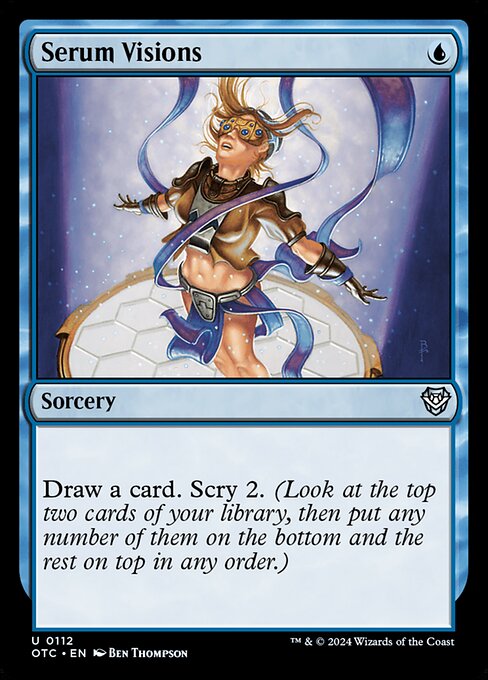 Serum Visions
Draw a card. Scry 2.
and
Consider
Serum Visions
Draw a card. Scry 2.
and
Consider
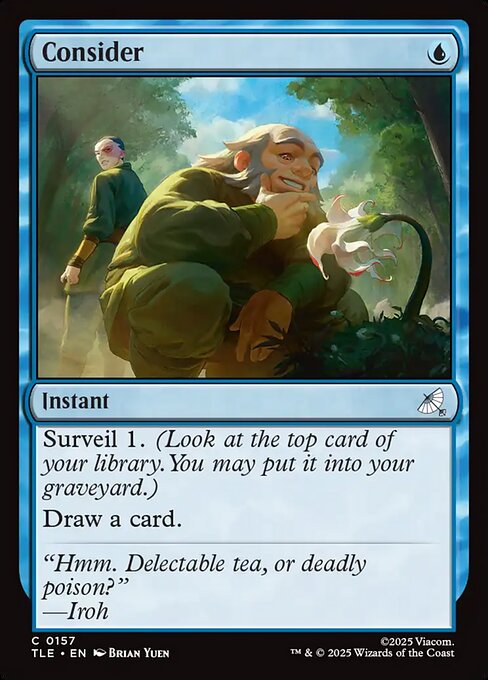 Consider
Surveil 1. (Look at the top card of your library. You may put it into your graveyard.)
Consider
Surveil 1. (Look at the top card of your library. You may put it into your graveyard.)
Draw a card.
is a big deal. Preordain is very strong and helps make finding Case or Gifts Ungiven much easier.
Read More: MTG Designer Discusses Potentially Returning Blocks Feature
Strengths and Weaknesses
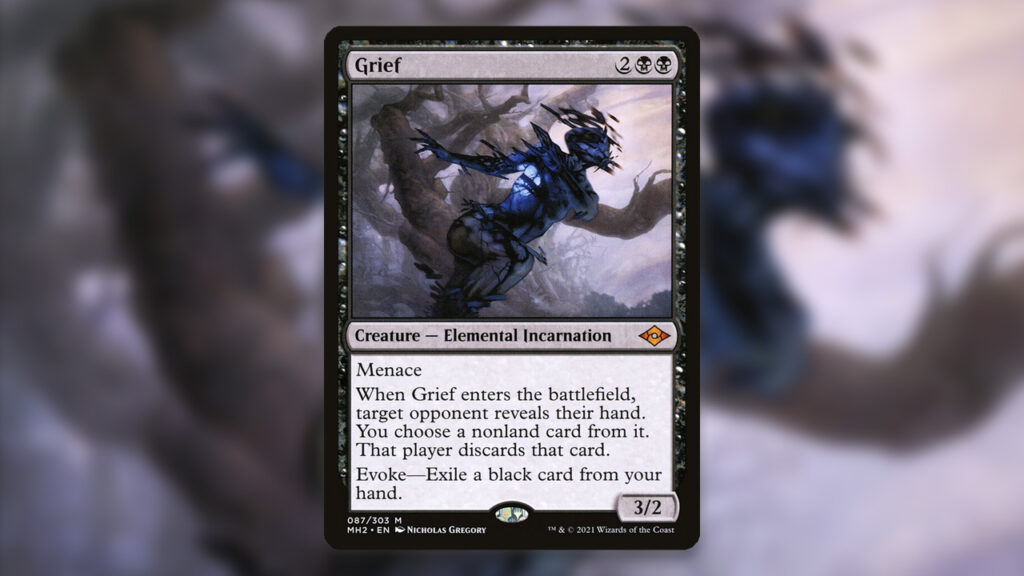
In general, Gifts Ungiven Storm still has its bevy of tough matchups to watch out for. Cascade decks are far from dead, and they are capable of presenting a quick clock backed up by Force of Negation. The presence of
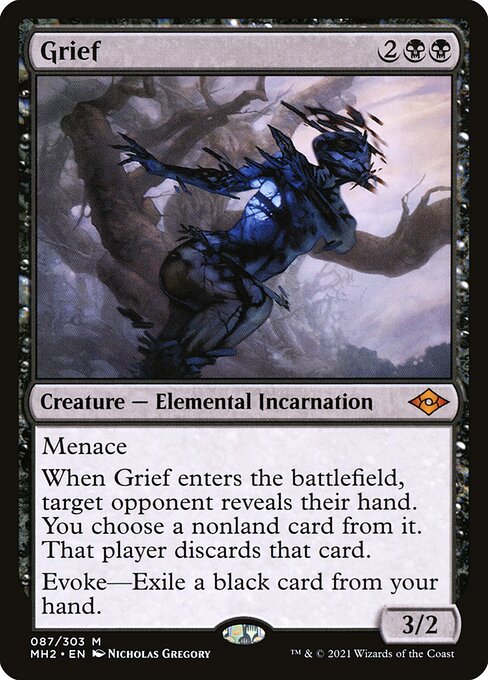
Grief
 Grief
Menace
Grief
Menace
When this creature enters, target opponent reveals their hand. You choose a nonland card from it. That player discards that card.
Evoke—Exile a black card from your hand.
in decks like Esper
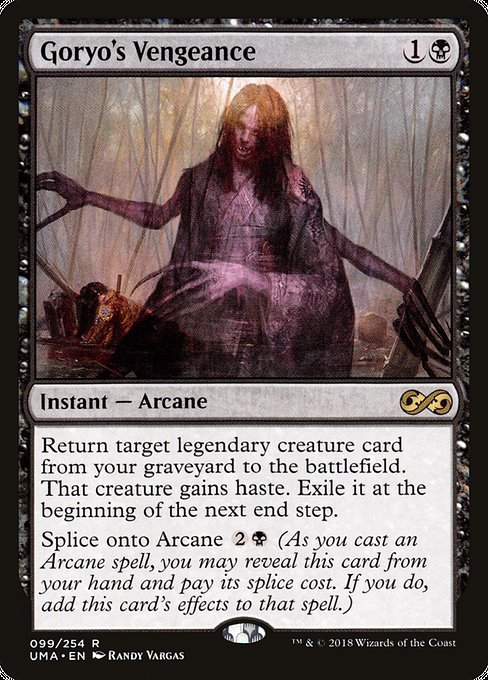
Goryo’s Vengeance
 Goryo’s Vengeance
Return target legendary creature card from your graveyard to the battlefield. That creature gains haste. Exile it at the beginning of the next end step.
Goryo’s Vengeance
Return target legendary creature card from your graveyard to the battlefield. That creature gains haste. Exile it at the beginning of the next end step.
Splice onto Arcane {2}{B} (As you cast an Arcane spell, you may reveal this card from your hand and pay its splice cost. If you do, add this card's effects to that spell.)
combo and Rakdos Scam can be a bit problematic. Izzet Murktide seems like the nightmare matchup, presenting a great mix of efficient threats and plenty of counter magic to make it nearly impossible for you to find your footing.
This doesn’t even take into account graveyard interaction and other forms of hate that have historically been effective against Storm shells. Still, this isn’t to say there aren’t some things going for the Storm deck. Other combo decks like Golgari
Yawgmoth, Thran Physician
Yawgmoth, Thran Physician
Protection from Humans
Pay 1 life, Sacrifice another creature: Put a -1/-1 counter on up to one target creature and draw a card.
{B}{B}, Discard a card: Proliferate. (Choose any number of permanents and/or players, then give each another counter of each kind already there.)
combo and Amulet Titan don’t play the widest range of disruption for the matchup, and you can often combo kill them before they can do the same to you. Slower strategies like Tron that need a bit of set up time can really struggle, too.
This deck attacks from a rather unique angle, so if you’re not prepared for it in some capacity, you may have a hard time. Additionally, this archetype is a rather budget-friendly option compared to the rest of the decks in the Modern format. Even with the pricy manabase and playset of Flusterstorm in the sideboard, you can purchase the entire deck for under $400.
This is a solid deal in an expensive format like Modern. With this in mind, whether you’re a Storm aficionado looking to dust off the cobwebs on your beloved Modern deck or you’re simply looking for something intriguing to play in this stale metagame, definitely give this deck a shot.
Read More: Top Five Most Broken MTG Modern Decks of All Time