
Since Outlaws of Thunder Junction was released, players have been working to find the best shell for
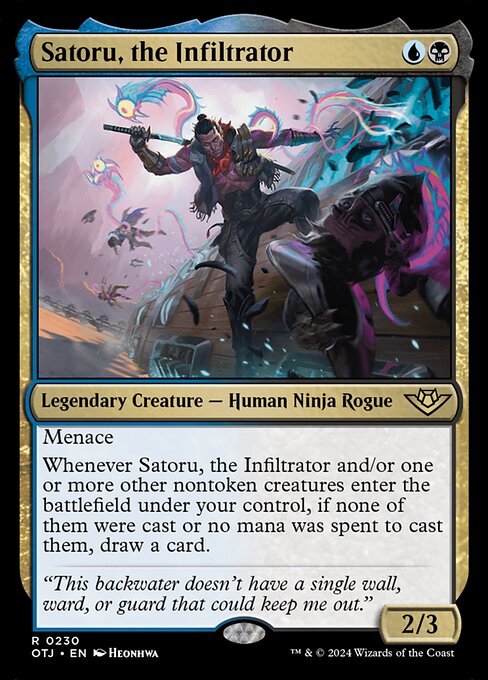
Satoru, the Infiltrator
 Satoru, the Infiltrator
Menace
Satoru, the Infiltrator
Menace
Whenever Satoru and/or one or more other nontoken creatures you control enter, if none of them were cast or no mana was spent to cast them, draw a card.
. Satoru is undoubtedly a powerful card in the right deck. The key is finding ways to best maximizing its abilities.
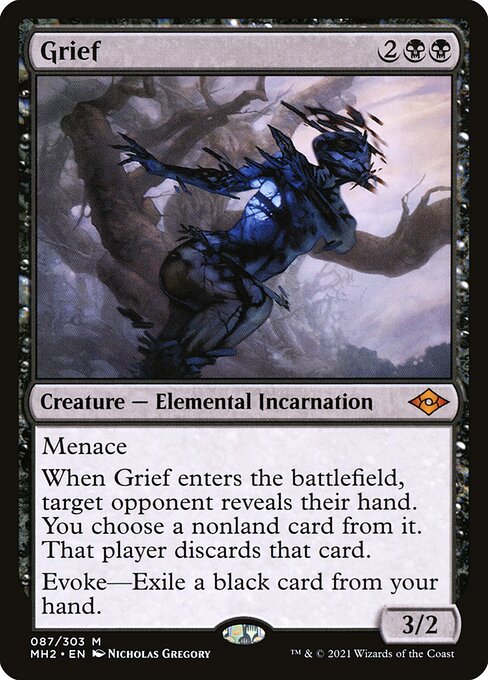
In Modern, we’ve seen Satoru pop up in Esper Reanimator and Dimir Scam strategies. Satoru’s synergy with the Evoke Elementals like
Grief
 Grief
Menace
Grief
Menace
When this creature enters, target opponent reveals their hand. You choose a nonland card from it. That player discards that card.
Evoke—Exile a black card from your hand.
is certainly notable. Players have also tried adding Satoru to Affinity builds, though largely to no avail. Given the wide range of free spells and recursive Creatures available in Modern, it wouldn’t be shocking at all if Satoru has a breakout performance in the near future.
What is a bit surprising, though, is that Satoru had a strong showing in a Magic Online Pioneer Challenge this weekend. With a more limited card pool, there are significantly less ways to abuse Satoru as a card advantage engine in Pioneer. However, it appears one player has taken it upon themselves to incorporate multiple combos into one deck, both of which work exceptionally well with Satoru. This deck truly looks like a mish mash of different ideas, but there might be more connectedness than you think.
Satoru and Cauldron Familiar
The key to making Satoru, the Infiltrator pop off is to have reliable ways to get Creatures into play without paying mana for them. In Pioneer, there aren’t many Creatures that you can naturally play for free. However, Satoru triggers when you cheat Creatures into play from your hand or recur them from your graveyard, as well. The idea behind this archetype is to go all-in on this theme.
This brings us to the first of multiple combos that make an appearance here. This combo relies on two key cards:
Cauldron Familiar
 Cauldron Familiar
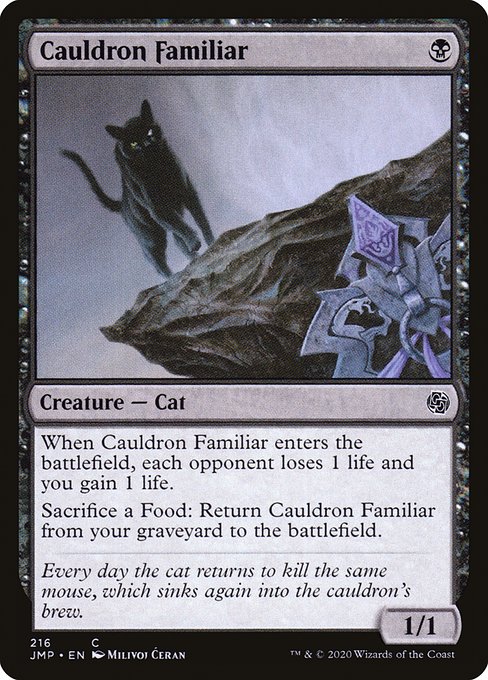
When this creature enters, each opponent loses 1 life and you gain 1 life.
Cauldron Familiar
When this creature enters, each opponent loses 1 life and you gain 1 life.
Sacrifice a Food: Return this card from your graveyard to the battlefield.
and
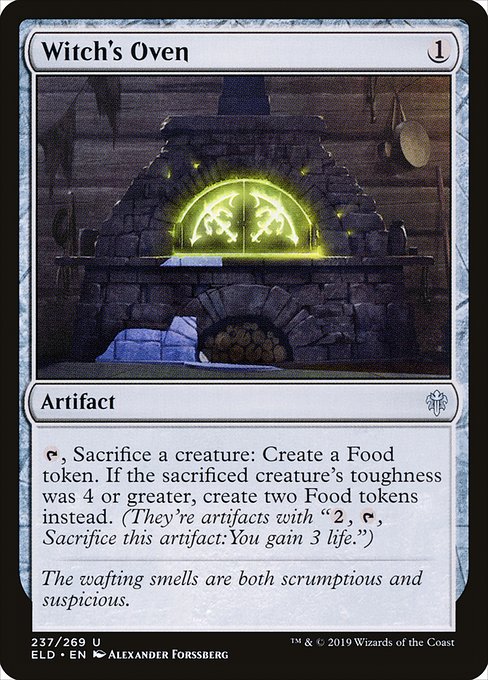
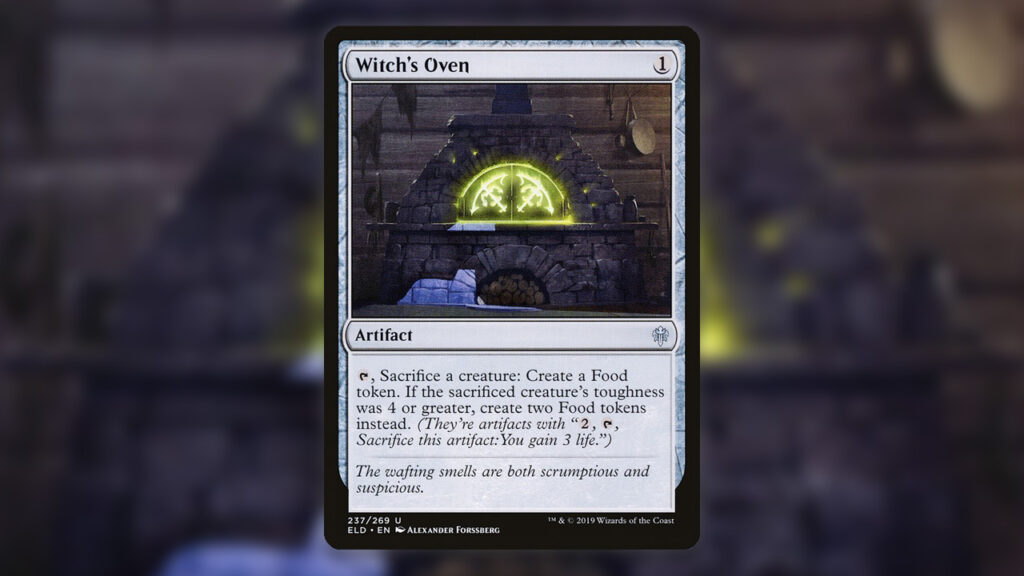
Witch’s Oven
 Witch’s Oven
{T}, Sacrifice a creature: Create a Food token. If the sacrificed creature's toughness was 4 or greater, create two Food tokens instead. (They're artifacts with "{2}, {T}, Sacrifice this token: You gain 3 life.")
. If you’ve played against Rakdos Sacrifice in Pioneer before, you know how annoying this combination of cards can be to play against.
Witch’s Oven
{T}, Sacrifice a creature: Create a Food token. If the sacrificed creature's toughness was 4 or greater, create two Food tokens instead. (They're artifacts with "{2}, {T}, Sacrifice this token: You gain 3 life.")
. If you’ve played against Rakdos Sacrifice in Pioneer before, you know how annoying this combination of cards can be to play against.
With both cards in play, you have a lot of inevitability. Every turn, you can sacrifice Cauldron Familiar to Witch’s Oven, creating a Food token in the process. That Food then lets you return Familiar to play, draining the opponent for one life. Draining for one life each turn may not sound scary, but it adds up quickly. The fact that you can always block with Familiar in combat before sacrificing it to Oven makes it difficult to race. If you have multiple Ovens going, things can start to get out of hand.
As good as Familiar and Oven are together, they become a major problem with Satoru in the mix. Each time Familiar comes back from the graveyard, you draw a card. Your opponent better kill Satoru quickly, otherwise you will bury them in card advantage.
Read More: Leaked MTG Modern Horizons 3 Reprint Sees 614% Price Increase!
Satoru and Sorin
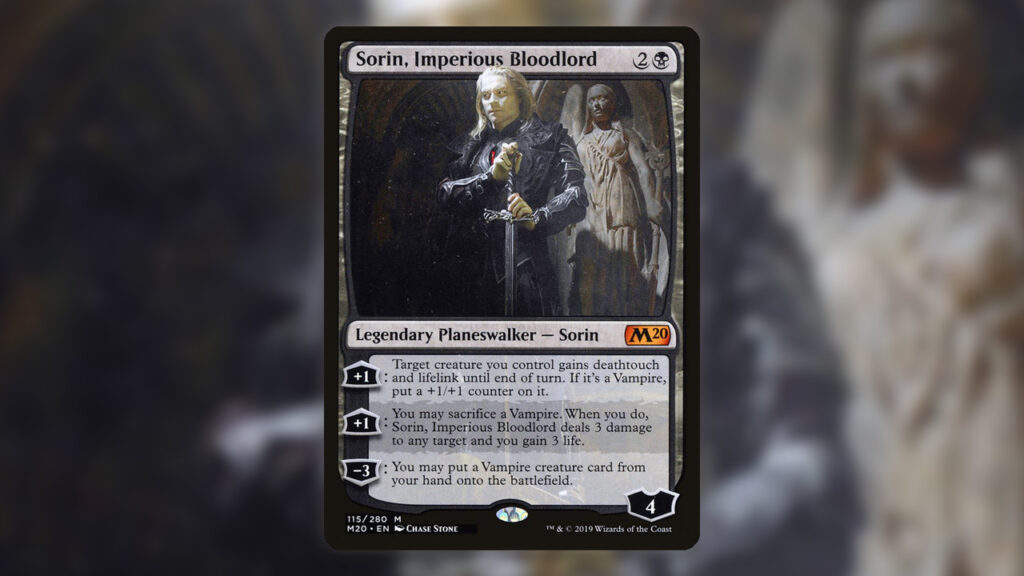
Beyond the Cauldron Familiar package, this deck also makes use of a potent combo that has revolutionized the Pioneer metagame. At this point, it’s well known just how strong the combination of Sorin, Imperious Bloodlord and
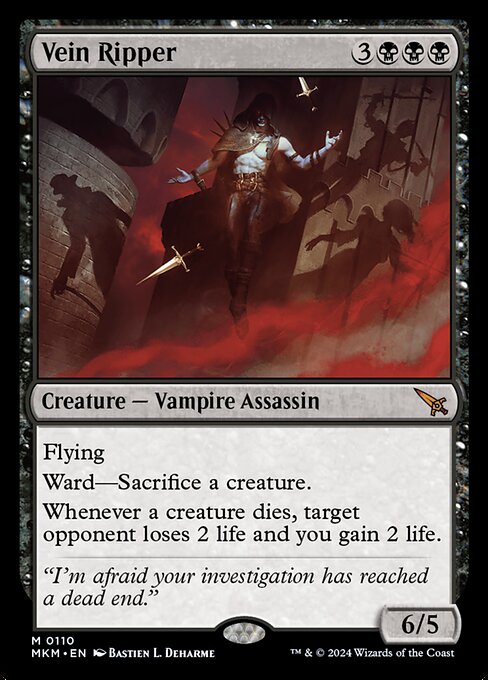
Vein Ripper
 Vein Ripper
Flying
Vein Ripper
Flying
Ward—Sacrifice a creature.
Whenever a creature dies, target opponent loses 2 life and you gain 2 life.
is. While these cards primarily show up in Rakdos Vampires shells in Pioneer, they have also popped up in Modern alongside powerful additions like
Bloodghast
 Bloodghast
This creature can't block.
Bloodghast
This creature can't block.
This creature has haste as long as an opponent has 10 or less life.
Landfall — Whenever a land you control enters, you may return this card from your graveyard to the battlefield.
.
Obviously, in any games where you can assemble Sorin+Vein Ripper on turn three, you’re golden. You’ll even get to draw a card off Satoru when you put Vein Ripper into play as a bonus! However, both cards actually work nicely individually in this deck. For instance, even if you don’t have Vein Ripper in hand to pair with Sorin,
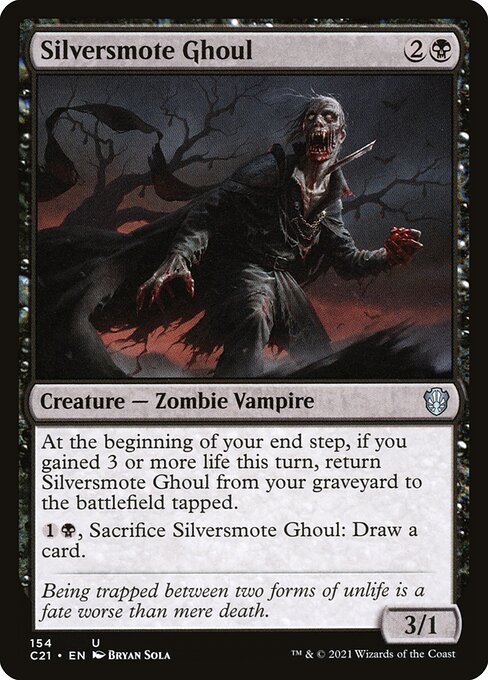
Silversmote Ghoul
 Silversmote Ghoul
At the beginning of your end step, if you gained 3 or more life this turn, return this card from your graveyard to the battlefield tapped.
Silversmote Ghoul
At the beginning of your end step, if you gained 3 or more life this turn, return this card from your graveyard to the battlefield tapped.
{1}{B}, Sacrifice this creature: Draw a card.
provides a synergistic backup plan.
With Sorin and Silversmote Ghoul at the ready, you can use Sorin’s +1 ability to sacrifice Silversmote Ghoul and get a virtual
Lightning Helix
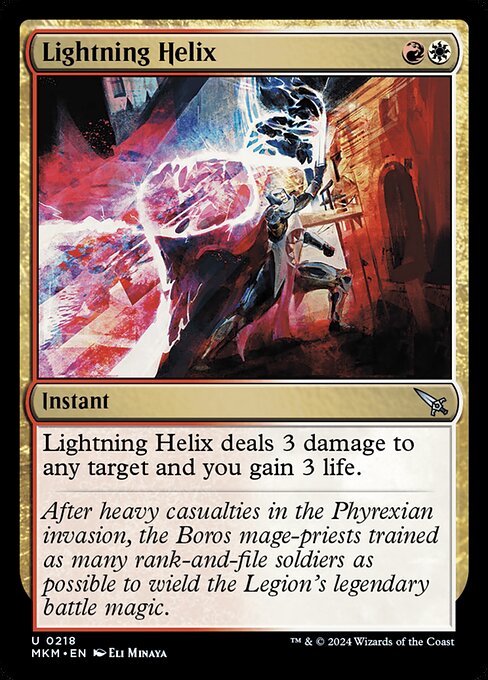 Lightning Helix
 deals 3 damage to any target and you gain 3 life.
out of the deal. Now that you’ve gained three life, Ghoul will come back on your end step, and you can repeat this again on the following turn. This is yet another way to trigger Satoru every turn cycle.
Lightning Helix
Lightning Helix deals 3 damage to any target and you gain 3 life.
out of the deal. Now that you’ve gained three life, Ghoul will come back on your end step, and you can repeat this again on the following turn. This is yet another way to trigger Satoru every turn cycle.
On top of that, Silversmote Ghoul works perfectly in conjunction with Witch’s Oven. If your opponent ever goes to kill Ghoul, you simply sacrifice it to make a Food token. That Food token conveniently gains you enough life to trigger Ghoul to return from your graveyard to play. Given how powerful Ghoul is with both Sorin and Satoru, I’m surprised to not see more copies of Ghoul in this decklist. It’s worth considering replacing
Spell Pierce
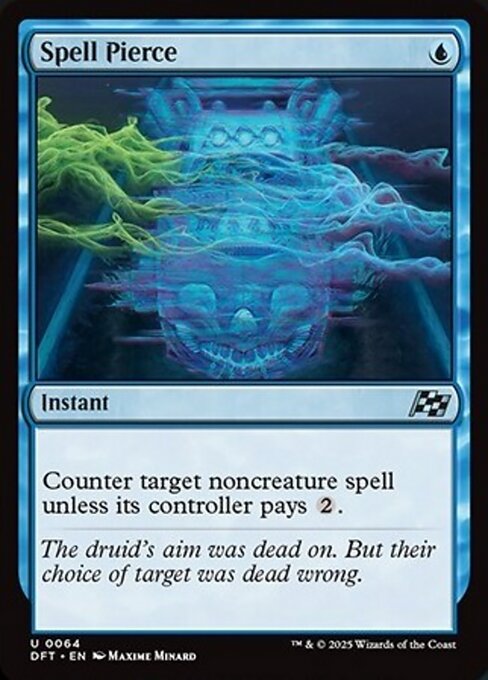 Spell Pierce
Counter target noncreature spell unless its controller pays {2}.
or
Preacher of the Schism
Spell Pierce
Counter target noncreature spell unless its controller pays {2}.
or
Preacher of the Schism
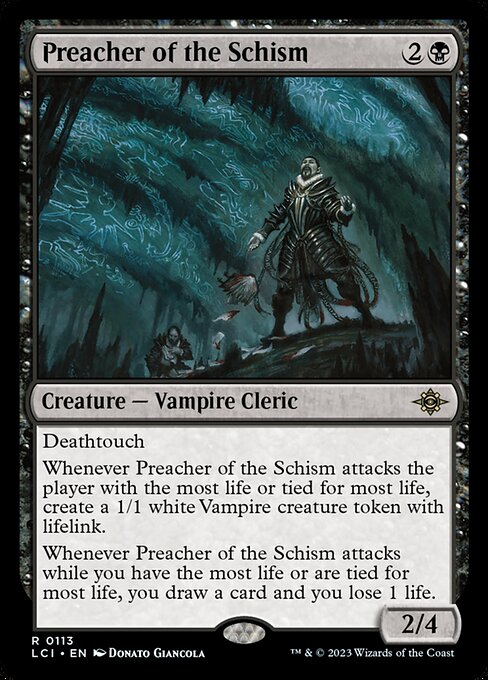 Preacher of the Schism
Deathtouch
Preacher of the Schism
Deathtouch
Whenever this creature attacks the player with the most life or tied for most life, create a 1/1 white Vampire creature token with lifelink.
Whenever this creature attacks while you have the most life or are tied for most life, you draw a card and you lose 1 life.
with more copies of Ghoul instead.
Notably, without access to
Fable of the Mirror-Breaker
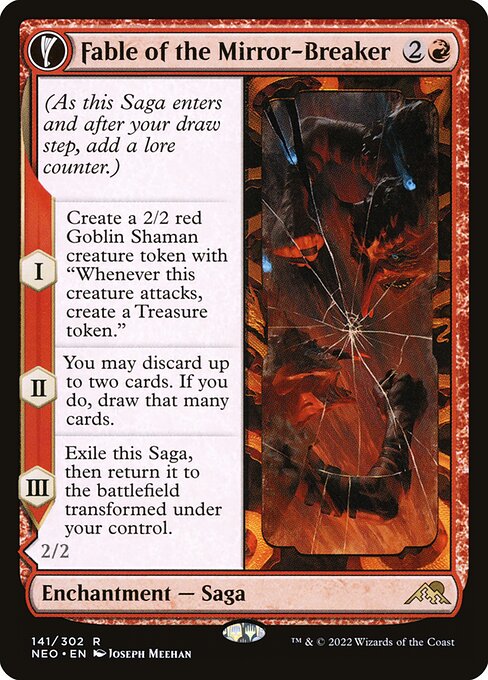 Fable of the Mirror-Breaker
(As this Saga enters and after your draw step, add a lore counter.)
Fable of the Mirror-Breaker
(As this Saga enters and after your draw step, add a lore counter.)
I — Create a 2/2 red Goblin Shaman creature token with "Whenever this token attacks, create a Treasure token."
II — You may discard up to two cards. If you do, draw that many cards.
III — Exile this Saga, then return it to the battlefield transformed under your control.
to ramp you towards Vein Ripper or discard excess copies of it, the card does have the risk of rotting in your hand for a little while. However, casting it is still very much on the table, and in this deck, it can close the game in short order. If you have Familiar and Oven going for example, Vein Ripper speeds up your clock substantially. It’s cool how all the seemingly disparate pieces of this deck actually fit together to form a coherent gameplan.
Read More: Leaked Special Guests Threaten Massive MTG Arena Disruption
Strengths and Weaknesses
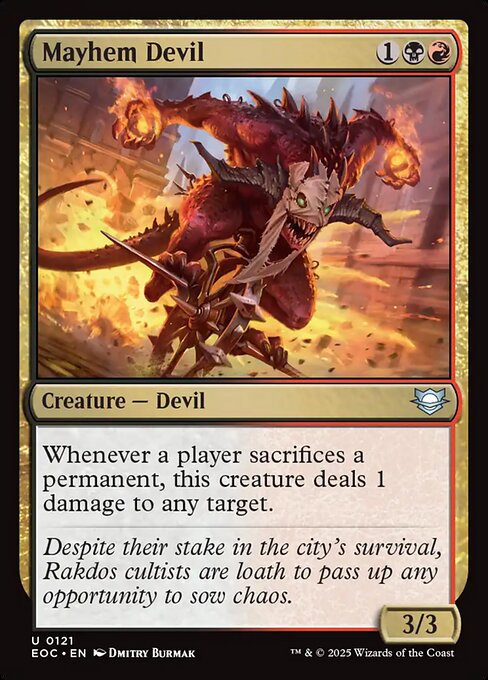
Generally, this strategy is going to do quite well against Creature decks. Cauldron Familiar and Witch’s Oven decks have historically done quite well against decks trying to race them in combat. Even though there’s no
Mayhem Devil
 Mayhem Devil
Whenever a player sacrifices a permanent, this creature deals 1 damage to any target.
present to mow down the opponent’s board, this deck has enough interaction to withstand an early barrage. Once Vein Ripper hits the board, it’s likely lights out for the opponent.
Mayhem Devil
Whenever a player sacrifices a permanent, this creature deals 1 damage to any target.
present to mow down the opponent’s board, this deck has enough interaction to withstand an early barrage. Once Vein Ripper hits the board, it’s likely lights out for the opponent.
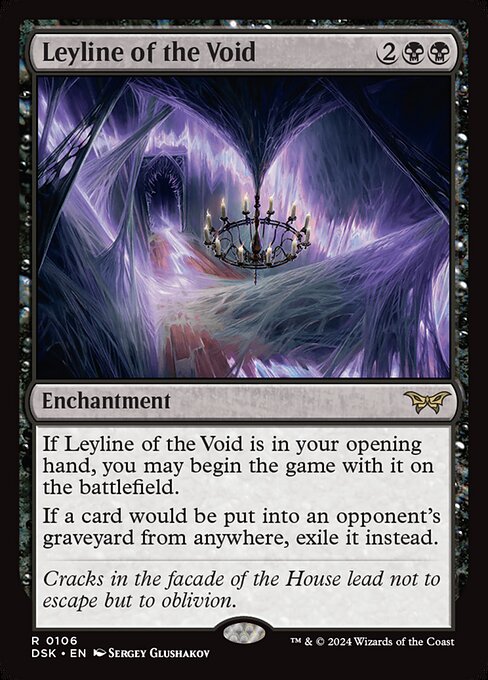
At the same time, Satoru and Ghoul are excellent in attrition battles. Card advantage, recursive threats, and four copies of
Leyline of the Void
 Leyline of the Void
If this card is in your opening hand, you may begin the game with it on the battlefield.
Leyline of the Void
If this card is in your opening hand, you may begin the game with it on the battlefield.
If a card would be put into an opponent's graveyard from anywhere, exile it instead.
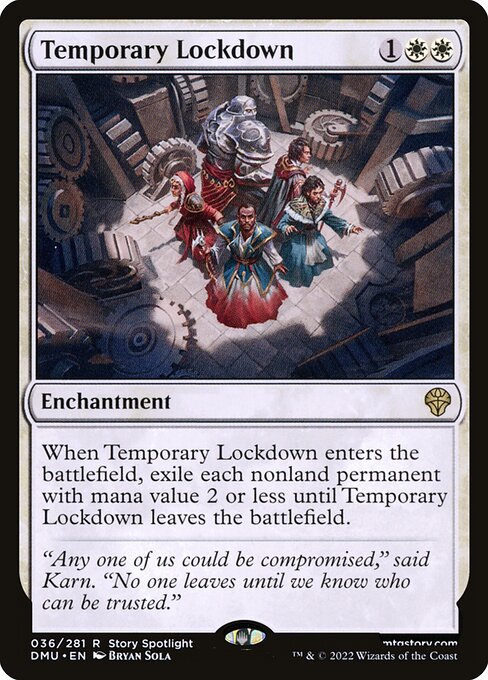
out of the sideboard give you a great chance versus Izzet Phoenix. The Vampires package makes this deck a little less vulnerable to
Temporary Lockdown
 Temporary Lockdown
When this enchantment enters, exile each nonland permanent with mana value 2 or less until this enchantment leaves the battlefield.
too, which is important against control.
Temporary Lockdown
When this enchantment enters, exile each nonland permanent with mana value 2 or less until this enchantment leaves the battlefield.
too, which is important against control.
The biggest area of weakness for this deck is definitely against combo. As good as Cauldron Familiar and Satoru are in grindy games, they don’t provide the fastest clock. Decks like Niv to Light and
Lotus Field
 Lotus Field
Hexproof
Lotus Field
Hexproof
This land enters tapped.
When this land enters, sacrifice two lands.
{T}: Add three mana of any one color.
combo may be able to ignore your incremental advantage and simply go over the top of it. Luckily, an early Vein Ripper backed up by
Thoughtseize
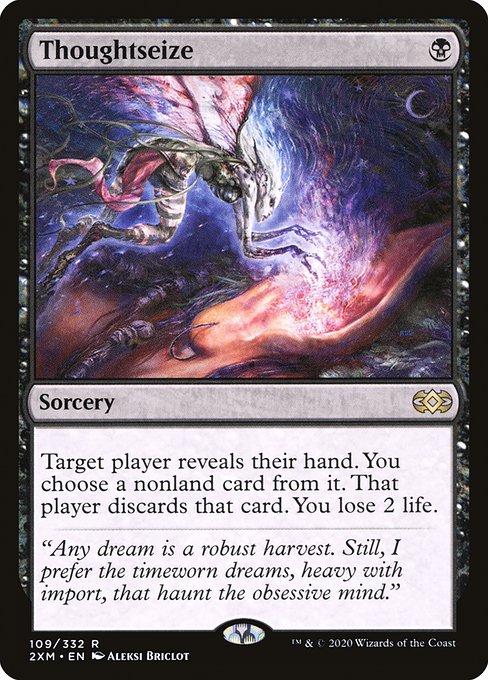 Thoughtseize
Target player reveals their hand. You choose a nonland card from it. That player discards that card. You lose 2 life.
still has the potential to bail you out of a tough spot.
Thoughtseize
Target player reveals their hand. You choose a nonland card from it. That player discards that card. You lose 2 life.
still has the potential to bail you out of a tough spot.
This deck is certainly less streamlined than traditional Rakdos Vampires, and likely has more polarizing matchups. Not having access to Fable definitely makes this deck less consistent than Rakdos Vampires or sacrifice decks normally would be. Still, this deck’s ability to attack from multiple angles makes it scary to play against. At the end of the day, Satoru has immense Constructed potential, and this is just the beginning.
Read More: New Cards Make a Strong Showing at Pro Tour Thunder Junction!