
Recently, Arena Championship 4 showcased an intriguing format for all the world to see at the highest level. Historic was the format of choice, one that is completely Arena-centric. While Standard exists both on Arena and in Paper, Historic as a whole is made up exclusively of all cards available on Arena, outside of a handful of cards that are banned in the format. This means that, for players that are newer to Historic, it can sometimes be difficult to know what cards and decks are the strongest. After all, there are a limited number of decklists from major events out there to go off of.
Not only that, but the Lord of the Rings MTG set introduced a multitude of elite cards into Historic, completely altering the landscape of the format. This was quite apparent at the Arena Championship as well. For anyone looking to get involved in this unique format but having trouble knowing where to start, we’ve got you covered. Today, we’re going over the best cards available in Historic, many of which are sensational build-around cards that can help get you started on the right path.
Of note, both
The One Ring
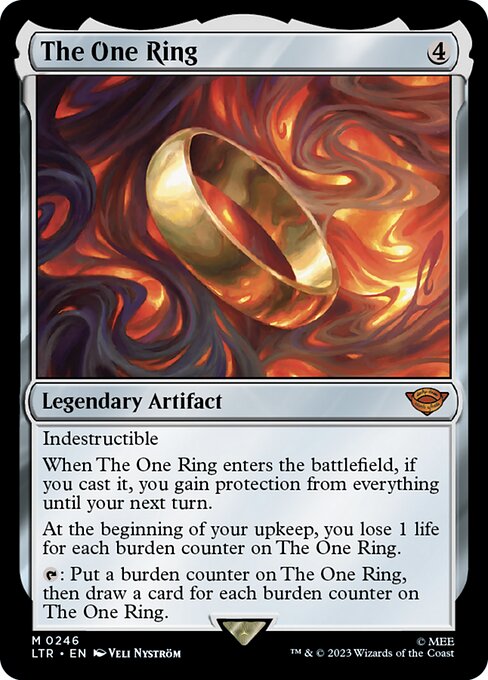 The One Ring
Indestructible
The One Ring
Indestructible
When The One Ring enters, if you cast it, you gain protection from everything until your next turn.
At the beginning of your upkeep, you lose 1 life for each burden counter on The One Ring.
{T}: Put a burden counter on The One Ring, then draw a card for each burden counter on The One Ring.
and
Orcish Bowmasters
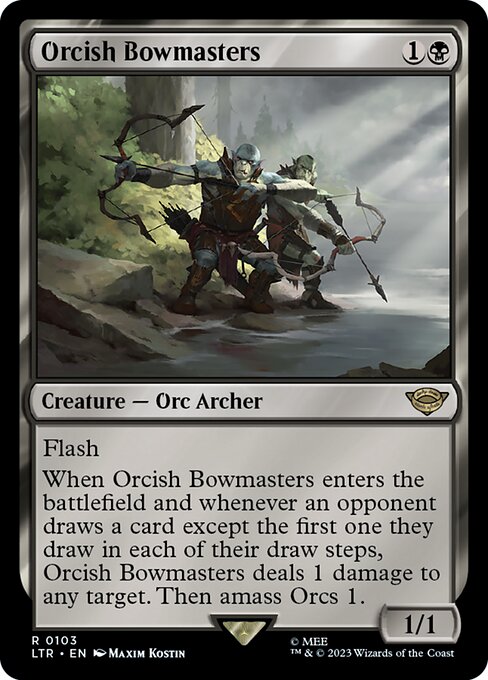 Orcish Bowmasters
Flash
Orcish Bowmasters
Flash
When this creature enters and whenever an opponent draws a card except the first one they draw in each of their draw steps, this creature deals 1 damage to any target. Then amass Orcs 1.
have very recently been nerfed on Arena. While we don’t have a ton of information on how these nerfs will shift the metagame moving forward, there is plenty of room for speculation, so these rankings reflect what we believe to be the top Historic cards moving forward. We will make sure to keep you updated as the format continues to shake out. With that out of the way, here are the best MTG cards in Historic.
#5 The One Ring
For those that have played or followed Modern since the release of Lord of the Rings: Tales of Middle-earth, it’s probably not too surprising to see this card on the list. The One Ring was a staple of Rakdos Midrange in Historic and showed up in some other strategies such as in the sideboard of decks with
Karn, the Great Creator
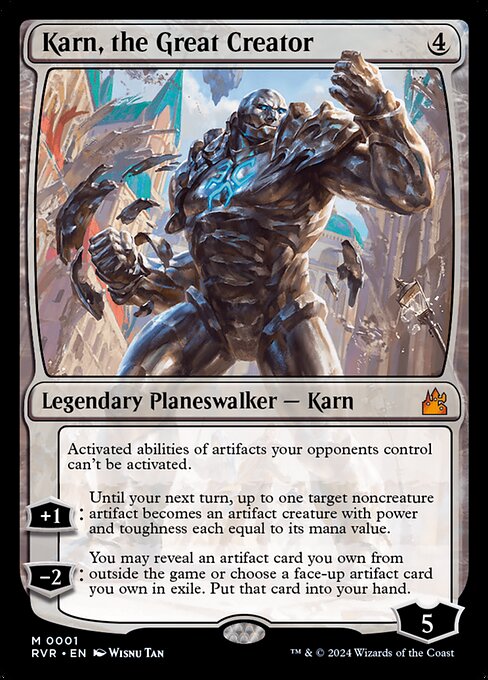 Karn, the Great Creator
Activated abilities of artifacts your opponents control can't be activated.
Karn, the Great Creator
Activated abilities of artifacts your opponents control can't be activated.
+1: Until your next turn, up to one target noncreature artifact becomes an artifact creature with power and toughness each equal to its mana value.
−2: You may reveal an artifact card you own from outside the game or choose a face-up artifact card you own in exile. Put that card into your hand.
and Golgari Yawgmoth from time to time.
Still, the card wasn’t quite as dominant in Historic as in Modern. This was, in part, due to the fact that, without free spells like
Solitude
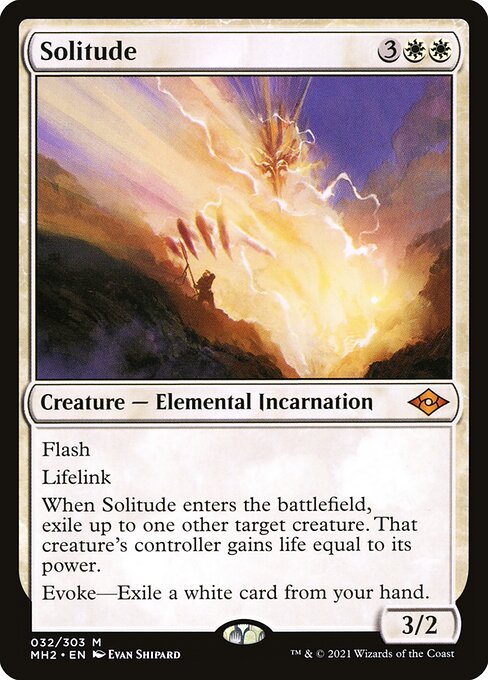 Solitude
Flash
Solitude
Flash
Lifelink
When this creature enters, exile up to one other target creature. That creature's controller gains life equal to its power.
Evoke—Exile a white card from your hand.
or
Force of Negation
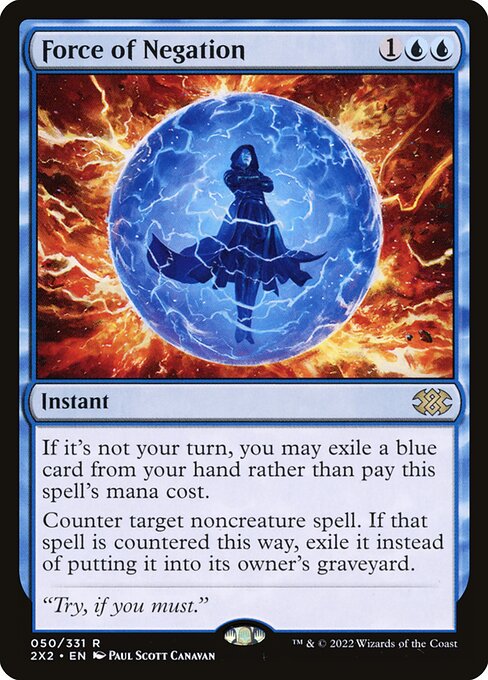 Force of Negation
If it's not your turn, you may exile a blue card from your hand rather than pay this spell's mana cost.
Force of Negation
If it's not your turn, you may exile a blue card from your hand rather than pay this spell's mana cost.
Counter target noncreature spell. If that spell is countered this way, exile it instead of putting it into its owner's graveyard.
to abuse, tapping out for a four-mana card at Sorcery speed that doesn’t ultimately affect the board in a big way isn’t always easy. This is especially true given how combo heavy Historic has been.
Yet, there’s no denying the power of The One Ring when left unchecked, and the synergy between it and
Sheoldred, the Apocalypse
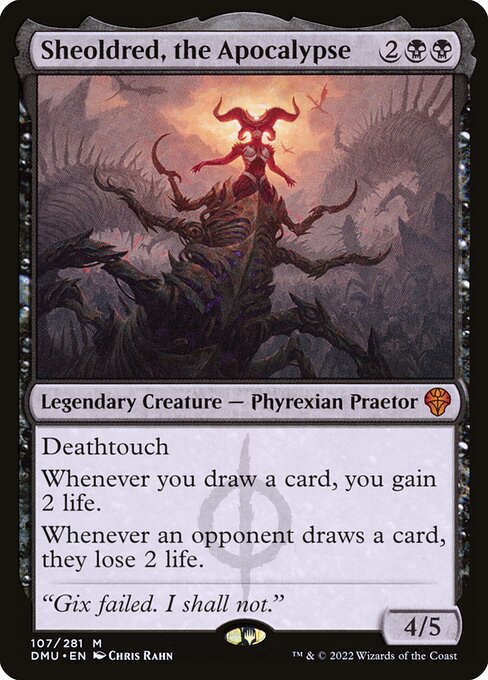 Sheoldred, the Apocalypse
Deathtouch
Sheoldred, the Apocalypse
Deathtouch
Whenever you draw a card, you gain 2 life.
Whenever an opponent draws a card, they lose 2 life.
which gains you life when you draw cards is quite powerful.
I do expect the nerf of The One Ring to affect its playability to a certain degree moving forward, however. While forcing players to pay an extra mana to put burden counters on it may not sound like a big deal, for decks like Rakdos Midrange that would normally slam the card turn four, the extra mana can be a big deal.
From now on, if you play the card turn with no mana left open, you will not be able to draw any extra cards until your next turn. That being said, the “Protection from everything” clause still applies, and waiting until you have five mana available to play and activate The One Ring is still likely to be a strong option. This card wasn’t nerfed quite as significantly as
Orcish Bowmasters
Orcish Bowmasters
Flash
When this creature enters and whenever an opponent draws a card except the first one they draw in each of their draw steps, this creature deals 1 damage to any target. Then amass Orcs 1.
. For these reasons, the card still makes the list, just not quite as high as it would be otherwise.
Read More: Top 12 MTG Best Commander Cards
#4 Fable of the Mirror-Breaker
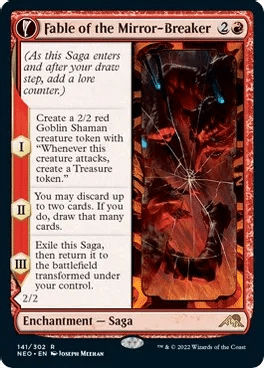
Fable of the Mirror-Breaker is a very powerful card, and one that gravitates players towards playing midrange decks. Both Rakdos Midrange and Jund Midrange were heavily supported by the strong three-drop. While Rakdos in its current form played both Orcish Bowmasters and The One Ring, which have since been weakened, Fable is still a great card that can hold these decks together.
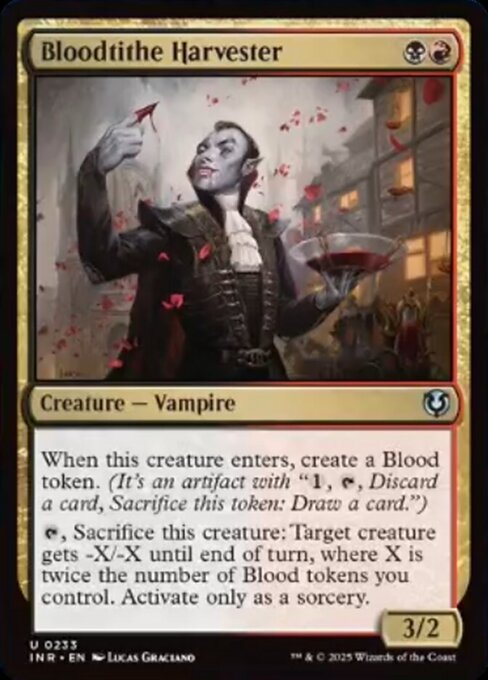
Bloodtithe Harvester
 Bloodtithe Harvester
When this creature enters, create a Blood token. (It's an artifact with "{1}, {T}, Discard a card, Sacrifice this token: Draw a card.")
Bloodtithe Harvester
When this creature enters, create a Blood token. (It's an artifact with "{1}, {T}, Discard a card, Sacrifice this token: Draw a card.")
{T}, Sacrifice this creature: Target creature gets -X/-X until end of turn, where X is twice the number of Blood tokens you control. Activate only as a sorcery.
is still a great card to copy with Fable and going back to running cards like
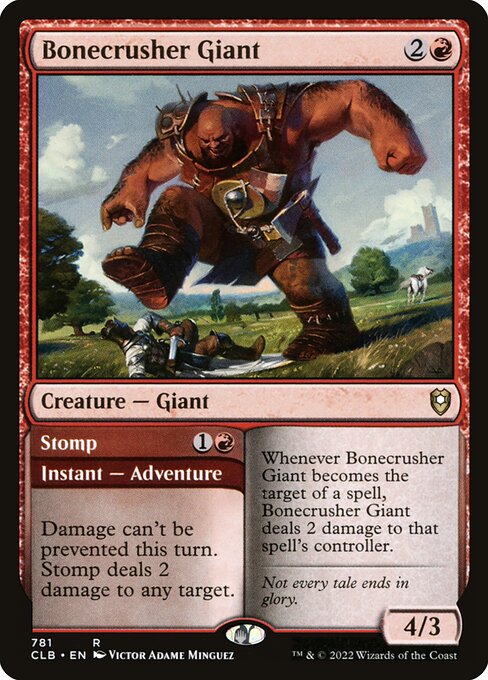
Bonecrusher Giant
 Bonecrusher Giant
Whenever this creature becomes the target of a spell, this creature deals 2 damage to that spell's controller.
alongside Fable seems like a perfectly reasonable option. Fable decks may still have their hands full with the multitude of combo decks in the format, but there’s no denying how good Fable is on rate, and I expect Fable decks to still be a pillar of the Historic format.
Bonecrusher Giant
Whenever this creature becomes the target of a spell, this creature deals 2 damage to that spell's controller.
alongside Fable seems like a perfectly reasonable option. Fable decks may still have their hands full with the multitude of combo decks in the format, but there’s no denying how good Fable is on rate, and I expect Fable decks to still be a pillar of the Historic format.
Read More: Top 10 Most Expensive Doctor Who MTG Cards
#3 Yawgmoth, Thran Physician/Kethis, the Hidden Hand
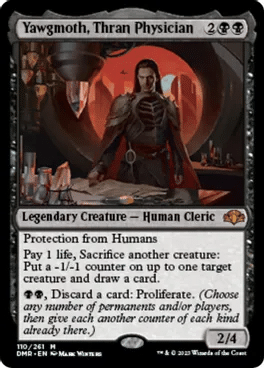
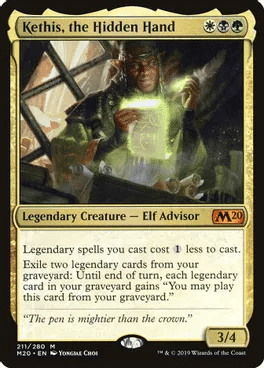
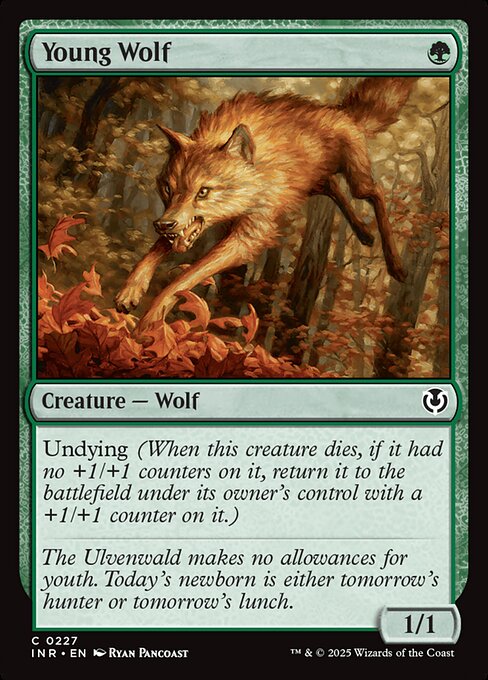
We decided to group these two cards because they play quite similar roles in their respective archetypes. Both cards are the primary combo pieces in which their archetypes are built around. Golgari Yawgmoth decks rely on using Yawgmoth in conjunction with Undying Creatures, such as
Young Wolf
 Young Wolf
Undying (When this creature dies, if it had no +1/+1 counters on it, return it to the battlefield under its owner's control with a +1/+1 counter on it.)
, and
Zulaport Cutthroat
Young Wolf
Undying (When this creature dies, if it had no +1/+1 counters on it, return it to the battlefield under its owner's control with a +1/+1 counter on it.)
, and
Zulaport Cutthroat
 Zulaport Cutthroat
Whenever this creature or another creature you control dies, each opponent loses 1 life and you gain 1 life.
, to draw a plethora of cards and drain the opponent for a ton of life all at once. The combo can be executed using the following steps:
Zulaport Cutthroat
Whenever this creature or another creature you control dies, each opponent loses 1 life and you gain 1 life.
, to draw a plethora of cards and drain the opponent for a ton of life all at once. The combo can be executed using the following steps:
- First, sacrifice a Young Wolf with Yawgmoth’s activated ability. Do not target any of your creatures with the -1/-1 counter. The Young Wolf will come back with a +1/+1 counter thanks to Undying. This will trigger Zulaport Cutthroat, draining your opponent for one.
- Second, sacrifice your Young Wolf that does not have a counter, targeting the Young Wolf that does have a counter. Your counters will cancel out. Your other Young Wolf will come back with a +1/+1 counter thanks to Undying. This, once again, will trigger Zulaport Cutthroat.
- You can repeat step two over and over, sacrificing the Young Wolf without a counter, targeting the one that does have a counter, thanks to -1/-1 counters and +1/+1 counters canceling one another out.
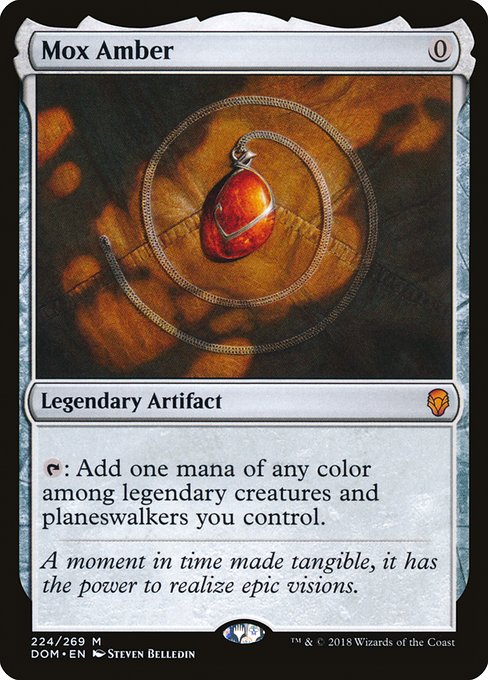
Kethis combo relies on using multiple copies of
Mox Amber
 Mox Amber
{T}: Add one mana of any color among legendary creatures and planeswalkers you control.
alongside Kethis and
Jace, the Perfected Mind
Mox Amber
{T}: Add one mana of any color among legendary creatures and planeswalkers you control.
alongside Kethis and
Jace, the Perfected Mind
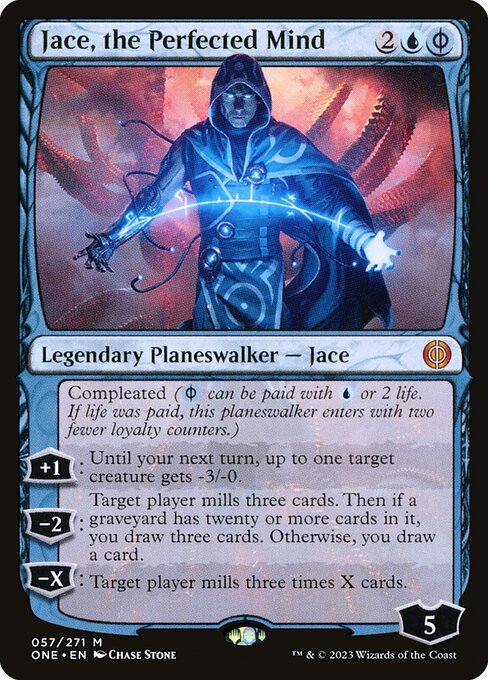 Jace, the Perfected Mind
Compleated ({U/P} can be paid with {U} or 2 life. If life was paid, this planeswalker enters with two fewer loyalty counters.)
Jace, the Perfected Mind
Compleated ({U/P} can be paid with {U} or 2 life. If life was paid, this planeswalker enters with two fewer loyalty counters.)
+1: Until your next turn, up to one target creature gets -3/-0.
−2: Target player mills three cards. Then if a graveyard has twenty or more cards in it, you draw three cards. Otherwise, you draw a card.
−X: Target player mills three times X cards.
to eventually mill your opponent’s entire library. With two copies of Mox Amber between your hand and your graveyard, you can use one to float mana, activate Kethis to cast the other from your graveyard causing the tapped copy to go to your graveyard via the “Legend Rule,” and repeat. With Jace in the mix, you can repeatedly mill yourself for a bunch via Jace’s last ability, then start targeting your opponent once your graveyard has enough cards in it to keep activating Kethis.
Both of these combo decks are quite strong, and both Yawgmoth and Kethis are robust value engines, even without the full combos intact. The importance of both cards to the format earns them a spot on this list, even if neither card shows up in other strategies.
Read More: Top 10 Most Expensive MTG Wilds of Eldraine Cards!
#2 Expressive Iteration
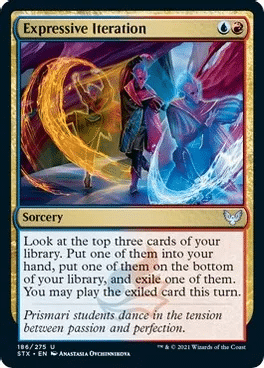
Expressive Iteration is an extremely strong source of card advantage. There’s a reason the card is banned in both Legacy and Pioneer. On turn three, assuming you hit a Land as one of the three cards see with Iteration, you can put a card into your hand and exile the Land to play during the same turn. For two mana, you got a decent mix of card selection as well as an advantage on total resources.
The best way to maximize Iteration, however, is to fill your deck with cheap spells. This way, you can cast Iteration and reliably exile a spell instead of a Land to cast until the end of your turn. The archetype where this card shines the most is certainly Izzet Wizards. Not only is Izzet Wizards filled with cheap spells, but cards like
Soul-Scar Mage
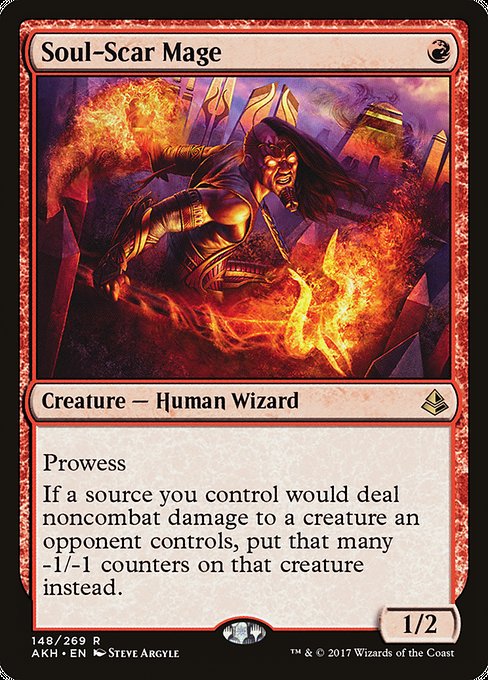 Soul-Scar Mage
Prowess
Soul-Scar Mage
Prowess
If a source you control would deal noncombat damage to a creature an opponent controls, put that many -1/-1 counters on that creature instead.
and
Balmor, Battlemage Captain
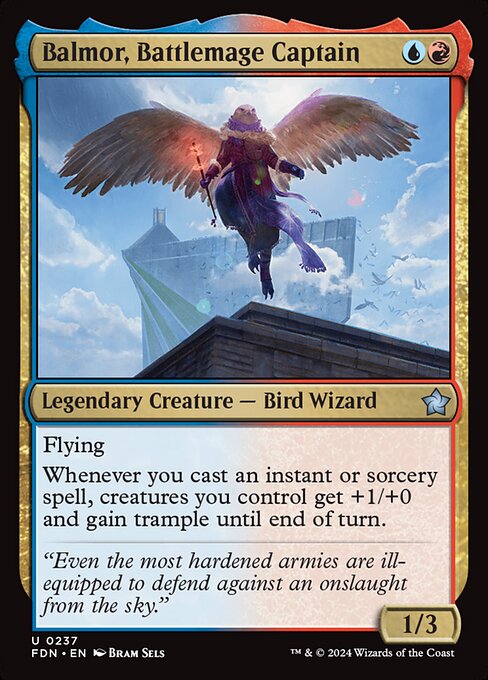 Balmor, Battlemage Captain
Flying
Balmor, Battlemage Captain
Flying
Whenever you cast an instant or sorcery spell, creatures you control get +1/+0 and gain trample until end of turn.
benefit from casting cheap spells as well. Izzet Wizards won the Arena Championship, and Iteration is a big reason why the deck is so strong. With Orcish Bowmasters heavily nerfed, we expect this deck to grow even more in popularity, and possibly move to playing even more cantrips.
Read More: MTG Arena Event Calendar
#1 Nykthos, Shrine to Nyx
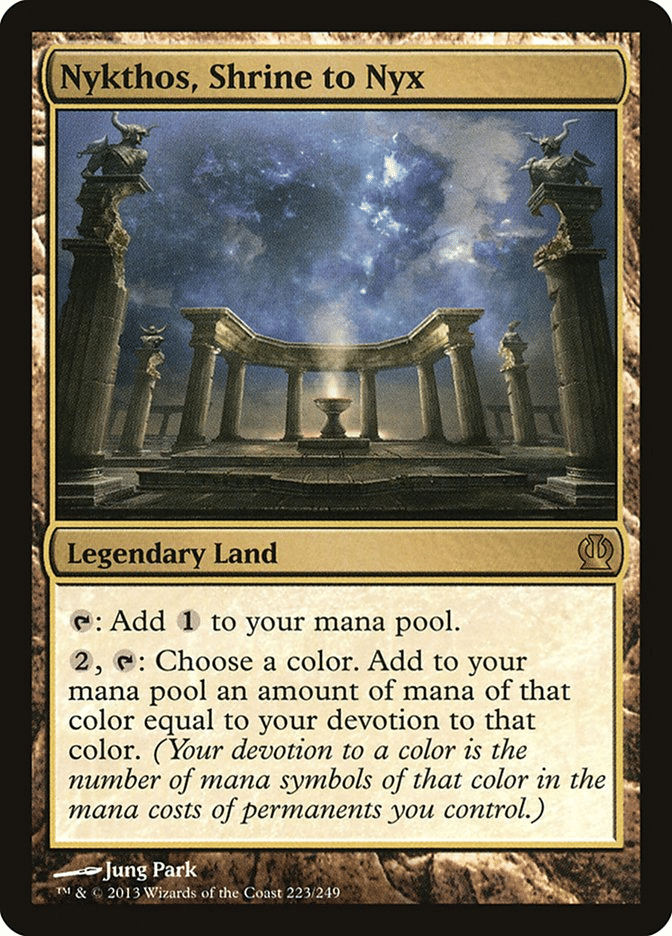
Similar to Yawgmoth and Kethis, Nykthos is relatively dependent on a specific archetype to make it super strong. This archetype is none other than mono-green Devotion. This deck is not much different than mono-green Devotion in Pioneer. Both decks use mana dorks, cards that add lots of devotion like
Old-Growth Troll
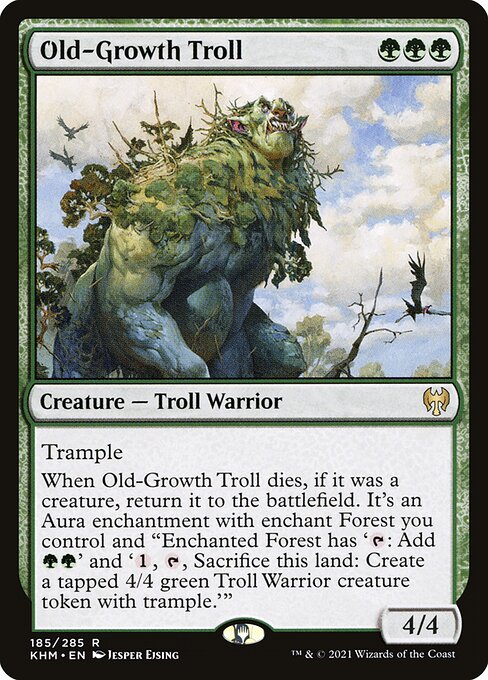 Old-Growth Troll
Trample
Old-Growth Troll
Trample
When Old-Growth Troll dies, if it was a creature, return it to the battlefield. It's an Aura enchantment with enchant Forest you control and "Enchanted Forest has '{T}: Add {G}{G}' and '{1}, {T}, Sacrifice this land: Create a tapped 4/4 green Troll Warrior creature token with trample.'"
, and ways to find Nykthos, such as
Cavalier of Thorns
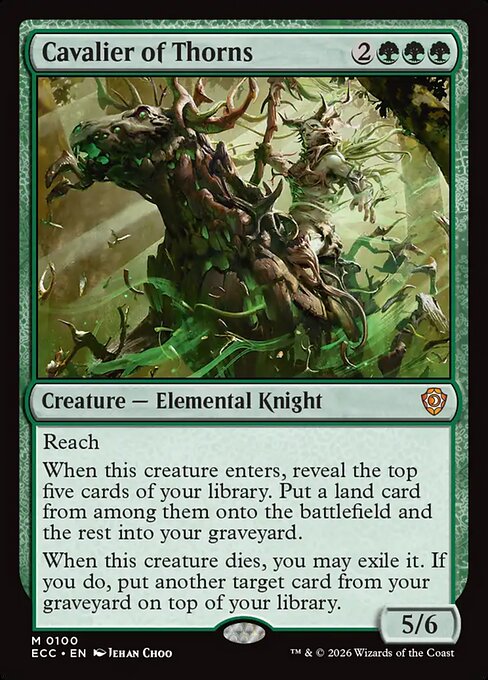 Cavalier of Thorns
Reach
Cavalier of Thorns
Reach
When this creature enters, reveal the top five cards of your library. Put a land card from among them onto the battlefield and the rest into your graveyard.
When this creature dies, you may exile it. If you do, put another target card from your graveyard on top of your library.
. With enough Devotion,
Karn, the Great Creator
Karn, the Great Creator
Activated abilities of artifacts your opponents control can't be activated.
+1: Until your next turn, up to one target noncreature artifact becomes an artifact creature with power and toughness each equal to its mana value.
−2: You may reveal an artifact card you own from outside the game or choose a face-up artifact card you own in exile. Put that card into your hand.
and
Storm the Festival
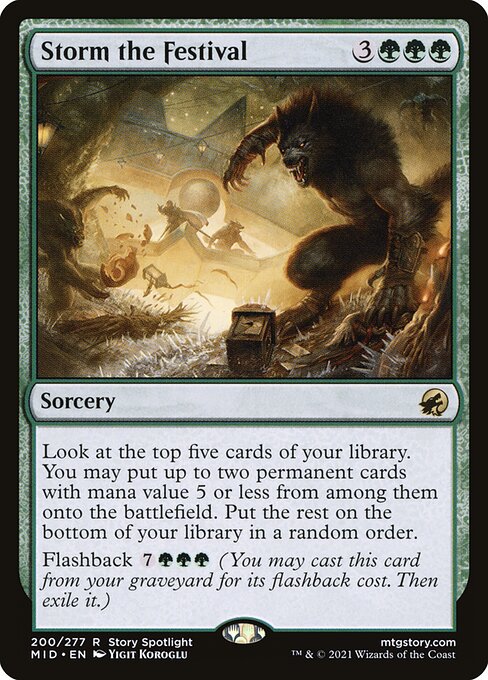 Storm the Festival
Look at the top five cards of your library. You may put up to two permanent cards with mana value 5 or less from among them onto the battlefield. Put the rest on the bottom of your library in a random order.
Storm the Festival
Look at the top five cards of your library. You may put up to two permanent cards with mana value 5 or less from among them onto the battlefield. Put the rest on the bottom of your library in a random order.
Flashback {7}{G}{G}{G} (You may cast this card from your graveyard for its flashback cost. Then exile it.)
become reliable win conditions. Notably, the Historic version gets to use
Utopia Sprawl
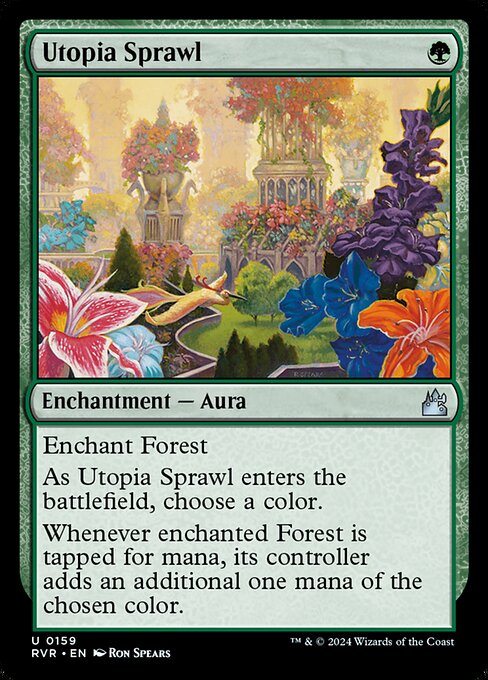 Utopia Sprawl
Enchant Forest
Utopia Sprawl
Enchant Forest
As this Aura enters, choose a color.
Whenever enchanted Forest is tapped for mana, its controller adds an additional one mana of the chosen color.
and
Delighted Halfling
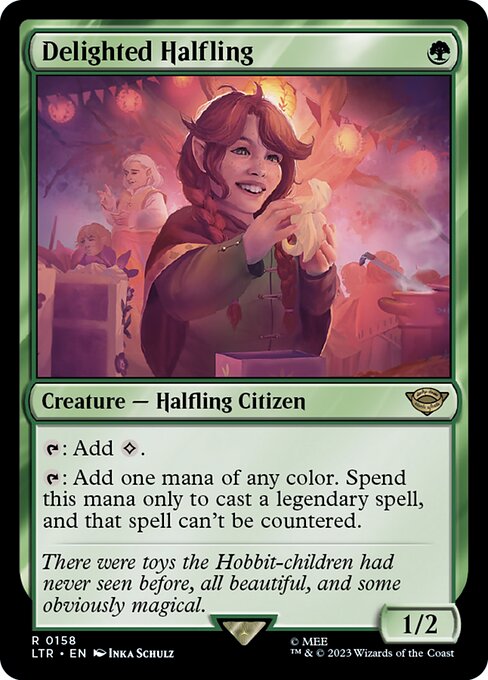 Delighted Halfling
{T}: Add {C}.
Delighted Halfling
{T}: Add {C}.
{T}: Add one mana of any color. Spend this mana only to cast a legendary spell, and that spell can't be countered.
in the one-drop slot, which are decent upgrades.
This deck is even capable of generating infinite mana and infinite life thanks to the backside of
Pestilent Cauldron
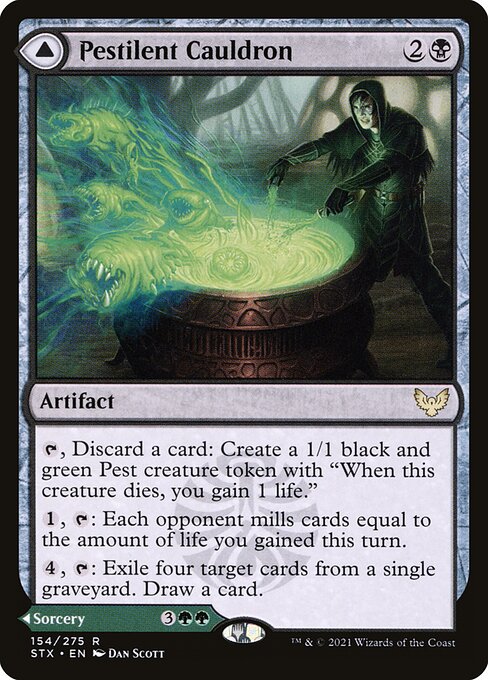 Pestilent Cauldron
{T}, Discard a card: Create a 1/1 black and green Pest creature token with "When this token dies, you gain 1 life."
Pestilent Cauldron
{T}, Discard a card: Create a 1/1 black and green Pest creature token with "When this token dies, you gain 1 life."
{1}, {T}: Each opponent mills cards equal to the amount of life you gained this turn.
{4}, {T}: Exile four target cards from a single graveyard. Draw a card.
. This requires two copies of Karn and two copies of
Kiora, Behemoth Beckoner
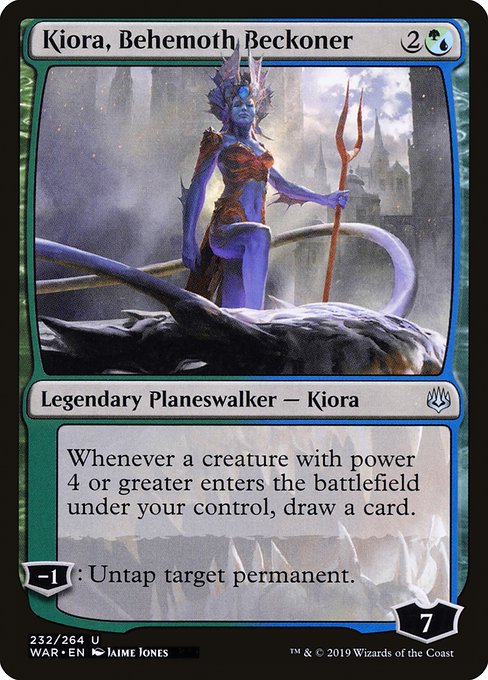 Kiora, Behemoth Beckoner
Whenever a creature you control with power 4 or greater enters, draw a card.
Kiora, Behemoth Beckoner
Whenever a creature you control with power 4 or greater enters, draw a card.
−1: Untap target permanent.
between the battlefield and graveyard, as well as enough Devotion. This combo is relatively convoluted though, so for simplicity’s sake, we will not explain it in full here.
The explosive turns that Nykthos helps create showcase why the card is high up on this list. The deck itself was relatively unaffected by the nerfs. With the amount of mana this deck generates, searching for The One Ring with Karn is still a viable strategy. This archetype was already excellent, and that is unlikely to change.
Read More: The MTG Best Format Choices Unordered (October 2023)