
If you ask most MTG players, the game’s complexity is undoubtedly one of its greatest strengths. Offering functionally infinite replayability, there’s nary a need to play anything else, ever. Unfortunately, as much as the depth and complexity of MTG are major boons, they’re not all good news. As many new players will know, trying to get into MTG can be seriously confusing.
Throughout the over 30 years that Magic: the Gathering has been around, Wizards has created some obscenely complex cards. Frequently resulting in scratched heads and judges being called, these cards are definitely a lot to deal with. The question remains, however, which MTG card is the most confusing ever printed?
Considering different MTG players will find different things confusing and complex, this is a very hard question to answer. Without data on all the huge callings ever made, we may never had a definitive data-driven answer. Thanks to a recent Reddit poll, however, we may have the next best thing.
Taking to Reddit recently, u/Corrutped asked MTG players a simple question, “What is the most complex card, in your opinion?” Responding in droves, players quickly pitched in all the worst offenders, with a few familiar faces providing extra problems. From this data, it seems we might finally have an answer, so, let’s go over all the worst offenders.
Here are the most confusing cards in MTG!
Honorable Mention | Chains of Mephistopheles
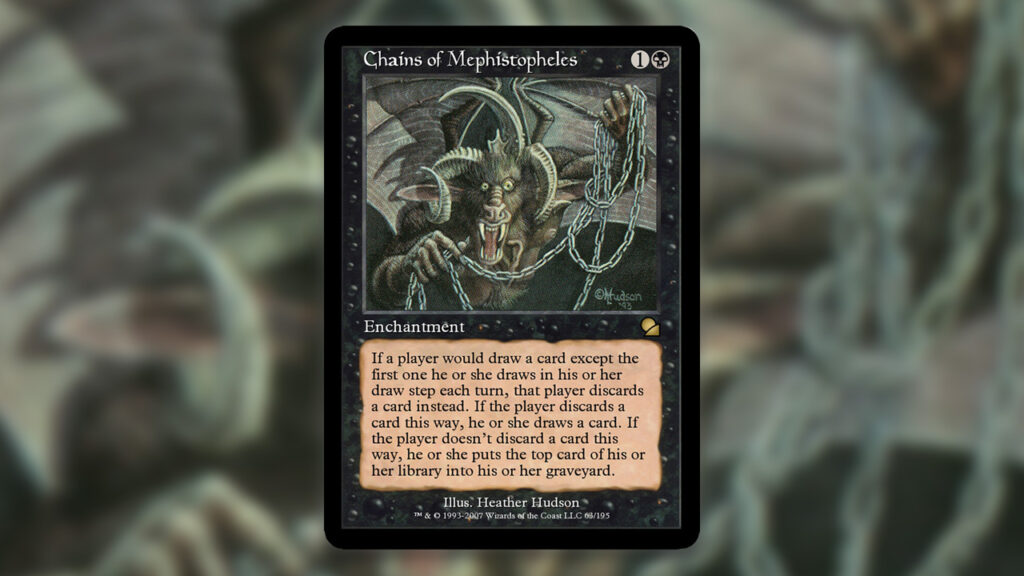
As one of the most iconic confusing cards in MTG, this list wouldn’t be complete without Chains of Mephistopheles. That being said, however, thanks to just how confusing it was, this problem has long been solved. Looking at the card might be a head-scratching nightmare, but on Gatherer, there’s a simple explanation.
“Here’s what happens when Chains of Mephistopheles replaces a player’s draw: — If that player has at least one card in their hand, they discard a card and then draws a card. — If that player’s hand is empty, they put the top card of their library into their graveyard. The player doesn’t draw a card at all.”
Wizards of the Coast
Thanks to this handy dandy explanation, Chains of Mephistopheles isn’t the nightmare it quite used to be. That being said, however, there are still edge cases and confusion to be had, especially if you’re lacking the above explanation.
4 | Fetch Lands
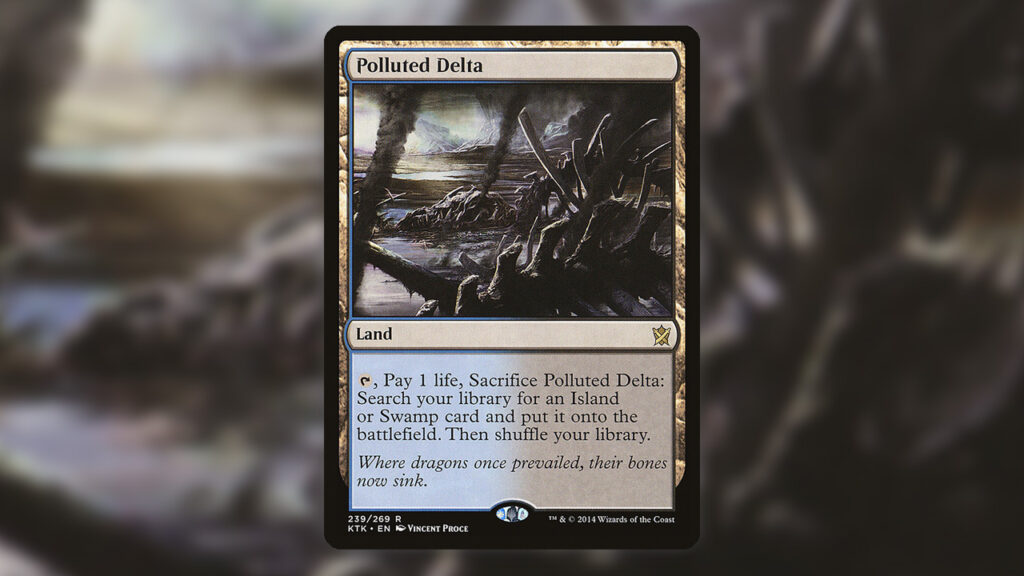
To kick off this list of confusing MTG cards, we have a rather oddball, perhaps even confusing, inclusion. Rather than just naming and shaming one card, the entire cycle of Fetch Lands is rather confusing. This, however, isn’t for the reason you might expect, as playing with these cards is very easy. Rather than being difficult in writing, Fetch Lands are instead rather difficult to properly understand and use well.
To new players, upon first glance, Fetch Lands might just look like
Evolving Wilds
 Evolving Wilds
{T}, Sacrifice this land: Search your library for a basic land card, put it onto the battlefield tapped, then shuffle.
on steroids. Able to find non-basic lands and play them untapped, Fetch Lands are obviously better, however, they get even stronger still. Alongside offering stellar fixing, each Fetch Lands also has incredible depth through synergy.
Evolving Wilds
{T}, Sacrifice this land: Search your library for a basic land card, put it onto the battlefield tapped, then shuffle.
on steroids. Able to find non-basic lands and play them untapped, Fetch Lands are obviously better, however, they get even stronger still. Alongside offering stellar fixing, each Fetch Lands also has incredible depth through synergy.
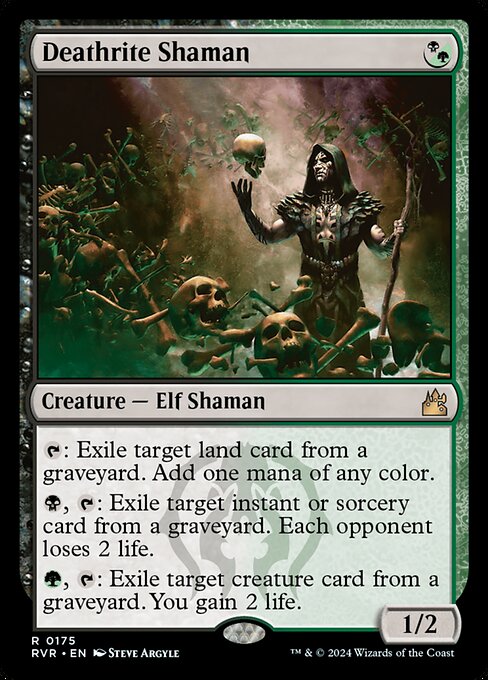
Synergizing with
Deathrite Shaman
 Deathrite Shaman
{T}: Exile target land card from a graveyard. Add one mana of any color. (Activate only as an instant.)
Deathrite Shaman
{T}: Exile target land card from a graveyard. Add one mana of any color. (Activate only as an instant.)
{B}, {T}: Exile target instant or sorcery card from a graveyard. Each opponent loses 2 life.
{G}, {T}: Exile target creature card from a graveyard. You gain 2 life.
,
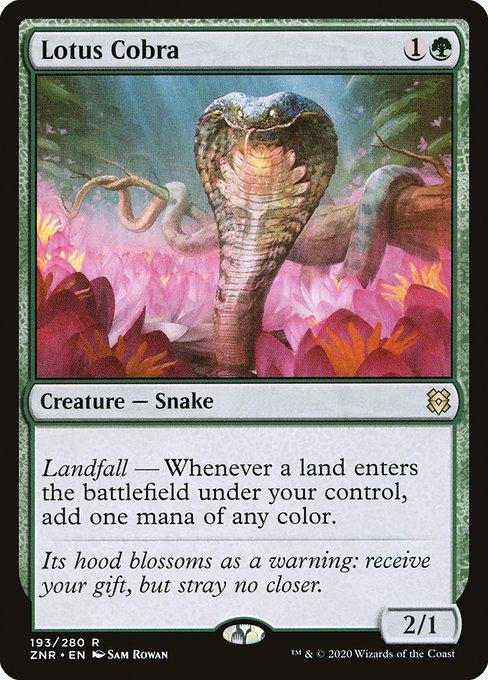
Lotus Cobra
 Lotus Cobra
Landfall — Whenever a land you control enters, add one mana of any color.
, and
Fatal Push
Lotus Cobra
Landfall — Whenever a land you control enters, add one mana of any color.
, and
Fatal Push
 Fatal Push
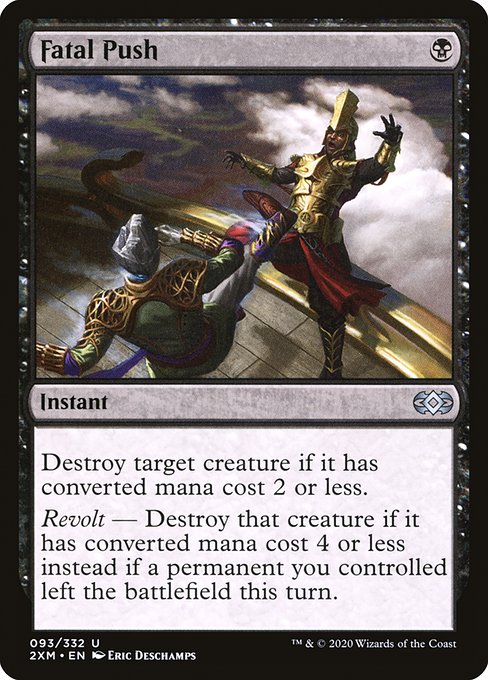
Destroy target creature if it has mana value 2 or less.
Fatal Push
Destroy target creature if it has mana value 2 or less.
Revolt — Destroy that creature if it has mana value 4 or less instead if a permanent left the battlefield under your control this turn.
Fetch Lands offer incredible value. Alongside this, Fetch Lands allow you to shuffle away the worst cards from your hand when playing
Brainstorm
 Brainstorm
Draw three cards, then put two cards from your hand on top of your library in any order.
.
Brainstorm
Draw three cards, then put two cards from your hand on top of your library in any order.
.
While these interactions aren’t too unfathomably complex, they don’t present themselves immediately when looking at a
Polluted Delta
 Polluted Delta
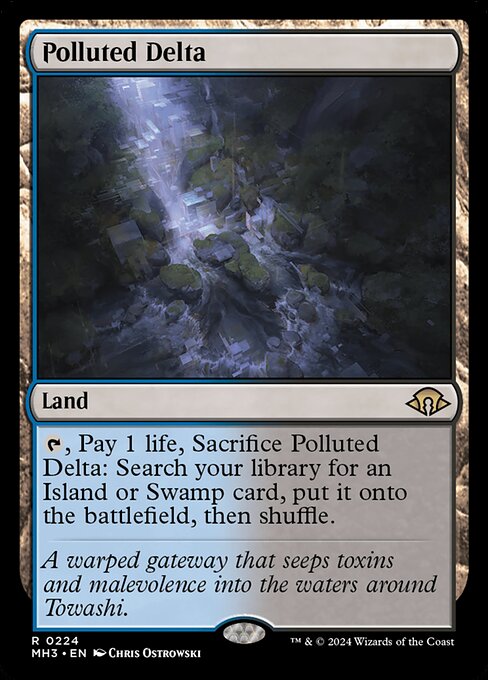
{T}, Pay 1 life, Sacrifice this land: Search your library for an Island or Swamp card, put it onto the battlefield, then shuffle.
. The actual function of Fetch Lands aren’t too confusing, but navigating all the other interactions with them can be. Thanks to this, Fetch Lands have a reputation for being more confusing than they should be.
Polluted Delta
{T}, Pay 1 life, Sacrifice this land: Search your library for an Island or Swamp card, put it onto the battlefield, then shuffle.
. The actual function of Fetch Lands aren’t too confusing, but navigating all the other interactions with them can be. Thanks to this, Fetch Lands have a reputation for being more confusing than they should be.
3 | Nazgûl
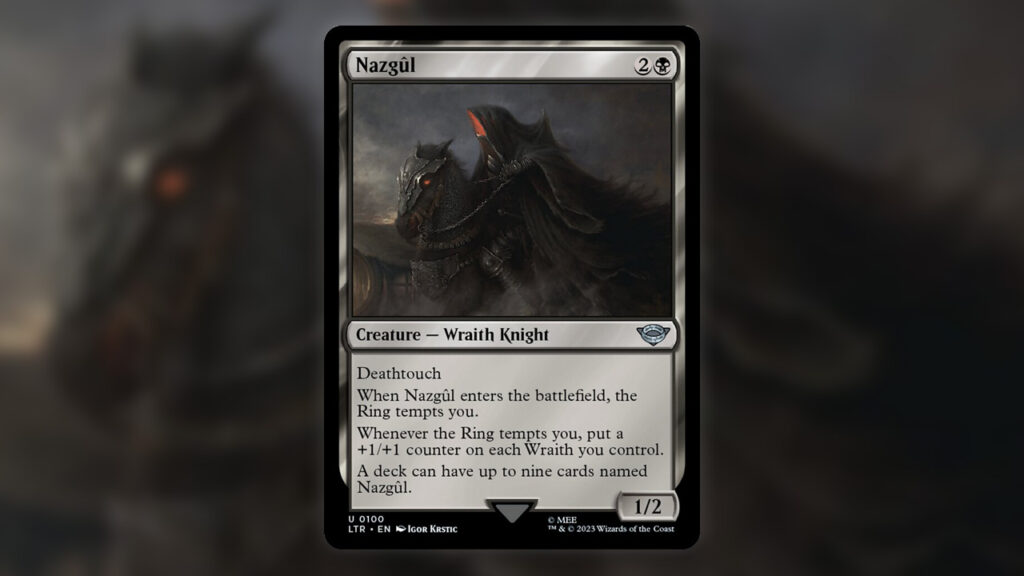
On their own, Nazgûl isn’t inherently too complex. Sure, they might flaunt deck construction rules, but reading the card explains the card… right? Unfortunately, no. As much as Nazgûl does lay things out clearly, it also includes the text “The Ring tempts you.” To a new player, this unusual bit of rules text is completely unexplained. In fact, not one of the 54 cards with this mechanic explains it at all.
To put it lightly, this is a major problem and a growing trend within recent MTG releases. Between The Ring, The Initiative, Monarch, and Venture into the Dungeon, confusion is definitely on the rise. Requiring supplemental game pieces to track and be explained, these mechanics are almost incomprehensible to new players.
Thankfully, as a small silver lining, thanks to online recourses and MTG Arena, confusion issues can be easily mitigated. That being said, however, cards like Nazgûl are nevertheless part of a worrying and growing trend of complexity. For added bonus points,
The Ring
 The Ring
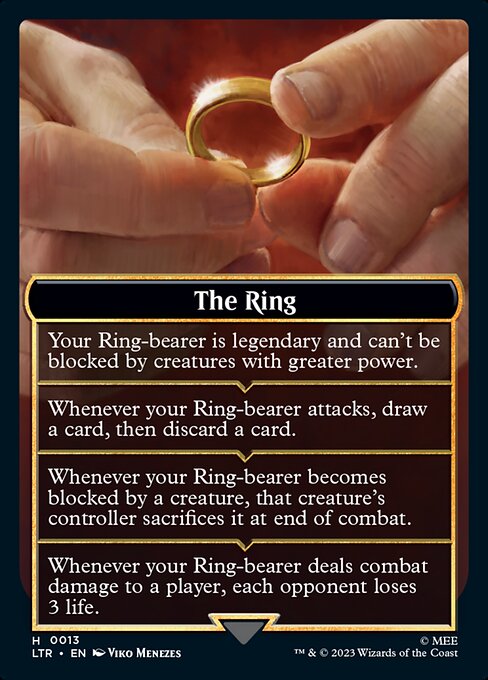
Your Ring-bearer is legendary and can't be blocked by creatures with greater power.
The Ring
Your Ring-bearer is legendary and can't be blocked by creatures with greater power.
Whenever your Ring-bearer attacks, draw a card, then discard a card.
Whenever your Ring-bearer becomes blocked by a creature, that creature's controller sacrifices it at end of combat.
Whenever your Ring-bearer deals combat damage to a player, each opponent loses 3 life.
is a bit confusing itself with plenty of niche and complex rulings.
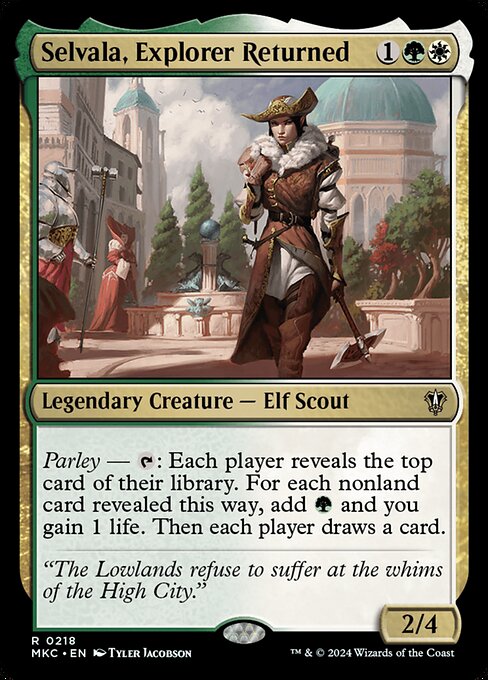
2 | Selvala, Explorer Returned
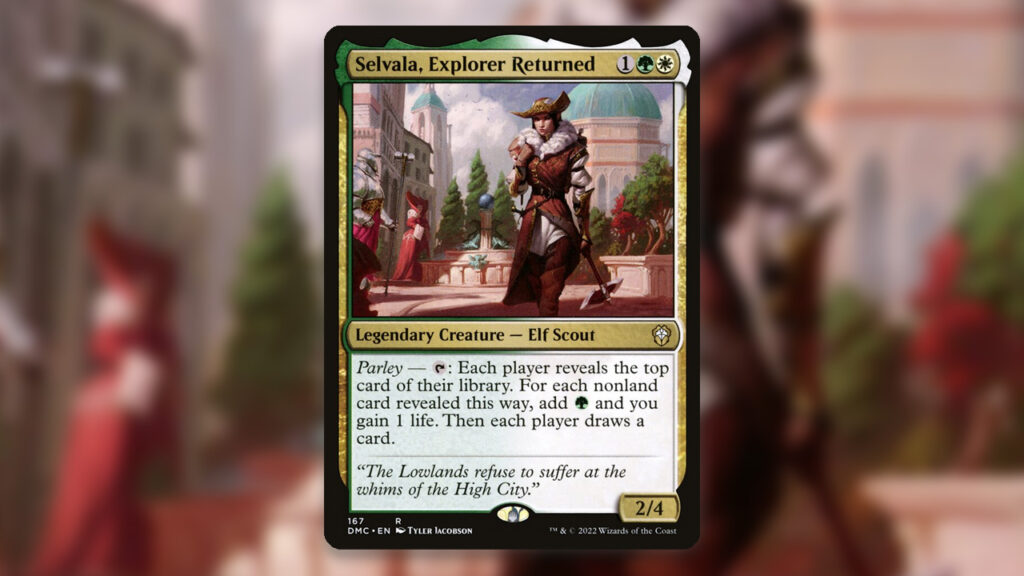
At first glance, Selvala, Explorer Returned looks deceptively simple. Surely their Parlay ability is just a potential mana generator and card draw engine, right? Technically yes, however, also no. While Selvala’s ability can be used very simply for the aforementioned effects it’s also a mana ability. Just like
Llanowar Elves
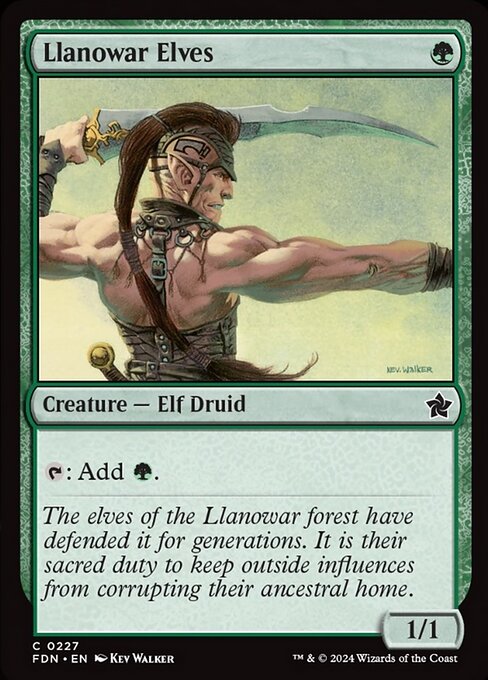 Llanowar Elves
{T}: Add {G}.
, this means it can be used to cast spells.
Llanowar Elves
{T}: Add {G}.
, this means it can be used to cast spells.
While this might all seem straightforward, unlike
Llanowar Elves
Llanowar Elves
{T}: Add {G}.
, Selvala can fail at generating mana. Should this happen, things get confusing fast, as the spell being cast and tapped land get reversed. To keep things confusing, Selvala’s ability won’t be reversed, so all players still get to draw a card.
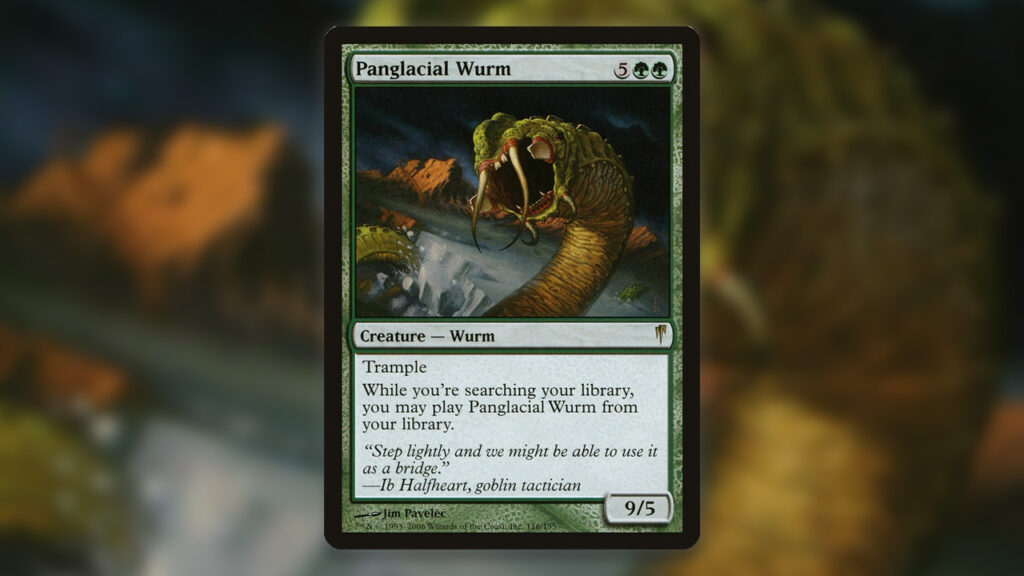
As if this unique failed mana generation wasn’t bad enough,
Panglacial Wurm
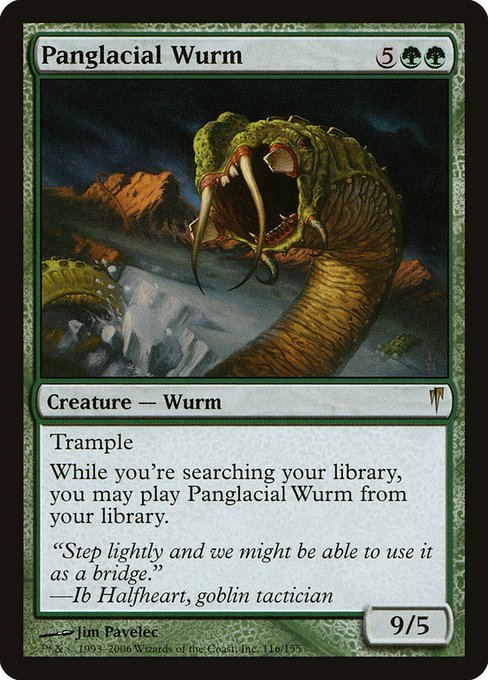 Panglacial Wurm
Trample
Panglacial Wurm
Trample
While you're searching your library, you may cast this card from your library.
can be thrown into the mix. When combined, this pair is an intently frustrating well of illegal actions, resulting in reversed spells and headaches all around. For the savvy player, however, this combo can be used to draw the top card of your library while you’re searching it.
The only silver lining here is that both these cards are incredibly scarcely played. As a result, there’s a good chance that you’re never going to run into this interaction in the wild.
1 | Word of Command
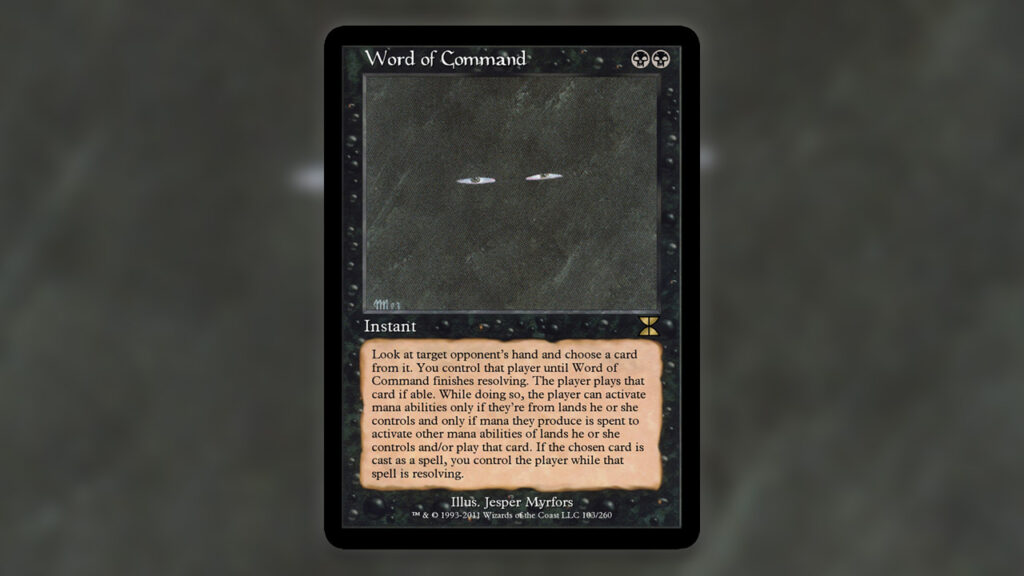
Claiming the dubious honor of being the most confusing card in MTG, we have
Word of Command
 Word of Command
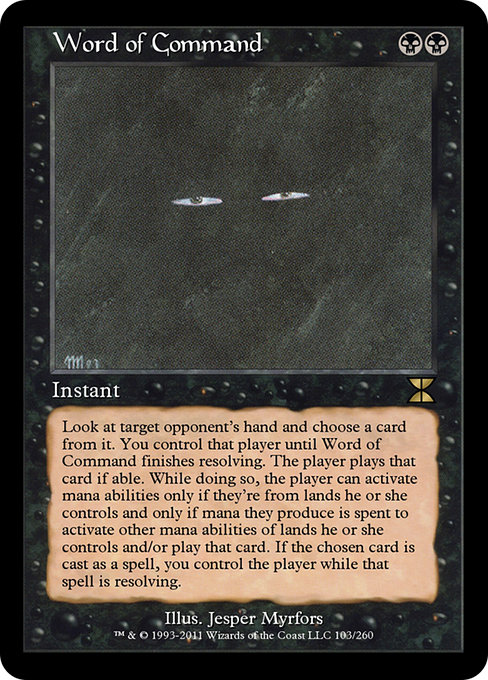
Look at target opponent's hand and choose a card from it. You control that player until Word of Command finishes resolving. The player plays that card if able. While doing so, the player can activate mana abilities only if they're from lands that player controls and only if mana they produce is spent to activate other mana abilities of lands the player controls and/or to play that card. If the chosen card is cast as a spell, you control the player while that spell is resolving.
. Just looking at the card, there’s no wonder it has earned this title, as it’s a baffling wall of text. Allowing you to take control of an opponent and force them to cast a spell, this Alpha card is full of edge cases and rules nightmares.
Word of Command
Look at target opponent's hand and choose a card from it. You control that player until Word of Command finishes resolving. The player plays that card if able. While doing so, the player can activate mana abilities only if they're from lands that player controls and only if mana they produce is spent to activate other mana abilities of lands the player controls and/or to play that card. If the chosen card is cast as a spell, you control the player while that spell is resolving.
. Just looking at the card, there’s no wonder it has earned this title, as it’s a baffling wall of text. Allowing you to take control of an opponent and force them to cast a spell, this Alpha card is full of edge cases and rules nightmares.
In its simplest form, after choosing a card with Word of Command, you get to choose how it’s cast. This means you pick the target as well as how the spell is paid for. As you might expect, this can lead to all manner of shenanigans and confusing antics. Unfortunately, practically none of this is explained on the card itself.
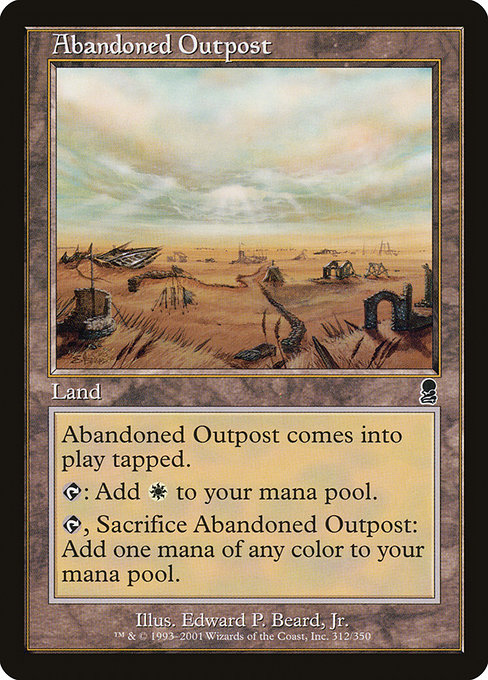
When controlling an opponent, even briefly with Word of Command, you get to see all that they do. This means you can take a peek at all face-down Morph cards, their hand, and even their deck through search effects. Bizarrely, you can even force the controlled player to play a land or sacrifice one like
Abandoned Outpost
 Abandoned Outpost
This land enters tapped.
Abandoned Outpost
This land enters tapped.
{T}: Add {W}.
{T}, Sacrifice this land: Add one mana of any color.
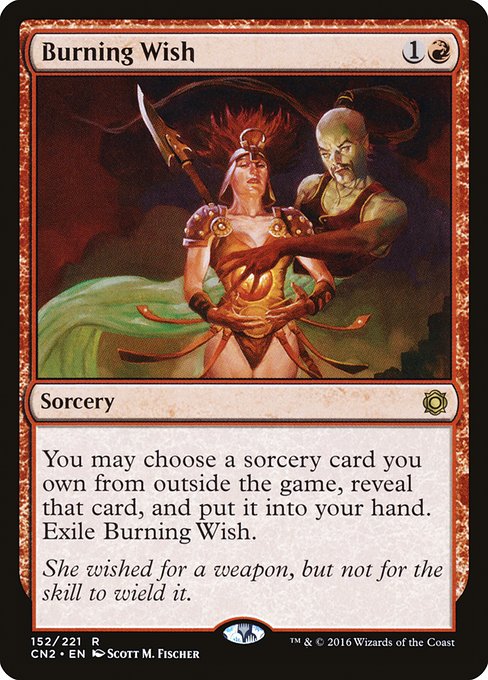
for mana. Despite all this information, you can’t look at your opponent’s Sideboard. This makes spells like
Burning Wish
 Burning Wish
You may reveal a sorcery card you own from outside the game and put it into your hand. Exile Burning Wish.
illegal to cast.
Burning Wish
You may reveal a sorcery card you own from outside the game and put it into your hand. Exile Burning Wish.
illegal to cast.
To add even more edge cases, Word of Command allows you to mandate and alternative casting costs are paid. Between Evoke spells, Pitch spells, Madness, Bargain, or Kicker, you can potentially do some real damage. If you find
Toxic Deluge
 Toxic Deluge
As an additional cost to cast this spell, pay X life.
Toxic Deluge
As an additional cost to cast this spell, pay X life.
All creatures get -X/-X until end of turn.
with Word of Command, you can even just kill your opponent outright.
Thankfully, just like
Selvala, Explorer Returned
 Selvala, Explorer Returned
Parley — {T}: Each player reveals the top card of their library. For each nonland card revealed this way, add {G} and you gain 1 life. Then each player draws a card. (Activate only as an instant.)
, Word of Command is not a very good spell. As a result, there’s a good chance that you’ll never have to face Word of Command in a real game.
Selvala, Explorer Returned
Parley — {T}: Each player reveals the top card of their library. For each nonland card revealed this way, add {G} and you gain 1 life. Then each player draws a card. (Activate only as an instant.)
, Word of Command is not a very good spell. As a result, there’s a good chance that you’ll never have to face Word of Command in a real game.
Read More: The Most Controversial MTG Cards of 2023