
Between different archetypes in MTG, Combo decks get the most publicity. These decks promote wacky interactions between cards that can win the game instantaneously. Other strategies play more traditionally, using creatures and board presence and removal to find a win by going under an opponent or by slowly running them out of options. Combo is an entirely different beast, as win conditions can be unnatural and explosive. These decks, therefore, can be difficult for more traditional players to adjust to. I am an MTG combo player. I have used various combo strategies to win cash in tournament play, and even when combo decks are terrible, you will find me playing them anyway.
After going down this rabbit hole, I have noticed that combo decks seem to have a bar-to-entry for the average MTG player, even though they get the most attention from players and spectators alike. This challenge comes from the different mindsets required to make these decks work. This doesn’t necessarily mean that combo decks are more challenging to play than a Tempo deck; UB Faeries was an incredibly difficult deck to play. No matter how much experience you have with the deck, the difference between a win and a loss always comes down to even the most minor decisions made during a game. While some combo decks are very difficult to pilot, most just require a different mindset. I hope that, with this article, readers will grow more appreciative of the combo archetype and have an idea of how to get into the combo mindset!
Different Types of Combo
Like the classification of traditional strategies, combo decks also have a bit of a division. While all fit under the combo umbrella, I would argue that there are two types of combo decks: Aggro Combo and Control Combo. These decks types require slightly different mindsets to approach, but there are a lot of overlapping factors. Here is a quick list of distinctions to help figure out what combo deck you’re trying to tackle:
- Aggro Combo refers to glass cannon strategies that don’t interact much with the opponent. You only care about doing your own complicated thing and winning out of nowhere. Examples of some Aggro Combo decks are traditional Storm and
Lotus Field
 Lotus Field
Hexproof
Lotus Field
Hexproof
This land enters tapped.
When this land enters, sacrifice two lands.
{T}: Add three mana of any one color. in Pioneer. These, generally, are the easiest combo decks to pilot but have a really steep learning curve. - Control Combo decks run a pile of interaction that slow the opponent down while you slowly get into a better position to combo off. Jeskai Mutate, Wilderness Reclamation, and
Splinter Twin
Splinter Twin
Enchant creature
Enchanted creature has "{T}: Create a token that's a copy of this creature, except it has haste. Exile that token at the beginning of the next end step." can all be considered Control Combo. These decks are the ones that I play the most and generally are the ones that destroy formats the most. These are also the most difficult decks to play since a bunch of micro decisions need to be made before you start to combo off. Think of these like a control deck with an alternate win condition because that’s precisely what it is.

Step 1: Learn How to Win

The whole point of playing combo in the first place is the uniqueness of the win condition. Since the win condition is the entire reason for playing combo, it makes sense that this is the most important thing to learn. Most combo decks have a main deck where almost every card in the deck’s purpose is to get you closer to the combo going off. These combo decks win a bit differently, so it’s essential to get your reps in and learn how exactly your combo deck is supposed to win.
The combo decks I am currently the most versed with are Jeskai Mutate (an EDH version of the Standard deck that has since rotated), Lotus Field in Pioneer, and the Goldspan Show of Confidence deck that was strong in Standard before Hinata Opus took the metagame over. These decks have different interactions that vie away from more traditional play. Those are the most significant barriers between learning and mastering the deck.
Step 1 Examples
- For the Goldspan combo decks, how the pilot utilizes the stack is both very important and very complicated. If you resolve your cards in the wrong order, you will end up accidentally killing your combo piece. This was more important for the Mutate combo deck. However, when missing a combo piece, the Show of Confidence Combo could still present more traditional kills by interacting with the Storm ability on Show of Confidence. These kills also required proper utilization of the stack. If you want more detail about combos of this style, we wrote a guide outlining Mutate in EDH.
- For the
Lotus Field
Lotus Field
Hexproof
This land enters tapped.
When this land enters, sacrifice two lands.
{T}: Add three mana of any one color. and other Storm styles of deck, it’s knowing what your requirements are before trying to combo and how actually to do the combo. Lotus Field, for example, is primarily a solitaire deck with some very easily repeatable lines that can net you a victory. There are also much more complicated lines that reward a knowledgeable pilot when the obvious ones aren’t available. With these types of decks, learn the basic combos first. The more complicated lines will become more apparent the longer your deck is played.
Learn the Required Setup

Every combo deck needs some setup to win. Whether it’s just having Deceiver Exarch and
Splinter Twin
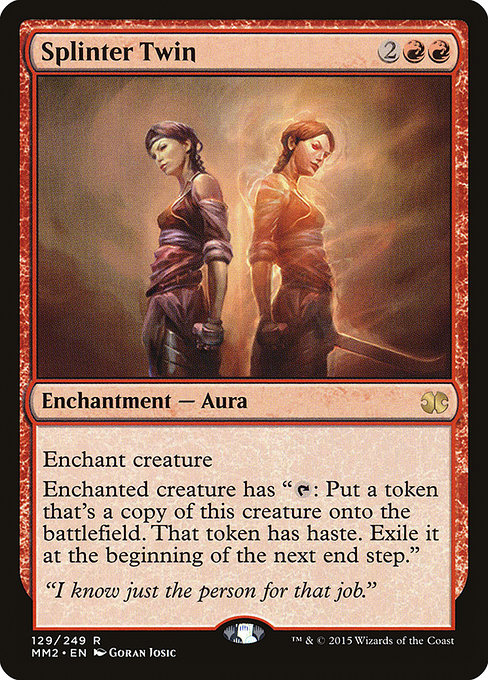 Splinter Twin
Enchant creature
Splinter Twin
Enchant creature
Enchanted creature has "{T}: Create a token that's a copy of this creature, except it has haste. Exile that token at the beginning of the next end step."
available or something more complicated, every combo deck can’t win from any spot. In the case of Mutate, you generally need a Goldspan Dragon, some Mutate piece, and a spell in your Graveyard that can accumulate card advantage before you go for the win. For Lotus Field, you almost always need to have two Lotus Fields available (most commonly acquired by using a Thespian’s Stage to copy your actual one). Of all the sets I’ve played with Lotus Field, I only won once where I didn’t have two Lotus Fields available near the beginning of the combo sequence.
After learning your setup, the next step is learning how likely you will get to that setup within a given turn. Once you decide to try and go for the win, missing it is generally disastrous and will lose you the game on the spot. If you don’t think you can win that turn, consider trying to take a turn where you get to a place where you can win (unless that will kill you. We’ll get into that later).
What Common Things Stop You?

Once you figure out how to win the game, the next step is to learn how to play around the most common things players use to stop you. This can be something like Memory Jar in a game of cEDH where your primary win condition is
Thassa’s Oracle
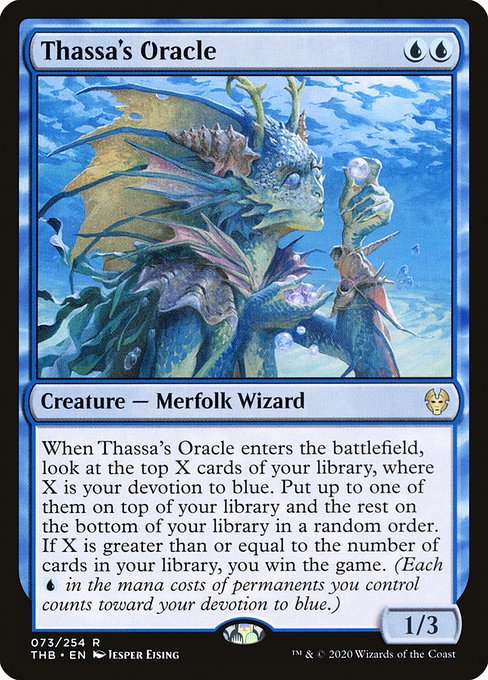 Thassa’s Oracle
When this creature enters, look at the top X cards of your library, where X is your devotion to blue. Put up to one of them on top of your library and the rest on the bottom of your library in a random order. If X is greater than or equal to the number of cards in your library, you win the game. (Each {U} in the mana costs of permanents you control counts toward your devotion to blue.)
, and your opponent is playing Magda or something unprotectable against the Show of Confidence Goldspan deck like Otawara’s Channel ability. Whatever the most common pieces are that stop your combo, you need to learn how to get through them. Some cards have a much heavier impact than others, like Damping Sphere for Lotus Field, and must be consistently played around when possible to prevent a blowout.
Thassa’s Oracle
When this creature enters, look at the top X cards of your library, where X is your devotion to blue. Put up to one of them on top of your library and the rest on the bottom of your library in a random order. If X is greater than or equal to the number of cards in your library, you win the game. (Each {U} in the mana costs of permanents you control counts toward your devotion to blue.)
, and your opponent is playing Magda or something unprotectable against the Show of Confidence Goldspan deck like Otawara’s Channel ability. Whatever the most common pieces are that stop your combo, you need to learn how to get through them. Some cards have a much heavier impact than others, like Damping Sphere for Lotus Field, and must be consistently played around when possible to prevent a blowout.
Archon of Emeria-like effects are a pretty common one you will need to deal with since most Combo wins require casting a whole bunch of spells. In the situation where you are playing Control Combo, you should (obviously) hold your removal for heavier impact options like the Archon. Using your removal too early can easily result in a game loss.
Practice Makes Perfect
At the end of the day, repetitions are the most important thing, like learning anything new. Because of how complex these decks are and how different they are from anything else MTG has to offer, sitting down and playing some low-pressure games with the deck is really important. It takes time to pick these things up unless you’re a genius. I, for one, am definitely not a genius. The best combo players are those obsessed with the grind and want to learn everything they can about the deck. The best way to demonstrate something like this is to do it by example.
Read More: Could Subgames return to MTG?
How I learned to Play Lotus Field
This took a bit of time to learn how to play properly, but I can now pilot it decently. Unfortunately, this Pioneer deck folds to a slight breeze, but it does demand for an action plan from opponents that isn’t parallel with a majority of the format. Regardless, here’s the steps that I took to learn Lotus Field:
- First, I learned how I’m actually supposed to win and how to get there most efficiently. Lotus Field has a pretty standard opening that sometimes requires a lot of mulligans to obtain consistently. I learned pretty quickly that if you can’t get to a Lotus Field in your opening hand, there’s a pretty good chance you don’t want it. In terms of learning how each card works, mana is the currency used for you to win the game instead of life totals. Learn how each card interacts with your total number of mana and use those numbers to navigate to a position where you can win the game. Hidden Strings, when you have two Lotus Fields in play, for example, translates to a spell that allows you to gain four mana of any two colors. Since Lotus Field taps for three mana of one color, and Hidden Strings costs two mana, you’re left with two mana in two different colors (plus your untapped lands).
- After this, I learned about play patterns to deal with common disruptive pieces like Thoughtseize and Damping Sphere. Honestly, unless you have some anti-discard, Thoughtseize will always be devastating (unless your hand is terrible). Damping Sphere, when played by your opponent at the right moment, can send you back to the stone age. Since your Lotus Field won’t be able to tap for colors, make sure that you keep yourself in a position where you can access (or try to find) removal for something like this when possible. Boseiju is your go-to option to deal with Damping Sphere, but Otawara can also delay it in a pinch (which is usually all you need). Leyline of Sanctity is the go-to card to try and deal with Thoughtseize, but Nephalia Academy is a more niche option that also sees play.
- I learned how to improvise under pressure. Lotus Field’s worst matchups are the ones that threaten to beat you up before you can do your thing. As a result, having to abandon plan A and try to get into a situation where you survive isn’t entirely uncommon. This, honestly, takes a lot of practice. The longer you play these decks, the clearer you can see a 5-step or a 10-step line to a place where you’re not dead. Once you’re at the point where you can start seeing a bunch of steps ahead of your current position, you’ve learned the deck to the point where you can pilot it decently. This is where I consider myself to be for
Lotus Field
Lotus Field
Hexproof
This land enters tapped.
When this land enters, sacrifice two lands.
{T}: Add three mana of any one color. , but I have gone further with other combo decks. - There is further you can go, but that generally means you will be changing the deck and coming up with ideas from scratch. If you go this far with a combo deck, make sure the investment is worth it. You will be sinking a lot of time into small changes, and if the deck is not well positioned in whatever format you’re playing, it’s a lot of wasted time.
The Constraints of Digital Clients
Unfortunately for all the combo fans out there, because these decks play atypically and push the boundaries of MTG, digital clients don’t always interact with them very well. We had a lengthy conversation about this topic, but an example is some of the painstaking practice you needed to do if you wanted to play Jeskai Mutate on MTG Arena when it was Standard legal. The Rope is in the game to prevent players from slow play in the situation where the opponent is winning. This is a necessary evil for the game but makes playing combo decks very difficult. Because the Mutate combo requires a lot of lengthy loops and clicks, this turns into an APM race instead of simply executing a combo. Therefore, if you’re planning on playing a complicated combo deck online, there may be even more learning to do.
Combos in EDH
Commander is a little bit different from other formats for combo decks. Because of Commander’s singleton nature and huge card pool, combo wins are miles ahead of the rest of the format. There are a ton of different combos that require minimal resources to win in Commander. If your playgroup is at the level of playing
Thassa’s Oracle
Thassa’s Oracle
When this creature enters, look at the top X cards of your library, where X is your devotion to blue. Put up to one of them on top of your library and the rest on the bottom of your library in a random order. If X is greater than or equal to the number of cards in your library, you win the game. (Each {U} in the mana costs of permanents you control counts toward your devotion to blue.)
and Demonic Consultation-like things, then your game plan for learning combo will be quite different. The most important thing is identifying when you should ‘go for it.’
There are four players, which means there are a lot more players who can interact and disrupt your game plan. This also means that more players are trying to go for their own wins. At the end of the day, this will also come down to repetition with complicated stacks to navigate. In that way, EDH combos are similar. The actual combo execution is much simpler, but the other moving pieces can be just as complicated (if not more) as they are for different formats.
Find your Currency and Practice!
To summarize the whole article in a brief sentence, the most important things to learn when playing a combo deck are first figuring out what your currency is (mana instead of life total, etc.) and then studying up on how to utilize your cards to get the most out of your currency. Past that point, it’s just knowing what direction you need to go to get to your unique win condition. If there’s enough interest around popular combo decks that readers would be interested in a guide, I would be happy to take some time and create an introductory piece on how to get into those decks. The best way to inform us is to spread this article around! It will let us know that people want to read about this.