
Yesterday, MH3 cards went live for all Magic Online users. Only a few hours later, players were able to compete in a Modern Challenge with all the new toys at their disposal. Unsurprisingly, MH3 cards had a huge impact throughout the event.
Decks built around the all-powerful
Nadu, Winged Wisdom
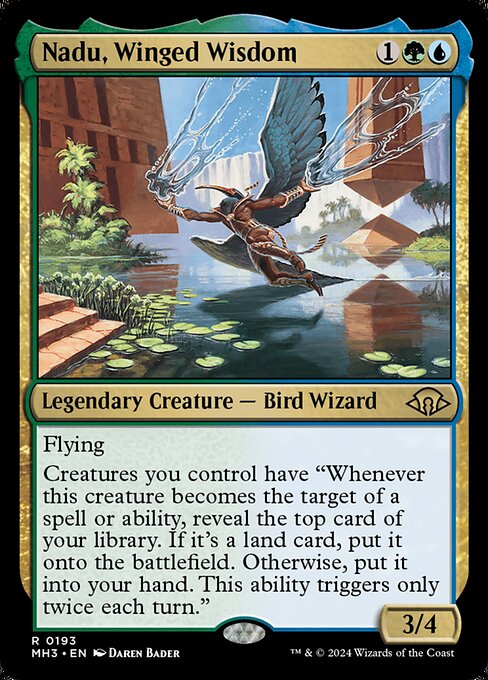 Nadu, Winged Wisdom
Flying
Nadu, Winged Wisdom
Flying
Creatures you control have "Whenever this creature becomes the target of a spell or ability, reveal the top card of your library. If it's a land card, put it onto the battlefield. Otherwise, put it into your hand. This ability triggers only twice each turn."
and
Ugin’s Labyrinth
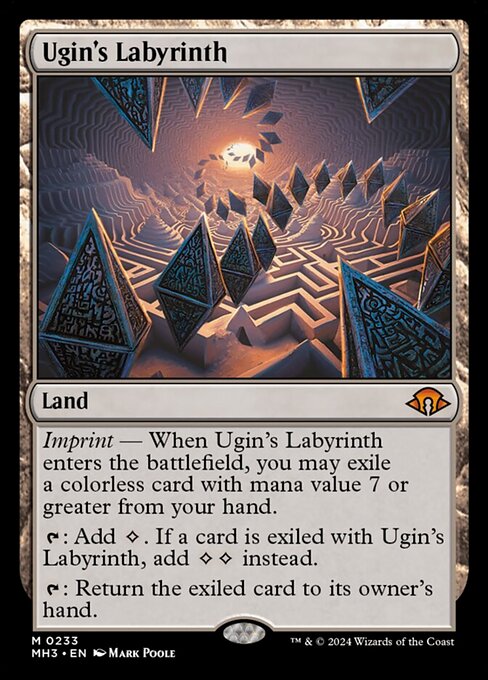 Ugin’s Labyrinth
Imprint — When this land enters, you may exile a colorless card with mana value 7 or greater from your hand.
Ugin’s Labyrinth
Imprint — When this land enters, you may exile a colorless card with mana value 7 or greater from your hand.
{T}: Add {C}. If a card is exiled with this land, add {C}{C} instead.
{T}: Return the exiled card to its owner's hand.
performed quite well, as both cards made their way into top eight. Decks like Nadu combo, Eldrazi Tron/aggro, and red Storm all received a bunch of hype this week, so seeing them make all make an appearance in the event isn’t too shocking.
However, one of the most interesting decks from the whole event, Boros midrange, managed to make it all the way to second place. This shell clearly fell under the radar, but there’s a lot to like about how it’s currently constructed.
Obosh, the Preypiercer
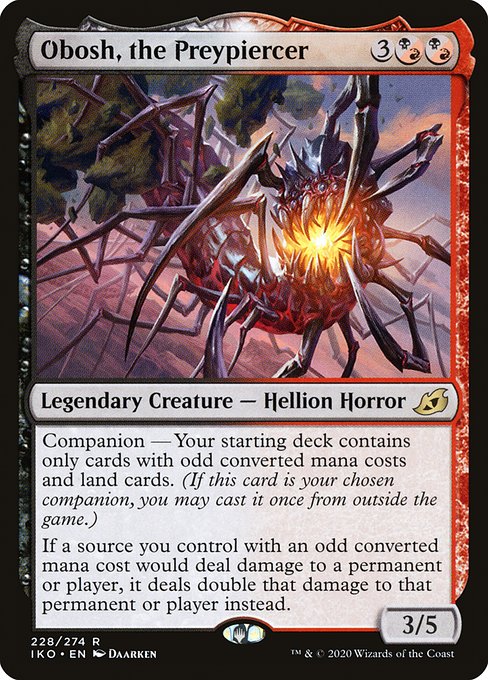 Obosh, the Preypiercer
Companion — Your starting deck contains only cards with odd mana values and land cards. (If this card is your chosen companion, you may put it into your hand from outside the game for {3} as a sorcery.)
Obosh, the Preypiercer
Companion — Your starting deck contains only cards with odd mana values and land cards. (If this card is your chosen companion, you may put it into your hand from outside the game for {3} as a sorcery.)
If a source you control with an odd mana value would deal damage to a permanent or player, it deals double that damage to that permanent or player instead.
fans rejoice, as it’s finally this Companion’s time to shine.
Tons of Interaction
Despite the fact that Boros is typically a very aggressive color pair, this archetype is fully prepared to play a long and grindy game. This deck utilizes playsets of three different removal spells that are all capable of getting rid of problematic threats as early as turn one.
Lightning Bolt
 Lightning Bolt
 deals 3 damage to any target.
is the premier one-mana red removal spell, and four copies are in the deck as expected. The appearance of
Galvanic Discharge
Lightning Bolt
Lightning Bolt deals 3 damage to any target.
is the premier one-mana red removal spell, and four copies are in the deck as expected. The appearance of
Galvanic Discharge
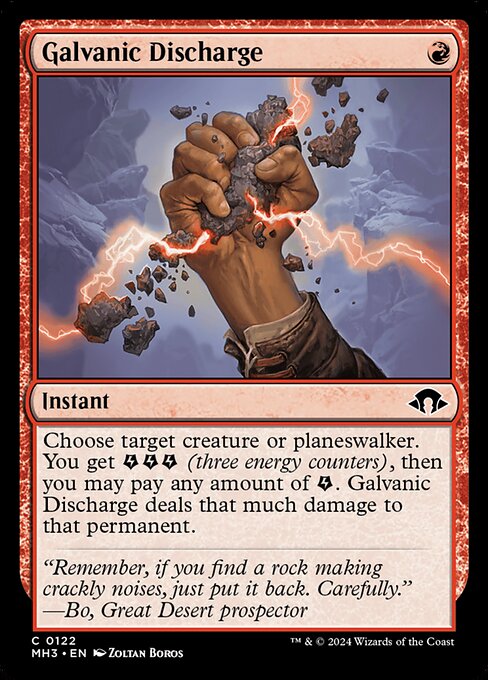 Galvanic Discharge
Choose target creature or planeswalker. You get {E}{E}{E} (three energy counters), then you may pay any amount of {E}. Galvanic Discharge deals that much damage to that permanent.
, on the other hand, may seem a bit unorthodox.
Galvanic Discharge
Choose target creature or planeswalker. You get {E}{E}{E} (three energy counters), then you may pay any amount of {E}. Galvanic Discharge deals that much damage to that permanent.
, on the other hand, may seem a bit unorthodox.
As far as interaction is concerned, though, Galvanic Discharge is actually very efficient, and this is the perfect style of deck for it. Because this deck is designed to drag the game out and most of its draws aren’t super assertive, Galvanic Discharge’s inability to deal damage to the opponent isn’t a big deal. This strategy also isn’t designed to reliably obtain Delerium, so
Unholy Heat
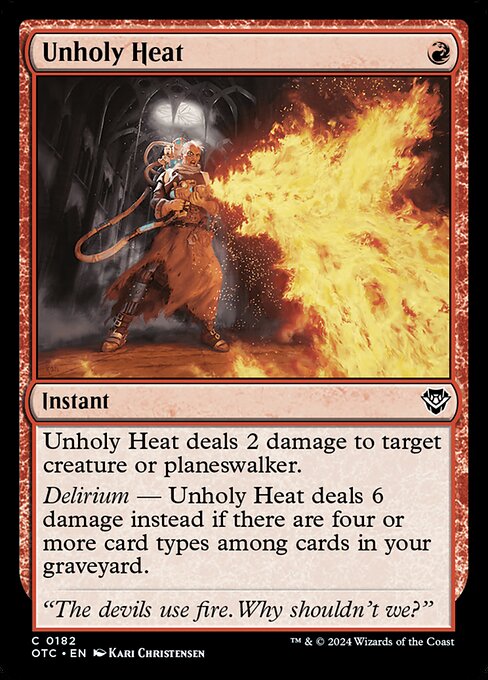 Unholy Heat
 deals 2 damage to target creature or planeswalker.
Unholy Heat
Unholy Heat deals 2 damage to target creature or planeswalker.
Delirium — Unholy Heat deals 6 damage instead if there are four or more card types among cards in your graveyard.
isn’t much of a consideration.
Galvanic Discharge can always kill three-toughness creatures just like Lightning Bolt, but it also works exceptionally well in multiples. For instance, if you kill a mana dork or some other small creature, you get to store energy for later. Then, any future Galvanic Discharges can hit more burly threats, which can be quite important in matchups like Golgari Yawgmoth.
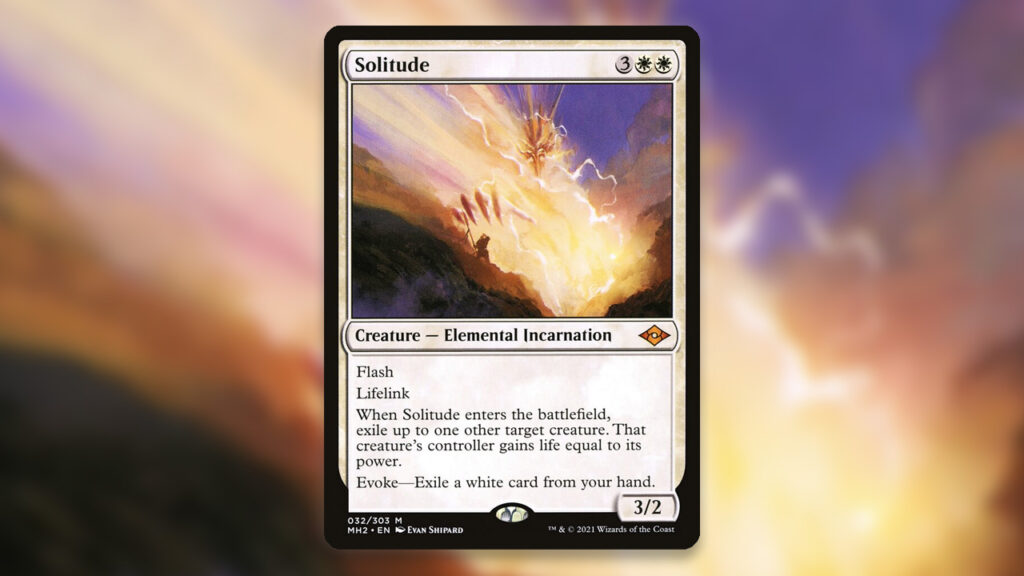
Solitude is excellent here. It can serve as a free answer to opposing threats of any size but has the added bonus of being a great five-drop to hard cast. Beyond just creature removal, this deck makes use of a full four copies of
Blood Moon
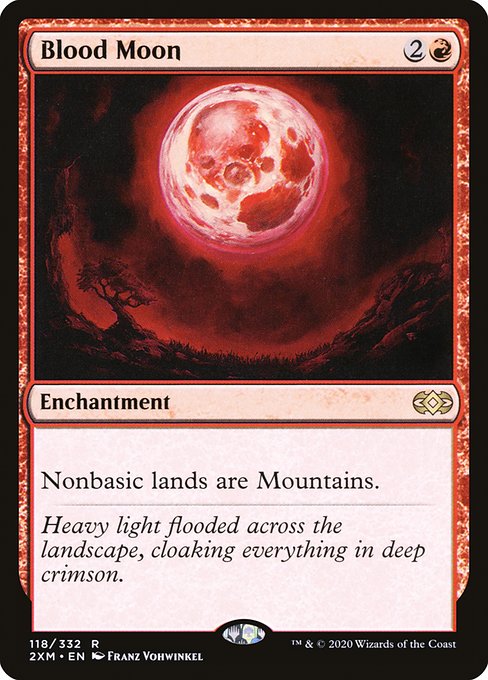 Blood Moon
Nonbasic lands are Mountains.
in the maindeck. Blood Moon works overtime against Amulet Titan and Tron strategies, while simultaneously blanking
Urza’s Saga
Blood Moon
Nonbasic lands are Mountains.
in the maindeck. Blood Moon works overtime against Amulet Titan and Tron strategies, while simultaneously blanking
Urza’s Saga
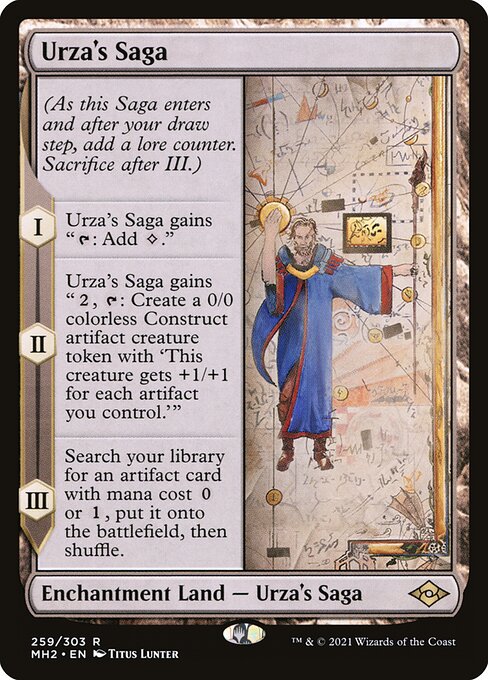 Urza’s Saga
(As this Saga enters and after your draw step, add a lore counter. Sacrifice after III.)
Urza’s Saga
(As this Saga enters and after your draw step, add a lore counter. Sacrifice after III.)
I — This Saga gains "{T}: Add {C}."
II — This Saga gains "{2}, {T}: Create a 0/0 colorless Construct artifact creature token with 'This token gets +1/+1 for each artifact you control.'"
III — Search your library for an artifact card with mana cost {0} or {1}, put it onto the battlefield, then shuffle.
. Playing Blood Moon on turn two after connecting with
Ragavan, Nimble Pilferer
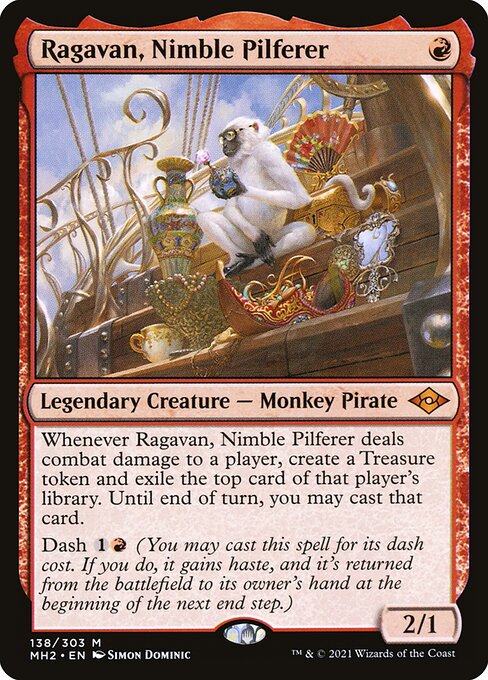 Ragavan, Nimble Pilferer
Whenever Ragavan deals combat damage to a player, create a Treasure token and exile the top card of that player's library. Until end of turn, you may cast that card.
Ragavan, Nimble Pilferer
Whenever Ragavan deals combat damage to a player, create a Treasure token and exile the top card of that player's library. Until end of turn, you may cast that card.
Dash {1}{R} (You may cast this spell for its dash cost. If you do, it gains haste, and it's returned from the battlefield to its owner's hand at the beginning of the next end step.)
can singlehandedly win games.
Read More: New MTG Secret Lair Showcases Sacrifice Staples of Underwhelming Value
Closing Games Quickly
Before the banning of
Fury
 Fury
Double strike
Fury
Double strike
When this creature enters, it deals 4 damage divided as you choose among any number of target creatures and/or planeswalkers.
Evoke—Exile a red card from your hand.
, mono-red Obosh decks would put up solid performances here and there. Even with Fury, though, the deck never broke out into the top echelon of Modern archetypes. A huge issue the deck had was actually closing games in a reasonable time frame. With so much disruption present, sticking a win condition wasn’t always easy. This gave Boros Burn and various combo decks tons of time to assemble a kill.
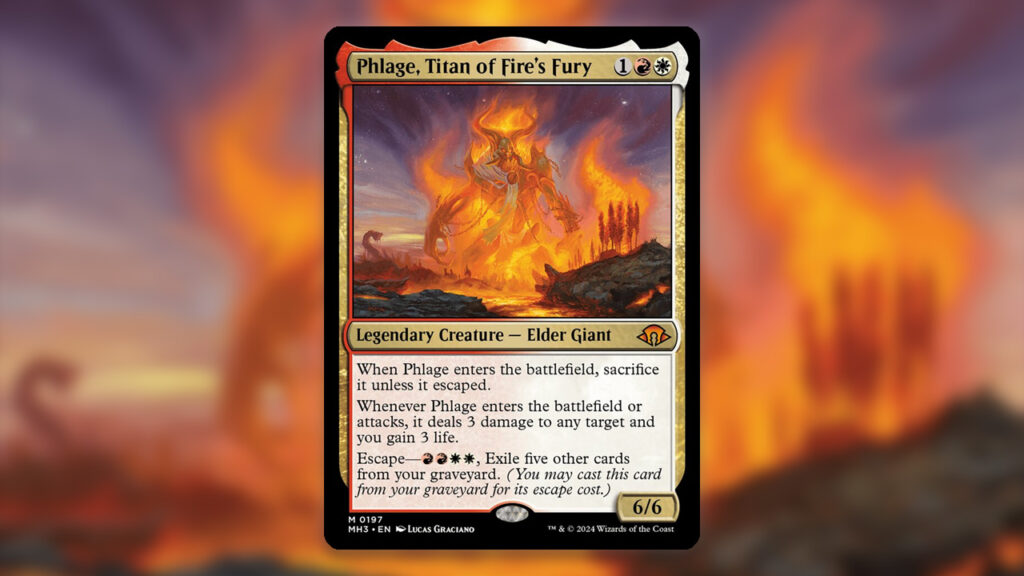
While this is still a natural weakness to red midrange decks in general, the addition of Phlage, Titan of Fire’s Fury helps shore things up to a certain extent. Phlage simply does everything you want. Playing it for three mana is completely reasonable, and the life cushion it provides is essential against Burn and Prowess. You can also discard it to
Fable of the Mirror-Breaker
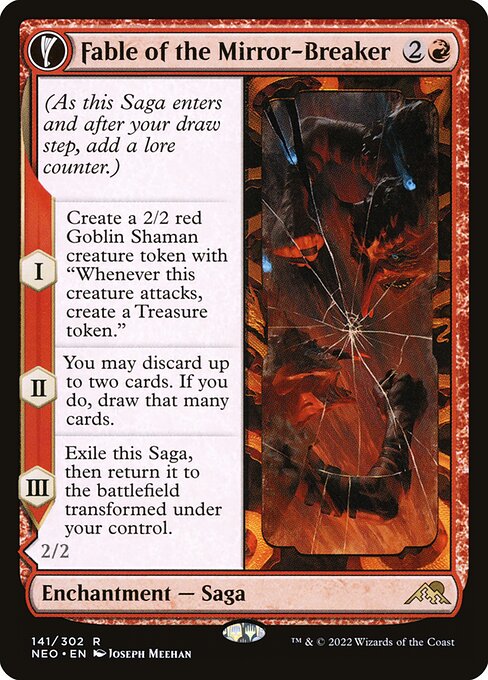 Fable of the Mirror-Breaker
(As this Saga enters and after your draw step, add a lore counter.)
Fable of the Mirror-Breaker
(As this Saga enters and after your draw step, add a lore counter.)
I — Create a 2/2 red Goblin Shaman creature token with "Whenever this token attacks, create a Treasure token."
II — You may discard up to two cards. If you do, draw that many cards.
III — Exile this Saga, then return it to the battlefield transformed under your control.
or
Seasoned Pyromancer
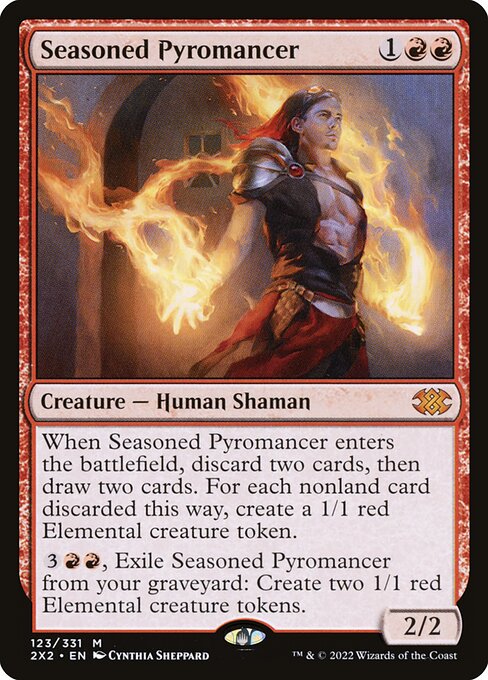 Seasoned Pyromancer
When this creature enters, discard two cards, then draw two cards. For each nonland card discarded this way, create a 1/1 red Elemental creature token.
Seasoned Pyromancer
When this creature enters, discard two cards, then draw two cards. For each nonland card discarded this way, create a 1/1 red Elemental creature token.
{3}{R}{R}, Exile this card from your graveyard: Create two 1/1 red Elemental creature tokens.
to bypass this transaction.
Enabling Phlage is simple with Fetchlands and Surveil Lands at the ready. Once you manage to Escape Phlage, the Giant threatens to close things out in short order. Its triggered ability works exceptionally well with Obosh, potentially giving you the opportunity to burn the opponent out without even entering combat. If you draw multiple copies of the legend, you can always pitch one to Solitude. Phlage may not be quite the menace that Uro, Titan of Nature’s Wrath was, but it’s an elite versatile finisher that provides a big incentive for adding white to the traditional red Obosh shell.
Read More: MTG Players Push Back Against ‘Predatory’ Microtransactions
Strengths and Weaknesses
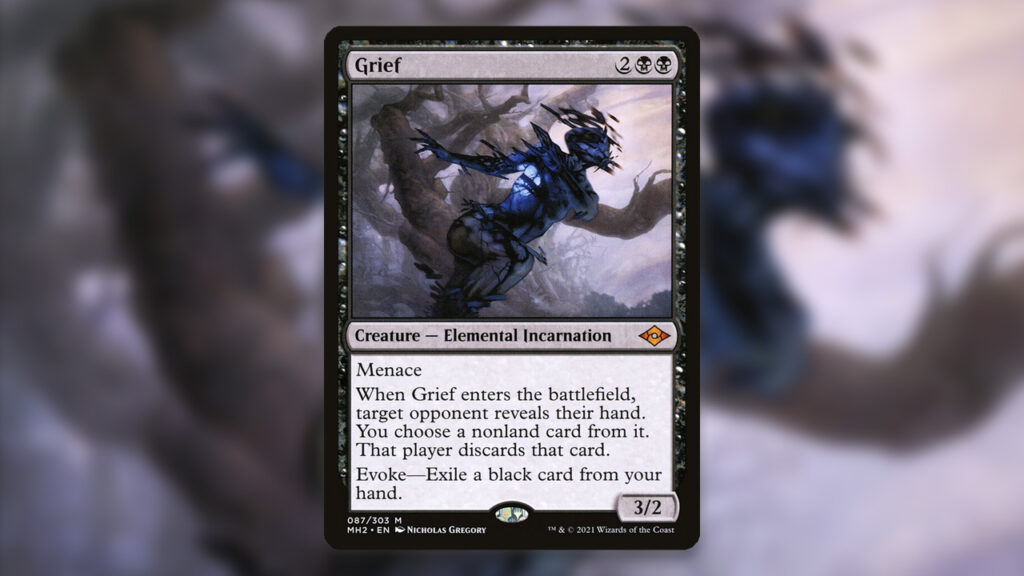
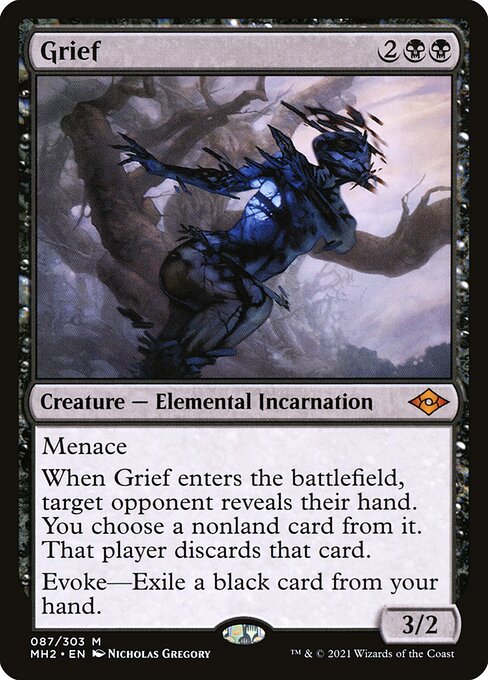
It’s clearly still early on in MH3 Modern, so the metagame is bound to keep shifting. As things currently stand, though, this deck has a lot going for it. The deck’s vast number of efficient removal spells gives you a big edge against aggressive decks like Prowess and helps prevent an early
Grief
 Grief
Menace
Grief
Menace
When this creature enters, target opponent reveals their hand. You choose a nonland card from it. That player discards that card.
Evoke—Exile a black card from your hand.
from taking over.
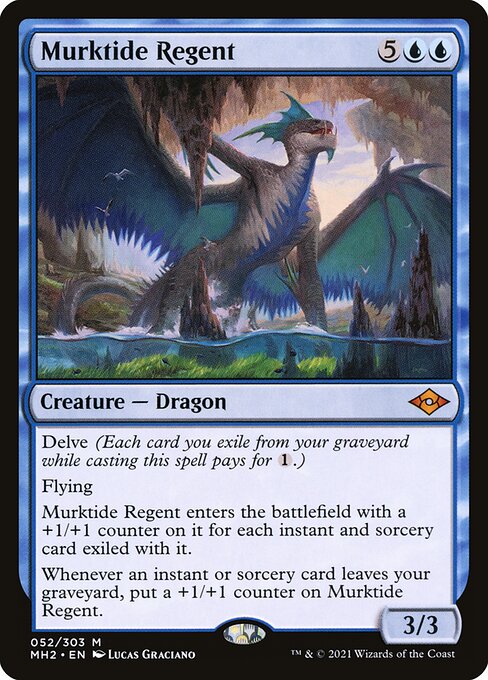
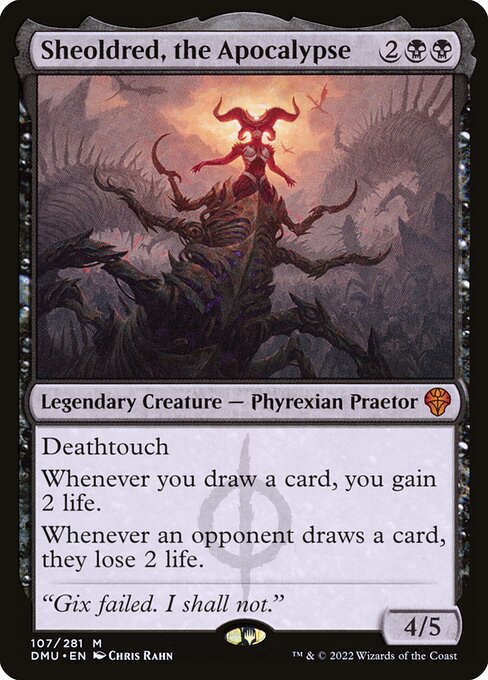
Between Seasoned Pyromancer, Fable, and Phlage, you can easily out-grind Izzet Murktide or Rakdos Scam. Solitude can then make sure you don’t get punked by the big haymakers like
Murktide Regent
 Murktide Regent
Delve (Each card you exile from your graveyard while casting this spell pays for {1}.)
Murktide Regent
Delve (Each card you exile from your graveyard while casting this spell pays for {1}.)
Flying
This creature enters with a +1/+1 counter on it for each instant and sorcery card exiled with it.
Whenever an instant or sorcery card leaves your graveyard, put a +1/+1 counter on this creature.
and
Sheoldred, the Apocalypse
 Sheoldred, the Apocalypse
Deathtouch
Sheoldred, the Apocalypse
Deathtouch
Whenever you draw a card, you gain 2 life.
Whenever an opponent draws a card, they lose 2 life.
.
The Blood Moon package, combined with
Magus of the Moon
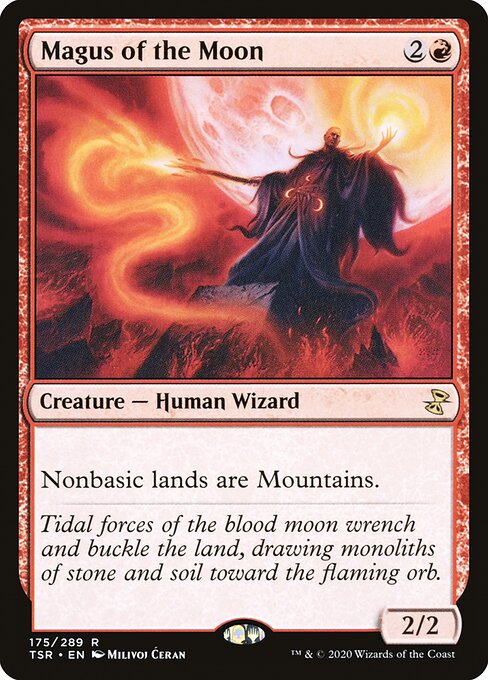 Magus of the Moon
Nonbasic lands are Mountains.
out of the sideboard, gives you a fighting chance against big mana decks that would otherwise be rather problematic. Where this deck can start to run into issues, however, is against fast combo decks that don’t play to the board.
Living End
Magus of the Moon
Nonbasic lands are Mountains.
out of the sideboard, gives you a fighting chance against big mana decks that would otherwise be rather problematic. Where this deck can start to run into issues, however, is against fast combo decks that don’t play to the board.
Living End
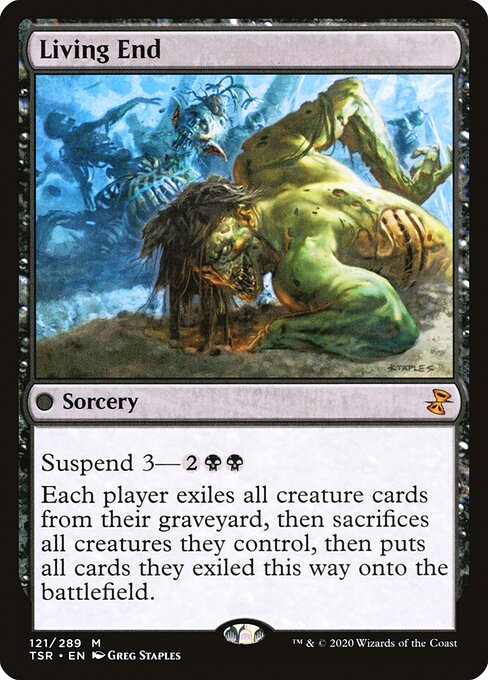 Living End
Suspend 3—{2}{B}{B}
Living End
Suspend 3—{2}{B}{B}
Each player exiles all creature cards from their graveyard, then sacrifices all creatures they control, then puts all cards they exiled this way onto the battlefield.
, for instance, attacks on a unique axis that this deck is not prepared to defend.
Similarly, the surging mono-red Storm deck seems like a nightmare matchup. The deck is essentially immune to Blood Moon and wins at blazing speed. Sure, you play removal for Ral, Monsoon Mage, but you have almost no ways to get Ruby Medallion off the table. Without a fast Ragavan start, it’s incredibly difficult to race Dimir Mill, too. Not to mention, Phlage is not a reliable win condition at all in the face of
Surgical Extraction
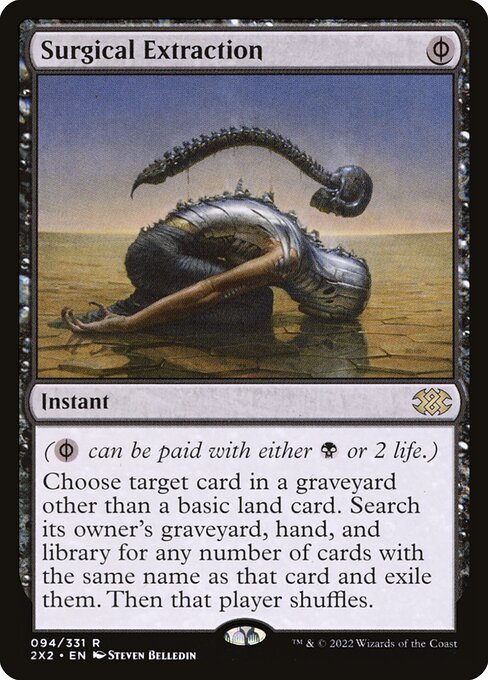 Surgical Extraction
({B/P} can be paid with either {B} or 2 life.)
Surgical Extraction
({B/P} can be paid with either {B} or 2 life.)
Choose target card in a graveyard other than a basic land card. Search its owner's graveyard, hand, and library for any number of cards with the same name as that card and exile them. Then that player shuffles.
and the like.
In this sense, Boros midrange is far from unbeatable. Still, against decks where you’re interaction lines up in a favorable manner, you’re in for a good time. Phlage made a variety of matchups like Burn and Rakdos Scam much stronger, which is a big deal. This deck’s strong performance cannot be denied, so expect to see more players revealing Obosh at the start of games in the near future.
Read More: Taylor Swift Secret Lair Suggestion Shot Down By MTG Players