
Cards from The Lost Caverns of Ixalan have recently become available for play on Magic Online and MTG Arena. Unsurprisingly, players have begun trying out a variety of different strategies utilizing these new cards. In some cases, this just means adding fairly straight-forward upgrades to well-established archetypes. For instance, kindred-style decks like mono-white Humans in Pioneer have begun adopting
Cavern of Souls
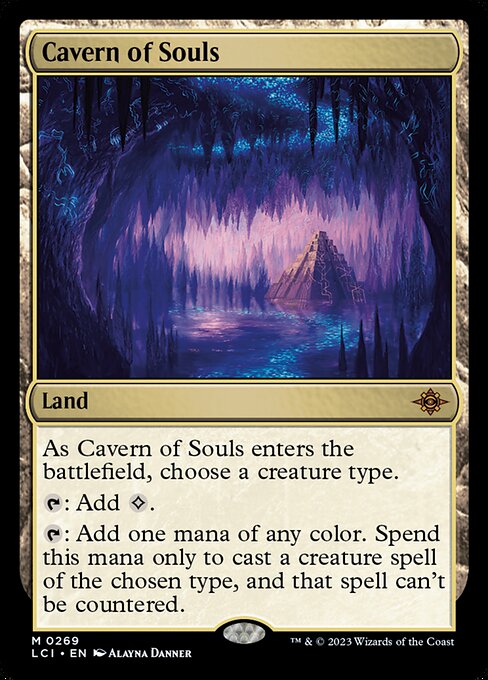 Cavern of Souls
As this land enters, choose a creature type.
Cavern of Souls
As this land enters, choose a creature type.
{T}: Add {C}.
{T}: Add one mana of any color. Spend this mana only to cast a creature spell of the chosen type, and that spell can't be countered.
into the manabase.
Of course, not everyone is content simply adding upgrades to top tier strategies. The Lost Caverns of Ixalan, in particular, has a bunch of cards that offer tons of room for brewing opportunities. The combo featuring
Amalia Benavides Aguirre
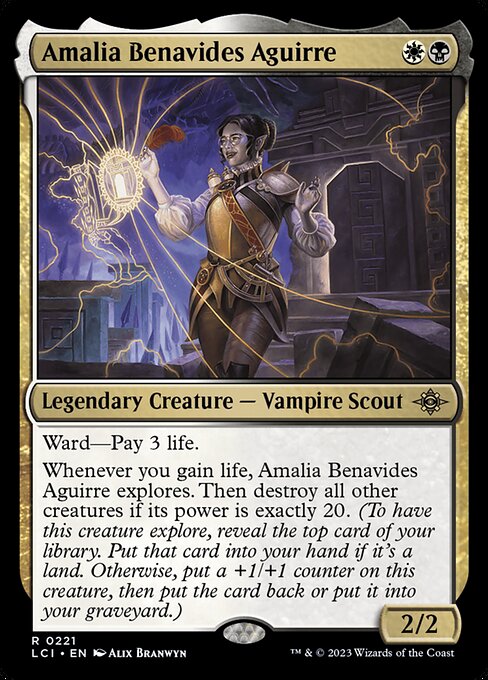 Amalia Benavides Aguirre
Ward—Pay 3 life.
Amalia Benavides Aguirre
Ward—Pay 3 life.
Whenever you gain life, Amalia Benavides Aguirre explores. Then destroy all other creatures if its power is exactly 20. (To have this creature explore, reveal the top card of your library. Put that card into your hand if it's a land. Otherwise, put a +1/+1 counter on this creature, then put the card back or put it into your graveyard.)
and
Wildgrowth Walker
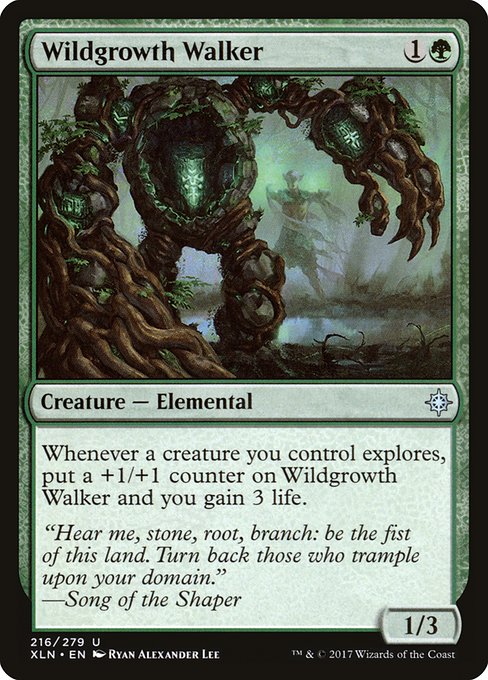 Wildgrowth Walker
Whenever a creature you control explores, put a +1/+1 counter on this creature and you gain 3 life.
, for example, could result in the creation of a brand-new archetype.
Wildgrowth Walker
Whenever a creature you control explores, put a +1/+1 counter on this creature and you gain 3 life.
, for example, could result in the creation of a brand-new archetype.
As it turns out, The Lost Caverns of Ixalan features lots of combo cards that open the door for anyone interested in brewing. Today, we are going to focus on one combo card in particular:
Quintorius Kand
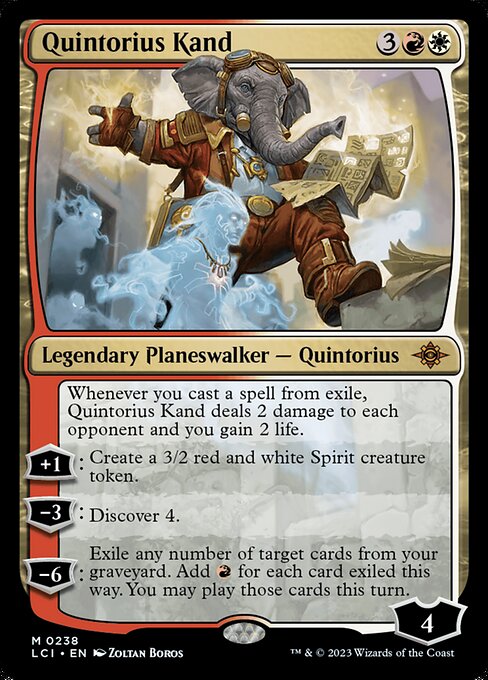 Quintorius Kand
Whenever you cast a spell from exile, Quintorius Kand deals 2 damage to each opponent and you gain 2 life.
Quintorius Kand
Whenever you cast a spell from exile, Quintorius Kand deals 2 damage to each opponent and you gain 2 life.
+1: Create a 3/2 red and white Spirit creature token.
−3: Discover 4.
−6: Exile any number of target cards from your graveyard. Add {R} for each card exiled this way. You may play those cards this turn.
. In both Explorer on Arena as well as Pioneer, Quintorius Kand works extremely well in conjunction with cards like Spark Double, maximizing the Planeswalker’s -3 ability. The key is building a shell around this particular combo that helps with consistency and resiliency. To start, let’s take a look at how the combo actually works.
Combo Core
For those who have played with or against Gyruda, Doom of Depths combo in Pioneer, you may recall the vital role that multiple
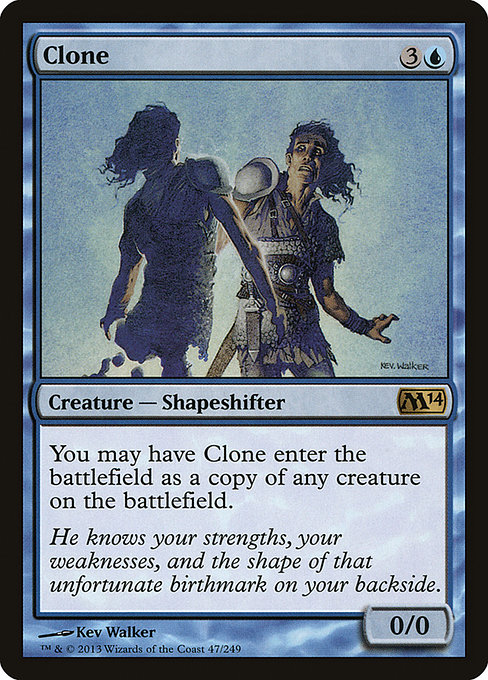
Clone
 Clone
You may have this creature enter as a copy of any creature on the battlefield.
variants played in the combo’s execution. The goal was to repeatedly mill over different Creatures that could copy Gyruda, and therefore copy Gyurda’s triggered ability. The core of the combo with Quintorius Kand is actually pretty similar. With Quintorius in play, you can use its -3 ability to Discover 4.
Clone
You may have this creature enter as a copy of any creature on the battlefield.
variants played in the combo’s execution. The goal was to repeatedly mill over different Creatures that could copy Gyruda, and therefore copy Gyurda’s triggered ability. The core of the combo with Quintorius Kand is actually pretty similar. With Quintorius in play, you can use its -3 ability to Discover 4.
By filling your deck specifically with Lands, four-mana ways to copy Quintorius and a plethora of non-Land cards that cost five or more mana, you are guaranteed to hit one of those four-mana cards. In Pioneer as well as Explorer on Arena, Spark Double, Clever Impersonator, and Mythos of Illuna can create copies of Quintorius.
Importantly, when you Discover 4, the card you end up casting is cast from exile. Thanks to Quintorius’s static ability, this means that you drain your opponent for two life in the process. Because you are guaranteed to get a card that can copy Quintorius, you can simply choose to keep the new copy via legend rule (or in the case of Spark Double, keep both copies), use the new copy to Discover 4 again, and repeat this process. The end result will be a victory by draining your opponent’s entire life total, assuming they did not gain a ton of life.
Read More: Infamous MTG Storm Deck Makes Surprise Comeback!
Adding Redundancy
As mentioned, this combo requires that all of your other non-Land cards in your deck cost at least five mana. This obviously makes your deck a bit clunky, though as we will see later, there are plenty of cards with mana value five or more that can still be cast in the early turns. The thing is, this also makes it a bit tough to make the combo as consistent as possible. For instance, cheap tutors like Call the Gatewatch are off the table. Thanks to another new card from The Lost Caverns of Ixalan, though, there’s more redundancy than you might think.
This new card is none other than
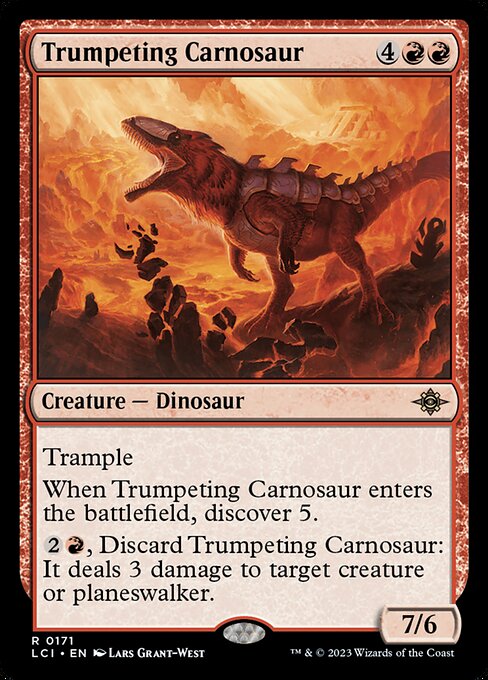
Trumpeting Carnosaur
 Trumpeting Carnosaur
Trample
Trumpeting Carnosaur
Trample
When this creature enters, discover 5.
{2}{R}, Discard this card: It deals 3 damage to target creature or planeswalker.
. Trumpeting Carnosaur is a beefy Creature with a strong enters-the-battlefield ability. If you go even further and make sure that the only five-drop in the deck is Quintorius, this triggered ability actually helps make sure you get Quintorius into play reliably. See, with Discover 5, you are now guaranteed to either hit Quintorius or a way to copy Trumpeting Carnosaur. When you copy Trumpeting Carnosaur, you just get to repeat this process.
Theoretically, you could end up hitting all of your Clone effects back-to-back before Quintorius, meaning you won’t win immediately with Quintorius’s static ability. That being said, not only is this very unlikely, but this worst-case scenario still results in you having a plethora of 7/6 Tramplers on board, which a lot of decks can’t beat.
Read More: Lost Caverns of Ixalan Rare Sees Surprise Temporary MTG Arena Ban!
Adding Interaction
Now that we have all of the combo stuff out of the way, it’s important to add some interaction to make sure we don’t get run over in the early turns. As stated, there are actually tons of options. Right off the bat, one of the best six-mana cards available to cast for cheap in a multi-color deck is
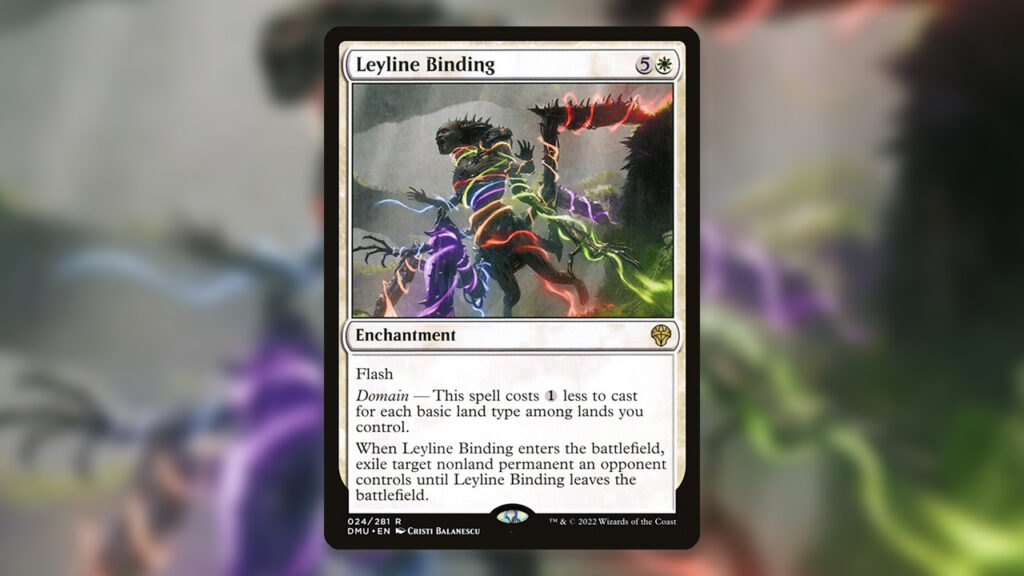
Leyline Binding
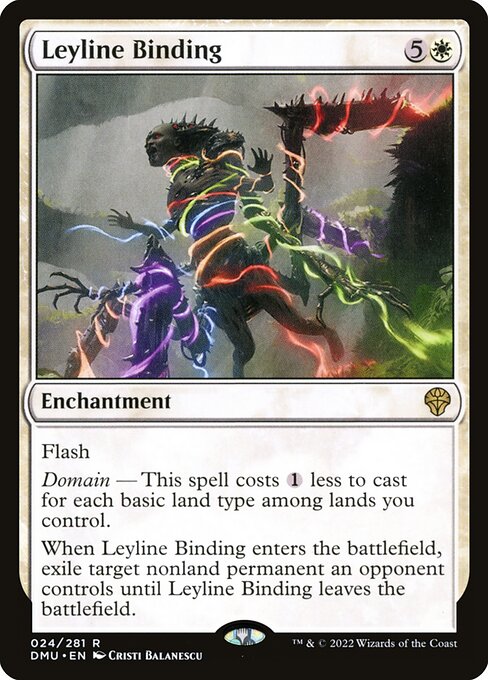 Leyline Binding
Flash
Leyline Binding
Flash
Domain — This spell costs {1} less to cast for each basic land type among lands you control.
When this enchantment enters, exile target nonland permanent an opponent controls until this enchantment leaves the battlefield.
. Leyline Binding can be cast as early as turn two to help answer any problematic permanents.
In a similar vein, both
Virtue of Persistence
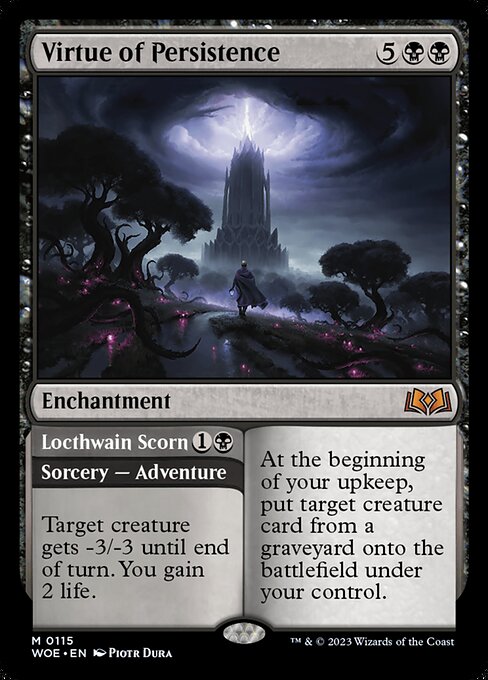 Virtue of Persistence
At the beginning of your upkeep, put target creature card from a graveyard onto the battlefield under your control.
and Horned Loch-Whale are expensive permanents, but they come with cheap Adventure spells attached. Virtue of Persistence is especially strong, because it can bring back Trumpeting Carnosaur from your graveyard to play in the late game. This helps make sure that you can fight through counter magic or other forms of interaction from the opponent. Trumpeting Carnosaur acts as additional interaction when you need it, too, and by discarding it, reanimating it with Virtue of Persistence is fair game.
Virtue of Persistence
At the beginning of your upkeep, put target creature card from a graveyard onto the battlefield under your control.
and Horned Loch-Whale are expensive permanents, but they come with cheap Adventure spells attached. Virtue of Persistence is especially strong, because it can bring back Trumpeting Carnosaur from your graveyard to play in the late game. This helps make sure that you can fight through counter magic or other forms of interaction from the opponent. Trumpeting Carnosaur acts as additional interaction when you need it, too, and by discarding it, reanimating it with Virtue of Persistence is fair game.
Finally, it’s likely worth playing some amount of ramp to help turbo out Quintorius against opposing combo decks. Some players have opted to use cards like
Magma Opus
 Magma Opus
 deals 4 damage divided as you choose among any number of targets. Tap two target permanents. Create a 4/4 blue and red Elemental creature token. Draw two cards.
Magma Opus
Magma Opus deals 4 damage divided as you choose among any number of targets. Tap two target permanents. Create a 4/4 blue and red Elemental creature token. Draw two cards.
{U/R}{U/R}, Discard this card: Create a Treasure token.
that can be discarded on turn two to make Treasures. The only issue with this is that Treasures only get a one-time usage, so if Quintorius gets countered or removed while you are trying to go for the combo, you won’t have that extra mana for future turns. This means that it might be worthwhile playing cards like Beanstalk Giant that put Lands onto the battlefield from your library.
Read More: Two-Card Ixalan MTG Combo Draws 12 Cards and Cheats out Creatures!
Beating Interaction
While the combo is glamorous and can work in theory, you’d ideally want the combo in your overall clunky deck to be a bit more resilient. The reality is, once you activate Quintorius’s -3 ability, if your opponent has any way to deal a damage to Quintorius at Instant speed, your Clone effects won’t be able to copy the Planeswalker. For this reason, when playing against a deck like Rakdos midrange that plays Bonecrusher Giant, it may actually be best to just use Quintorius’s +1 ability to generate tokens.
Between Trumpeting Carnosaur, Horned Loch-Whale, Virtue of Persistence, and
Keruga, the Macrosage
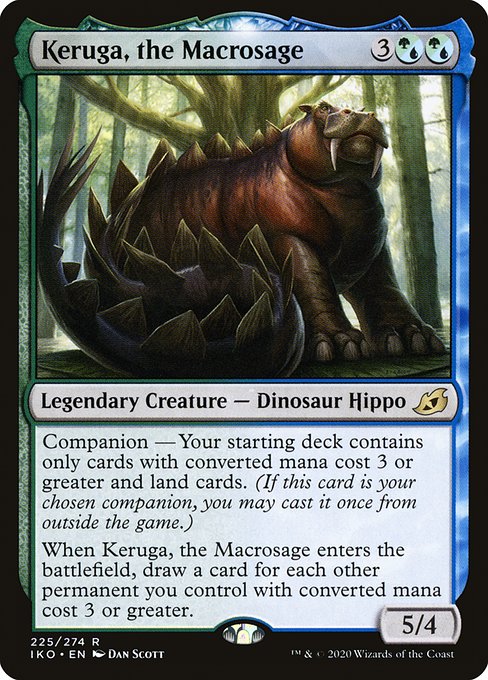 Keruga, the Macrosage
Companion — Your starting deck contains only cards with mana value 3 or greater and land cards. (If this card is your chosen companion, you may put it into your hand from outside the game for {3} as a sorcery.)
Keruga, the Macrosage
Companion — Your starting deck contains only cards with mana value 3 or greater and land cards. (If this card is your chosen companion, you may put it into your hand from outside the game for {3} as a sorcery.)
When Keruga enters, draw a card for each other permanent you control with mana value 3 or greater.
as your Companion, this deck can play a longer, grindier game when necessary. This plan is just very slow, but it’s a nice option to have against midrange decks. Unfortunately, there just aren’t that many ways to protect your combo, especially given the mana cost restriction of cards in your deck.
Notably, there is another variant of the Discover Clone combo going around that utilizes Geological Appraiser instead of Quintorius Khan. This variant of the deck is quicker, potentially going off on turn three. The downside is, since the deck simply creates a lot of 3/2’s, that one badly timed Supreme Verdict completely destroys the strategy.
Perhaps the addition of Dragonlord Dromoka out of the sideboard can help you steal some games against decks with ways to counter Quintorius, such as Azorius control or Spirits. Overall, it might be a longshot for this combo to start making waves in major competitive Pioneer events, but it’s a rather intriguing combo that has game against decks that are unprepared. There’s definitely room for exploration within this shell, both in Explorer and Pioneer, so if you enjoy tinkering around with unusual combos, now’s your opportunity.
Read More: Bizarre Leyline Combo Deck Takes Over MTG Format!