
Thassa’s Oracle
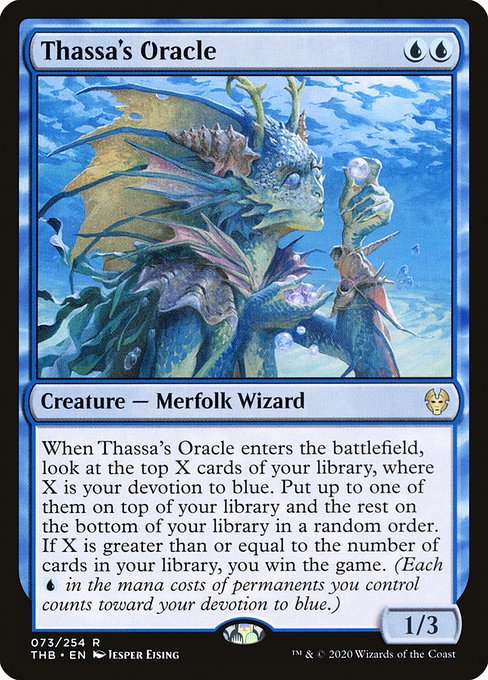 Thassa’s Oracle
When this creature enters, look at the top X cards of your library, where X is your devotion to blue. Put up to one of them on top of your library and the rest on the bottom of your library in a random order. If X is greater than or equal to the number of cards in your library, you win the game. (Each {U} in the mana costs of permanents you control counts toward your devotion to blue.)
feels one of the many problem children of the format alongside cards such as Cyclonic Rift or Yawgmoth’s Will. It was clearly designed for the higher-powered Commander Pods in mind, but is it simply too good for the singleton format overall?
Thassa’s Oracle
When this creature enters, look at the top X cards of your library, where X is your devotion to blue. Put up to one of them on top of your library and the rest on the bottom of your library in a random order. If X is greater than or equal to the number of cards in your library, you win the game. (Each {U} in the mana costs of permanents you control counts toward your devotion to blue.)
feels one of the many problem children of the format alongside cards such as Cyclonic Rift or Yawgmoth’s Will. It was clearly designed for the higher-powered Commander Pods in mind, but is it simply too good for the singleton format overall?
For two Blue mana, the Merfolk does quite a bit. Not only is it a clear upgrade on the once favored Labratory Maniac, but it offers a streamlined ‘win the game’ clause for little effort. Alongside
Uro, Titan of Nature’s Wrath
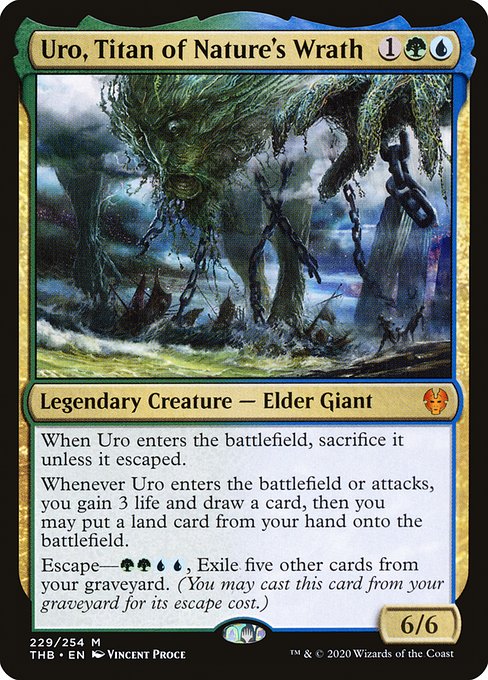 Uro, Titan of Nature’s Wrath
When Uro enters, sacrifice it unless it escaped.
Uro, Titan of Nature’s Wrath
When Uro enters, sacrifice it unless it escaped.
Whenever Uro enters or attacks, you gain 3 life and draw a card, then you may put a land card from your hand onto the battlefield.
Escape—{G}{G}{U}{U}, Exile five other cards from your graveyard. (You may cast this card from your graveyard for its escape cost.)
, it’s one of the most powerful cards to come from Theros Beyond Death.
Case For Banning Thassa’s Oracle
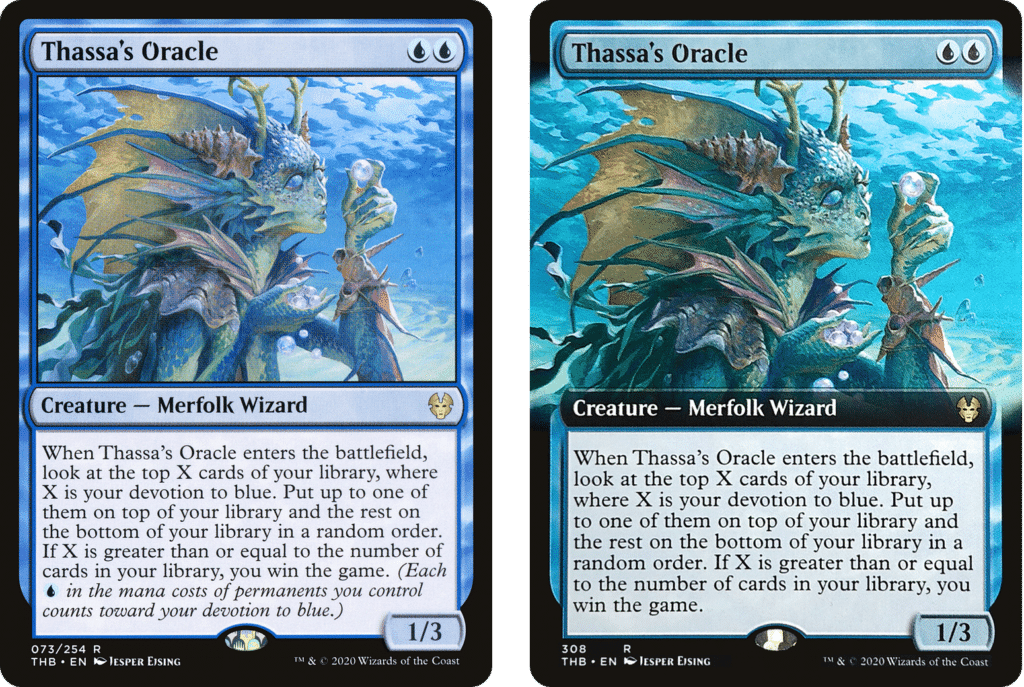
In constructed, the card saw a ban in Historic due to the printing of Tainted Pact which created a miserable metagame for the MTG Arena-exclusive format. Going further, Inverter of Truth was met with a similar fate due to the power of the Merfolk Wizard, combined it created one of the best Pioneer strategies since the format’s birth. But instead of banning
Thassa’s Oracle
Thassa’s Oracle
When this creature enters, look at the top X cards of your library, where X is your devotion to blue. Put up to one of them on top of your library and the rest on the bottom of your library in a random order. If X is greater than or equal to the number of cards in your library, you win the game. (Each {U} in the mana costs of permanents you control counts toward your devotion to blue.)
, Wizards of the Coast B&R decided to ban the Mythic Eldrazi instead.
It can pub stomp casual Commander tables if players aren’t aware and it’s not a fun experience in a Commander Pod. Using cards such as Demonic Consultation allows you to win the game easily and as the Merfolk Wizard is in Blue, you have interaction to protect it too. Also, the card became the catalyst for the ban of Flash since it paired incredibly well with Protean Hulk in the format.
This week, the Canadian Highlander Committee upgraded the points on
Thassa’s Oracle
Thassa’s Oracle
When this creature enters, look at the top X cards of your library, where X is your devotion to blue. Put up to one of them on top of your library and the rest on the bottom of your library in a random order. If X is greater than or equal to the number of cards in your library, you win the game. (Each {U} in the mana costs of permanents you control counts toward your devotion to blue.)
from 2 points to 7. In Canadian Highlander, you have a max of 10 points to work with when constructing your deck, but this can also include cards such as the Power Nine. The reason a point system works for Candian Highlander is to offer diversity and not play the same broken thing every time, since it is a 1v1 format. [tootlips]Thassa’s Oracle[/tooltips] is now on the same points as Ancestral Recall[/tootlips], [tooltips]Time Vault,
Black Lotus
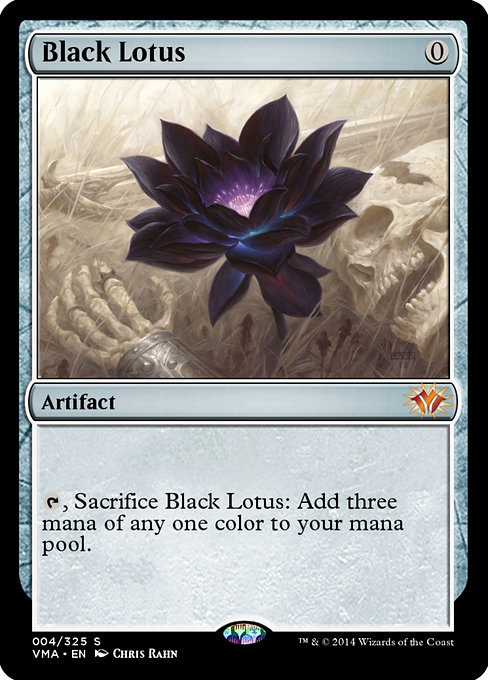 Black Lotus
{T}, Sacrifice this artifact: Add three mana of any one color.
, and Time Walk. This should give you an indication of how highly valued the card is within that format. Granted, Canadian Highlander plays differently to Commander, but you have to respect the thought process given it’s a singleton format.
Black Lotus
{T}, Sacrifice this artifact: Add three mana of any one color.
, and Time Walk. This should give you an indication of how highly valued the card is within that format. Granted, Canadian Highlander plays differently to Commander, but you have to respect the thought process given it’s a singleton format.
Read More: Best Upgrades for MTG’s Spirit Squadron Commander Deck
But What About Coalition Victory?
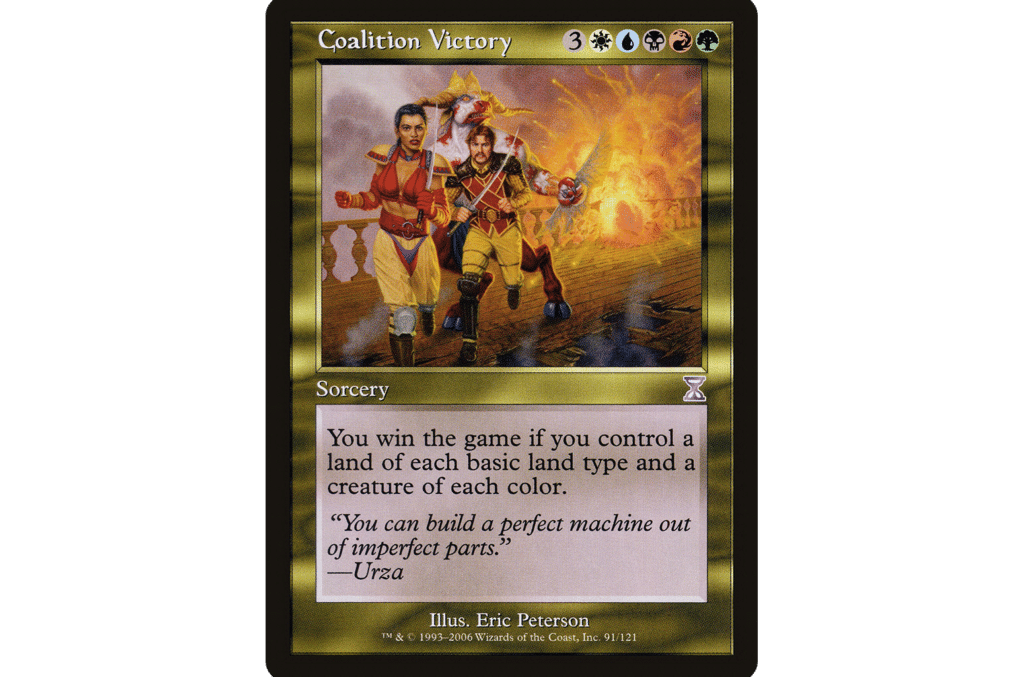
Interestingly, the Rules Committee (RC) are often against ‘win the game’ clauses especially those that require minimal effort to pull off. For example, Coalition Victory is on the current Commander ban list as there is a case for giving five-color strategies a ‘win the game’ clause. If we’re looking at an 8 mana spell that can easily work, surely
Thassa’s Oracle
Thassa’s Oracle
When this creature enters, look at the top X cards of your library, where X is your devotion to blue. Put up to one of them on top of your library and the rest on the bottom of your library in a random order. If X is greater than or equal to the number of cards in your library, you win the game. (Each {U} in the mana costs of permanents you control counts toward your devotion to blue.)
should be in the conversation too?
Either way,
Thassa’s Oracle
Thassa’s Oracle
When this creature enters, look at the top X cards of your library, where X is your devotion to blue. Put up to one of them on top of your library and the rest on the bottom of your library in a random order. If X is greater than or equal to the number of cards in your library, you win the game. (Each {U} in the mana costs of permanents you control counts toward your devotion to blue.)
is a powerful card that presents a miserable play experience for those who don’t care for combos in Commander. Especially when CEDH can bleed into casual Commander which was the case for Flash, which eventually saw a ban on acknowledgment from the Commander Rules Committee. What do you think? Is the Merfolk Wizard too good?
Read More: The 10 Best Magic: the Gathering Infinite Combos in Commander