
MTG Arena may be Wizards of the Coast’s premier free-to-play game, but depending on what you want to do in the game, Magic Online, or MTGO, can be significantly cheaper. Interestingly, depending on how far you want to deep dive into online MTG, MTGO gets much more affordable than MTGA. If you’re interested in playing a format seriously on the platform and not just cobbling a deck together with free giveaways on the Arena client, then MTGO is significantly cheaper. The only issue is that the client isn’t very user-friendly, so that starting can be difficult without some help. Fortunately, this guide should help bridge the gap.
There is no Free-to-Play

If you’re specifically after a free-to-play experience, regardless of how controversial the marketplace is for the game, then MTGO is not for you. You need to fork up $5 at the smallest to activate your account entirely. Additionally, to do MTGO right, you will generally need to pay more. The good news is, if you’re a good player, you can make your money back. This isn’t like going infinite with Gems in Magic Arena either; you can exchange your winnings for real-world cash. If you’re an excellent drafter and are tired of getting rewarded with in-game currency, this could be the switch for you. Additionally, there are no mobile components to MTGO. If you’re a diehard portable player, it may be difficult to play MTGO. Judging by how prehistoric this client is, a particularly determined MTG player can probably find a way to make this work. If there is one, we’ll be sure to let you know!
How to Start
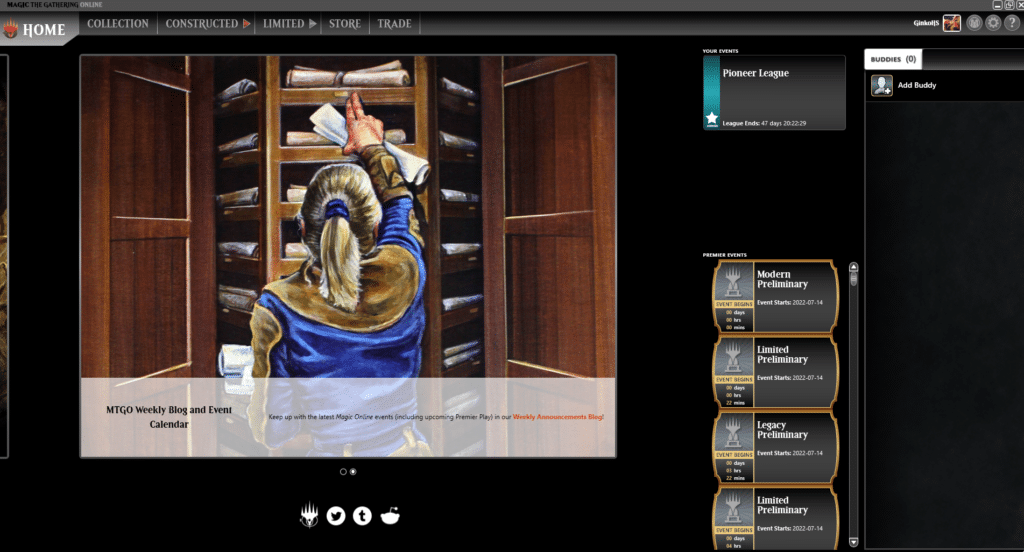
Step one is pretty simple. Activate your account, then buy the $5 add-on in the store to fully activate your account. Past that point, you’re ready to play! The interface may look scary initially, but it’s not as bad as you think. The first thing to break down is the options bar at the top of the screen. From left to right, here is what each thing does:
- Home simply brings you to the page you enter when logging into your account (also the screen pictured above). You can find a bulletin with some events that MTGO is promoting, a quick tab to whatever events you have open, and a summary of the premier competitive events happening within (generally)a week.
- Collection refers to all of the items you own on your account. There are two options in this tab (near the top left) that divide your cards from any non-card item that you own. These could be Event Tickets, Play Points, or Booster Packs. No need to worry; we’ll explain what these do. You also build all your decks and trade binders here. Deck building in MTGO is exceptionally straightforward once you know where everything is.
- Limited refers to all the Limited (draft, sealed, etc.) you can play on MTGO. Like the Constructed tab, you’ll be presented with a top-down menu dividing the events you can play into sections. When writing this, the menu includes Premier Events (expensive competitive events that can qualify you for major tournaments), Draft, Sealed, and Gauntlet. The only Gauntlet event as of the writing of this article was a new player event using new player points you’re granted when creating an account.
- Constructed is where you will likely be spending most of your time. In this tab, you’ll find all Constructed Events (and queues) on MTGO. You can play Standard, Pioneer, Modern, Legacy, Vintage, Commander, Pauper, and Specialty formats. There are a lot more options for MTGO than Magic Arena. Commander players can even shuffle up a 99 and play an actual factual online game! Finding cards can seem expensive at first, but not to worry, with some guidance, it’s actually pretty cheap!
- Store is exactly what it reads. You can purchase in-game currency (Event Tickets) that can also be traded back for real-world cash. Otherwise, you can buy booster packs and whatnot here. From personal experience, a savvy MTGO player will NOT spend much time here.
- Trade is rather complicated, but you can basically trade your collectibles to Bots from various third parties for in-game currency. We’ll get more into this.
Read More: Top 10 Most Expensive MTG Playmats
How to Get Cards
This is the catch with all the MTG clients. To play, you must buy all the cards in your deck. If you want to play constructed formats on MTG Arena, this is where most of your costs are going to skyrocket. Unless you can draft infinitely, you can quickly drop hundreds of dollars trying to build a few of the top decks in any format. This is also where you can save a lot of money by playing MTGO.
On MTGO, you generally have two options: buy the cards yourself (which is incredibly expensive but can be correct under certain conditions) or join a rental program. The only situation, in my opinion, where purchasing the cards yourself is right is when you only want to play one deck for a very long period of time. This can be confusing for Standard players since they experience yearly rotation, but most MTG formats don’t rotate. Buying the cards for an archetype you repetitively want to jam makes more sense. If you only want to stick to playing one deck and only wish to purchase cards to update your flex slots, then buying cards does make sense. If you’re like me and want to play multiple decks in multiple formats, then rental programs will change your MTG Online experience.
Rental Programs

A rental program will typically either charge you a lower price to rent out a deck of cards or will charge you monthly to access every card on the MTGO platform. I prefer the monthly rental program because I frequently change decks. Manatraders has been fantastic for my rental needs. I’m on a Pioneer binge, so I can make do with one of their cheaper plans. That being said, if you want to play every format the platform offers, you should expect to pay approximately $50/month. If you wish to access every card in the game, $50 a month is much cheaper than trying to complete a collection on MTGA. It can take a few days to iron out your subscription (they need some ID data in case you accept their cards and run away immediately after), but they won’t charge you when they iron your identity out. If you’re confident that this is a service you’ll want for a while, you can subscribe for multiple months and save money. This is my personal recommendation for playing MTG online on a budget. Unfortunately, this isn’t all you’ll have to pay, but whether you lose or make money past this point is, like Magic Arena, dependent on how good you are at MTG.
Read More: MTG Rotation and Renewal Guide 2022
How to Play MTGO
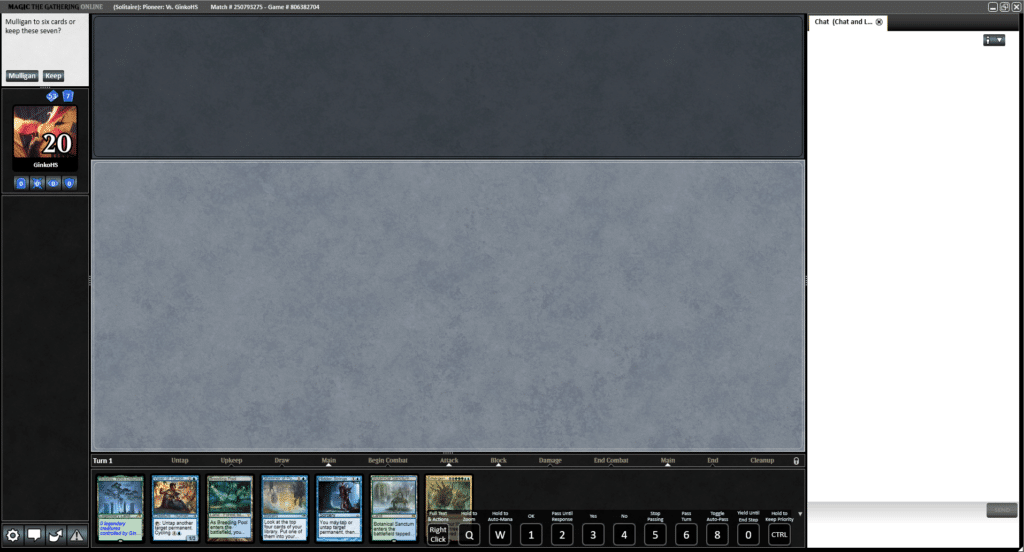
This is the most significant barrier to entry that the older MTG platform has. Playing on this platform is far from intuitive. Instead, learning everything is a bit of a nightmare. It’ll probably take a few days of playing before things become crystal clear, but this primer should give you an excellent place to start. Fortunately, while learning, you can create a one-player match in a format’s “open play” section by going to the constructed tab and clicking on your preferred format. Past that point, create a one-player lobby to access a mock game where you can explore how the client feels.
To begin, you’ll find four little icons under your life total and avatar with your Game ID.
- The one shaped like a tombstone tells you the number of cards in your graveyard. If you click on it, you can open or close a subsection to the left of the field of play with the contents of your graveyard. The same works for your opponent.
- The one beside shaped like an X with a circle in the middle is your exiled cards. It works the same as the graveyard tab.
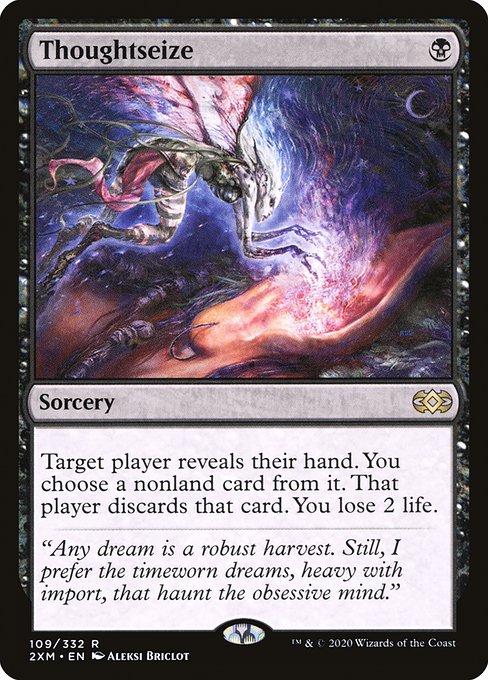
- The eyeball-shaped tab is the ‘revealed zone’ here. Any cards that have been revealed to your opponent will be put into this zone. This can be used as a reminder of what cards you’ve seen if your opponent’s hand got
Thoughtseize
 Thoughtseize
Target player reveals their hand. You choose a nonland card from it. That player discards that card. You lose 2 life.
d or vice versa. Be sure to note that, for this purpose, the cards they play will not affect the revealed zone, so if they play the Island you saw, it probably was the actual Island even though there’s still one in the revealed zone.
Thoughtseize
Target player reveals their hand. You choose a nonland card from it. That player discards that card. You lose 2 life.
d or vice versa. Be sure to note that, for this purpose, the cards they play will not affect the revealed zone, so if they play the Island you saw, it probably was the actual Island even though there’s still one in the revealed zone. - The shield-looking icon is an ‘active effects’ tab. Much like Boons in MTG Arena, this tab keeps track of any live effects that are occurring.
- Finally, if you use a Companion, which is pretty common in eternal formats, you will have a heart icon after declaring your Companion at the beginning of the game. This is your Companion Zone. You can open the tab at any point and click on your Companion to pay the three generic mana needed to add it to your hand.
Going through gameplay phases is very intuitive. It’s all marked clearly on a line in between your hand and the battlefield. When declaring Combat, a red line will appear in the middle of play. All you need to do is click on the creatures you wish to attack. Alternatively, you can right-click for a series of shortcuts.
Past that point, things are somewhat straightforward. The board of play is above the bottom layer, which contains your hand. Unlike MTGA, there’s no auto tap function to cast your spells. You’ll have to do everything yourself. This prevents the computer from tapping the wrong lands but can tax you in an entirely different way: time.
Read More: The Best Thing About Double Masters 2022 Isn’t the Reprints
Spend your Time Wisely
Generally, you and your opponent each have a 25-minute chess clock timer. This seems appropriate because an average competitive round of MTG in paper equates to 50 minutes. It’s important to note that MTGO timers are shorter than competitive MTGA timers. There are no animations to slow you down, but since you need to do everything manually, there is much more clicking involved with Magic Online. If you run out of time, you will immediately lose the set. A five-minute inactivity timer will cause you to lose the game if you don’t take action. This can lead to some rather degenerate opponents, but MTGO is taking action to punish this sort of gameplay.
As long as you’re taking actions, you can theoretically have a 25-minute turn. Unlike MTGA, there is no rope outside the five-minute inactivity timer. This is a blessing for combo players but can quickly result in a massive time bank between both players. This is a common way to lose a set, so be mindful of your time management.
Play Points and Event Tickets

These are the other two currencies available on MTGO. Typically, you use these to enter different events where you can win prizes. If you win out, you (obviously) will get more rewards than what you used to enter the event. Event Tickets can be exchanged with third parties for real-world currency, allowing you to make real currency if you’re good enough. Each Event Ticket is worth approximately one American Dollar, while 10 Play Points are equivalent to one Event Ticket. Play Points, on the other hand, are not tradeable. Getting to this level is, admittedly, very difficult. That being said, there’s nowhere to get better than MTGO!
The most common competitive events you can play in are as follows:
- A constructed or Limited League. These are typically five rounds of Bo3 in whatever format you should choose. Entry for constructed leagues are generally 100 Play Points or 10 Event Tickets with prizes, depending on the popularity of the format, maxing out at 150 Play Points, 11 Treasure Chest Packs (worth about 2.4 Event Tickets in trade), and some league points that can enter you into more competitive events.
- Weekend Challenges offer heavier prizing for an increased cost. Like leagues, these are Bo3 sets in your format of choice, but the number of rounds depends on the number of entrants. There is a top eight cut like an actual swiss tournament where some serious prizing is rewarded. Entry is generally three times that of a league, and first place rewards 600 Play Points (two times the entry fee), 100 Treasure Chests (about $200 or more in value), and a complete set of the most recent MTG. Standard Legal Set! The value of these can vary, but if you’re a paper player, you can transform this set into real cards for a modest fee.
- Preliminaries are short, intense tournaments that reward many league points for those who want to compete for competitive spots in larger tournaments. Typically, these reward higher EV than leagues do but are more expensive. Entry for these is the same as Weekend Challenges, with prizing being the same amount of Play Points (600) with 5 Treasure Chests and 40 league points, which is enough to enter a tournament directly.
- Most other competitive events on the platform do not have a regular schedule. These are instead special events that offer qualifications for Regional Championships or Pro Tour-like events to top finishers.
Finally, for new players, there are ‘new player events’ that use new player points that are granted on your account. These low bar-to-entry events are significant when getting used to how the client works. The only downside is that the events are generally phantom, meaning you don’t get anything from completing them outside of more new player points. They are also usually atypical of what you may be interested in playing to prepare for more significant events.
Read More: Thieves Steal 200,000 Worth of MTG Cards
Trading
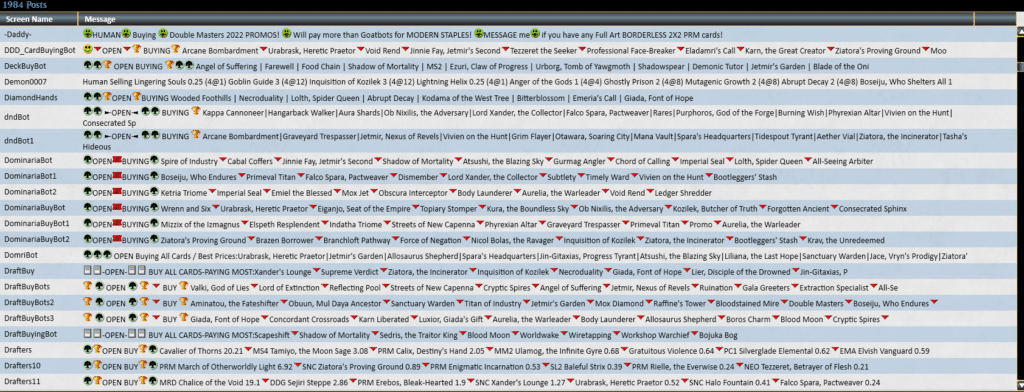
So far, we’ve gone through a rough introduction on how to play, where to deck build and how to start your account up. Trading will help you get the most out of your value when playing MTGO. A few bad leagues can put you out in entry fees without trading. Suddenly, what was an excellent financial option was draining your bank account. Trading will help turn your Booster Packs from Limited and your Treasure Chests in competitive events into Event Tickets! Trading with a bot can be scary at first, but it’s actually relatively easy.
All bots should have their prices posted for individual cards or products they are programmed to trade for. Some bots have some poor prices and are straightforwardly trying to rip off. Make sure you do some research on what the average market price is for things you are looking to trade away. Remember that you won’t be getting the full price for items you traded to a bot, but you should get pretty close. As a general rule, if you’re not sure what bots are trustworthy, Goatbots are pretty reliable for having reasonable prices. Here are the steps for trading with a bot:
- Create a trade binder in your ‘Collection’ tab and put whatever you want to trade away in that binder. Make sure you know what the name of it is.
- Find a bot interested in your trade for a reasonable price. Click on the bot to request a trade (when it’s not busy)
- The bot will take what it’s interested in out of your trade binder. Past that point, a chat on the right side of the trade window will tell you what the bot will give in return.
- All you need to do is find the items you want and put them into your binder at the bottom left corner. To find Event Tickets (since this is what you’ll be trading for most of the time), go to the ‘other products’ tab like you would in your own collection and scroll until you find a ‘tickets’ section. Add whatever amount of tickets you are entitled to.
- Once this is done, and you ‘confirm trade’ at the bottom right, a quick overview of the trade will be shown. Click ‘confirm trade’ again to finalize the transaction.
Using rental programs will end up being a lot of the same. The only difference is that, when you’re receiving cards to build your deck, you’ll need to accept cards from the bot. To do this, click on one card and Control A to select everything and drag it down to your binder. Everything else is the same! There are videos out there demonstrating this with more detail, so if you’re still uncomfortable, you can check those out.
Read More: Top 10 Saltiest Planeswalkers in EDH
MTGO Play Tips and Tricks

Like when first starting MTG Arena, it can be a bit difficult to pull off advanced things like holding priority. MTGO is a bit the opposite. At the beginning, the program will automatically hold priority at every phase regardless of whether you have cards to play or not. This is great for bluffing, but not so great for your timer. Here are some quick tricks to try and make your gameplay experience smoother:
- Clicking 1 is a shortcut for hitting ok. This is significantly faster than using your mouse to click ok over and over to confirm an action.
- Triggers in MTGO will all need to be actively stacked and targeted by the player. They will also need confirmation to resolve. If you don’t want to confirm each resolution on an irrelevant trigger (like a ‘when this cards attacks, gain an attack point or something), you can choose to ‘always yield’ those triggers by right-clicking on it. This will avoid the client asking for confirmation each time that trigger pops up.
- You can also tap 6 to pass your turn entirely. Make sure you’ve done everything you want to before clicking this! A shortcut menu is present in your games if you’re interested in what all your shortcuts look like.
Give it a Go!
While this introduction may have seemed long, this is a VERY QUICK introduction to how MTGO works. A lot wasn’t mentioned here, from unique modes to the equivalent of a ‘tournament match’ in Magic Arena. This should be enough, however, to get you started. One last note with MTGO is that players on this platform are stronger on average compared to MTG Arena. Most players who go through the hassle of learning such a complex system tend to play the game a lot. Continue to reference resources when something new comes up because there’s a lot to learn!